


Cisco 84-MPA-2H12Z-M Router
- Global Price List Information (GPL)
-
Model: 84-MPA-2H12Z-M
-
Description:
-
Price: USDLast Update:
- End-of-Sale and End-of-Life Information (EOL/EOS)
- Release Date:
- End-of-Sale Date:
- End-of-Support Date:
The Cisco 8404 Router is a key member of the Cisco 8000 Series, designed to provide a high-performance, scalable, and reliable networking solution. By utilizing a centralized architecture, this platform effectively bridges the gap between the flexibility of fixed systems and the robust redundancy typically found in larger, distributed chassis. It is built upon the innovative Cisco Silicon One architecture and runs on the unified Cisco IOS XR software, ensuring that it meets the demanding requirements of modern network environments.
This router is engineered with a focus on investment protection and operational efficiency. Its design allows for a compact footprint while maintaining the ability to handle significant bandwidth. By offering both redundant and non-redundant operational modes, the Cisco 8404 provides organizations with the versatility to tailor their infrastructure to specific deployment needs, whether in core, edge, or aggregation roles.
Product overview
The Cisco 8404 system is a 4RU platform that prioritizes serviceability and performance. All major components, including the Route Switch Processors (RSPs), Modular Port Adapters (MPAs), power modules, and fan trays, are accessible from the front of the chassis. This design, combined with a shallow depth of 295 mm, makes it an excellent choice for installations where space is limited or environmental conditions are challenging.
At the heart of the system is the Cisco Silicon One K100 Network Processing Unit (NPU), which delivers up to 4.8 Tbps of bandwidth. The platform supports up to two RSPs, which function in an active-standby configuration to provide full control and data plane redundancy. Additionally, the system utilizes a variety of modular port adapters, allowing for diverse interface options ranging from 1G to 400G, ensuring that the hardware can adapt to evolving network demands over time.
Features and benefits
- Silicon Innovation: Powered by the Cisco Silicon One K100 NPU, providing high-scale routing and deep buffering using High-Bandwidth Memory (HBM) for superior performance at lower power consumption.
- Redundancy: Supports dual Route Switch Processors (RSPs) for active-standby control and data plane redundancy, with the option for non-redundant operation to optimize costs.
- Flexible Connectivity: Features two distinct Modular Port Adapters (MPAs): the 84-MPA-2H12Z-M (12x SFP56 and 2x QSFP28) and the 84-MPA-2FH/6H-M (2x QSFP56-DD or 6x QSFP28), both supporting MACsec.
- Environmental Resilience: Operates across an extended temperature range of -20°C to +65°C, making it suitable for harsh deployment environments.
- Advanced Security: Includes a hardware root of trust based on TCG and IEEE 802.1 AR standards, secure boot, and JTAG monitoring to protect against hardware and software tampering.
- Programmable Software: Runs Cisco IOS XR, which offers a modular, Linux-based environment with support for model-driven APIs (gRPC, NETCONF) and application hosting for custom automation and telemetry.
- Serviceability: All Field-Replaceable Units (FRUs) are front-accessible, simplifying maintenance and reducing operational overhead.
- Investment Protection: The modular design allows for the upgrade of major components, ensuring the chassis remains relevant as next-generation technologies emerge.
Overview of the Cisco 8000Series
The Cisco 8000 Series combines the revolutionary Cisco Silicon One, Cisco IOS XR software, and a clean-sheet chassis design to deliver a breakthrough in high-performance routers. It offers a full range of feature-rich, highly scalable, and reliable platforms. The Cisco 8404 is part of a new complementary portfolio based on a centralized architecture.
The Cisco 8404 is a unique platform that combines flexibility and reliability while offering investment protection. Customers can achieve unmatched reliability with redundant control and data plane via redundant route switch processors. Unlike the behavior on a distributed architecture, the forwarding decisions on centralized platforms are centrally performed. The Cisco 8404 can also be operated in a nonredundant mode if required by the customer. The Cisco 8404 first-generation route switch card is powered by the Cisco Silicon One K100 Network Processing Unit (NPU). A variety of modular port adapters allow for a high level of interface diversity.
This data sheet is specifically for the Cisco 8404 router. In addition to the centralized architecture in the Cisco 8404 and Cisco 8608, the Cisco 8000 Series includes two other distinct router architectures that use the Cisco Silicon One NPUs:
● Distributed: The Cisco 8800 Series provides the highest bandwidth via distributed chassis with a redundant control plane and switch fabric. The 8800 Series includes the Cisco 8804, 8808, 8812, and 8818. These chassis deliver up to 28.8 Tbps per line card.
● Fixed: The Cisco 8200 and 8700 Series use Cisco’s standalone architecture to deliver full routing functionality with a single NPU per router. The 8200 Series has deep buffers and expanded forwarding tables, while the 8700 Series is targeted for Edge applications with increased buffering and forwarding table scale requirements.
Learn more about the Cisco 8000 distributed and fixed portfolio in the Cisco 8000 data sheets.
Cisco 8404 overview
Large, distributed chassis have traditionally been designed to cater to the market requirement for total system bandwidth, port diversity, and redundancy. The requirements far exceeded what could be accomplished with a single NPU. Therefore, the fabrics that weave together multi-NPU systems had to be provisioned to the highest-bandwidth use case and deployed 100% upfront, consuming power and capital regardless of the number of installed line cards. That wisdom held true for multiple generations of core, edge, and aggregation distributed systems.
Now, with the advent of dense Cisco Silicon One NPUs, we can address these roles with a new breed of centralized architectures that combine the best aspects of distributed and fixed systems. The Cisco 8404 combines the redundancy and I/O diversity of distributed systems with the economics and simple elegance of fixed platforms. As a result, it delivers redundancy at an optimized cost while enabling flexibility and expandability through generational continuity.
The key chassis components, all of them accessible via front of the chassis, are described in the table below.
Table 1. Cisco 8404 chassis components
|
Component |
Details |
|
Maximum bandwidth and NPU |
● 4.8 Tbps, Cisco Silicon One K100; maximum of 4 pluggable Modular Port Adapters (MPAs), 1 integrated Port Adaptor (PA) in each Route Switch Processor [RSP] at 800G per Port Adapter
|
|
Chassis |
● 4RU in height with a sheet metal depth of 295 mm (11.61 in.)
● Chassis hosts the commons such as fan and power entry modules, RSPs, and MPAs
|
|
Route Switch Processor (RSP) |
● RSP hosts the CPU, the K100 NPU, I/O ports, and the integrated PAPort Adapter (PA) card; RSPs fit horizontally in the front of the chassis
● Up to two RSPs; RSPs work in active-standby mode, enabling both control and data plane redundancy
● 8-core ARM CPU
● 32-GB DDR5 DRAM and 40-GB eMMC
● I/O and timing ports
● Integrated PA
|
|
Power Entry Module (PEM) |
● 2 DC PEMs that provide 1+1 redundant power feed to the system
|
|
Fan tray |
● The fan tray has two rows of fans for increased redundancy
|
|
Air filter |
● The air filter protects the electronics against dust in the right-to-left-airflow chassis design
|
|
Supported Modular Port Adapters (MPAs) |
● 84-MPA-2FH/6H-M with 2x QSFP56-DD or 6x QSFP28
● 84-MPA-2H12Z-M with 12x SFP56 and 2x QSFP28
|
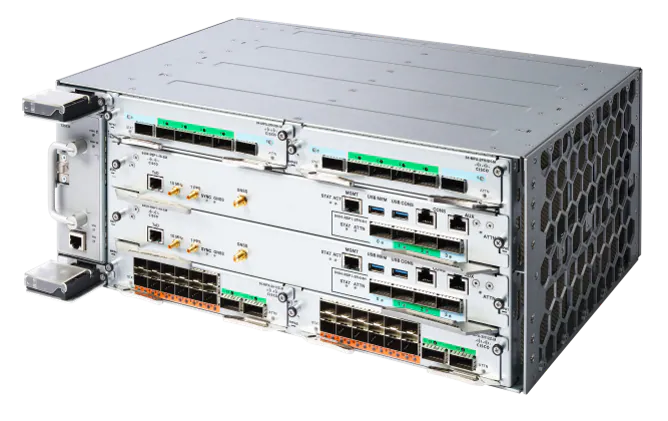
Cisco 8404 router, front view
Silicon innovation with Cisco Silicon One
Cisco Silicon One is Cisco’s first routing silicon architecture to break through the 10-Tbps benchmark for network bandwidth. This is accomplished without sacrificing route capacity, packet-per-second forwarding performance, or feature flexibility. The first-generation Cisco 8404 is driven by the K100 Cisco Silicon One NPU, which delivers in the 8404 design up to 4.8 Tbps of bandwidth and high-scale routing and deep buffering using High-Bandwidth Memory (HBM), thus avoiding any off-chip memory. HBM is connected via an ultra-fast silicon interface and delivers significant performance at low power.
Cisco 8404 system design innovation
The 8404 chassis, uses a backplane design with advanced cooling via right-to-left airflow to support the smallest possible product depth of 295 mm (<11.61 in.). The chassis and all data path components for the Cisco 8404 benefit from a clean-sheet design that allows the system to take full advantage of the latest technologies and Cisco’s design expertise. The four MPAs along with the two RSPs are horizontally oriented. Every major component of the Cisco 8404 was designed from the ground up, thus representing unprecedented investment and commitment to a long lifecycle for the platform.
Cisco 8404 value proposition
Redundancy: The Cisco 8404 introduces a new forwarding paradigm via a redundant control plane and data plane (RSP redundancy). A redundant 8404 requires two RSPs, while a nonredundant 8404 consists of a single RSP.
Extended temperature range: The Cisco 8404 supports an extended temperature range of -20°C to +65°C (-4°F to +149°F) with a startup temperature of -5°C (23°F). Combined with its chassis depth of 295 mm (<11.61 in.), the platform is ideally suited for installations in environmentally challenging situations.
Accessibility: The Cisco 8404 is designed with all Field-Replaceable Units (FRUs) accessible from the front for best serviceability in the field.
Investment protection: The design of the system allows for upgrade of all the major components of the chassis, such as the route switch cards. This will help ensure that customers’ investments into the commons are protected while Cisco launches next-generation components.
Flexibility: The system offers flexibility via MPA modularity and interface diversity, plus native port speed support from 1G up to 400G. A wide variety of optics support multiple customer use cases.
Cisco 8404 Route SwitchProcessor
The Cisco 8404 route switch processor is in the front of the chassis, horizontally oriented between the upper and lower row of MPAs. The NPU and CPU sit within the route switch card, with all forwarding and routing decisions driven by the route switch card. The RSP is built with an ARM 8-core 1.6-GHz CPU with 32 GB of DDR5 DRAM, 40-GB eMMC, RS-232 console, 100 Mbps/1 Gbps management, 2x USB 3.0, GPS (ToD, 10 MHz, 1 PPS) and GNSS. The RSP incorporates an integrated PA with 2x 400G/4x 100G ports. This is a true PA that can also be accessed by a second installed RSP for full redundancy.

Cisco 8404 route switch card
Cisco 8404 Modular PortAdapters
The Cisco 8404 supports two different MPAs. The details are provided in the table below.
Table 2. Cisco 8404 MPAs
|
Product ID |
Bandwidth |
SFP56 |
QSFP28 |
QSFP56-DD |
MACsec |
Timing |
|
84-MPA-2H12Z-M |
800 Gbps |
12 |
2 |
– |
Yes |
Class C |
|
84-MPA-2FH/6H-M |
800 Gbps |
– |
6 |
2 |
Yes |
Class C |
84-MPA-2H12Z-M
This MPA provides 800 Gbps of maximum throughput with MACsec support on all ports. The MPA supports 12x 1G/10G/25G/50G plus 2x 100G ports. It supports 4x10G or 4x25G breakout.
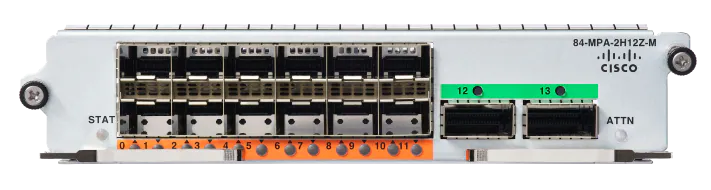
12-port SFP56 plus 2-port QSFP28 MPA
84-MPA-2FH/6H-M
This MPA provides 800 Gbps of maximum throughput with MACsec support on all ports. The MPA can be operated either in 2x 400G native mode or a mix of 400G and 100G with each of the three adjacent ports sharing the total of 400G of capacity. The MPA also supports 4x100G breakout via its 400G ports.
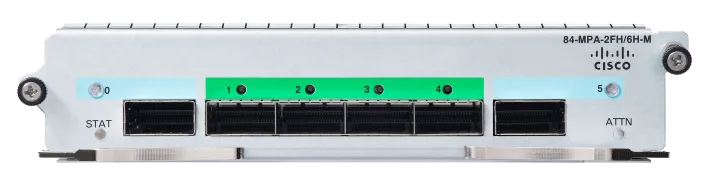
2-port QSFP56-DD 6-port QSFP28 MPA
Security
Security is a major concern for all Cisco customers. Attacks on networking equipment can have disastrous results. Network operators need assurance that the platform is secure against hardware and software breaches. The Cisco 8404 Router supports a hardware root of trust based on the Trusted Computing Group (TCG) and IEEE 802.1 AR standards. It also supports advanced security features to ensure platform and OS integrity.
● Cisco secures the supply chain of every system at manufacturing time. A technology called Chip Protection allows customers to be assured that the hardware they receive from Cisco has no counterfeit components. This is accomplished with the use of unique identifiers that are stored inside the Cisco Trust Anchor module (TAm) device to identify and track components through the entire lifecycle of the router. The checks cover all major components, including network processors, CPUs, and field-programmable gate arrays.
● Every image that a customer downloads from the Cisco site is cryptographically signed using Cisco private keys. Each platform has a TAm (based on the TCG standard) that uses built-in cryptographic functions to validate the image signature. Once the signature is validated, the software is considered authentic and is ready for install.
● During normal operation, the Joint Test Action Group (JTAG) ports on the chips are monitored. (JTAG is a standard for chip testing and verification.) These ports are one of the most common attack surfaces and therefore must be secured. Cisco uses a technology called secure JTAG to monitor the port. If any illegal activity is detected, it is flagged, and the system CPU is held in reset mode.
● The Secure Boot root of trust is anchored in the TAM. It establishes an authentication chain that validates the entire boot process.
Cisco IOS XR software
Cisco IOS XR is a unified network OS spanning access, aggregation, edge, and core. The networking protocol stack within XR can be cut down by two-thirds when the IP transport architecture is simplified. Improvements to the XR internal architecture have reduced the memory footprint by 35 percent. By reducing the code size and the resources required, XR can be installed onto even the most constrained hardware designs with full security features without an impact on boot times.
Modernizing XR with installation procedures using standard Linux software package managers has also improved operations. Instead of “one size fits all,” XR provides modularity, so customers can load only what they will use.
Service providers can easily access new software packages from trusted Cisco Red Hat Package Manager (RPM) repositories. Alternatively, they can build their own repository of both Cisco and custom software packages, which can be fetched for final system configuration without the need to spend time trying to sort out software dependencies. All the required Cisco software packages, homegrown/third-party software packages, and router configurations can be pulled into a single Cisco software image known as a Golden ISO. Customized images can now be installed consistently and with confidence across devices in the network.
Cisco IOS XR brings an unmatched level of openness for programmability and customization.
IOS XR supports open, model-driven APIs at all layers of the software stack. At the management layer, XR supports a comprehensive list of both native and industry-driven OpenConfig models with multiple encoding (XML and JSON) and transport (gRPC, NETCONF) options. The APIs at the management layer allow operators to apply configuration to the device or retrieve the state of the system. The APIs also address advanced traffic engineering use cases, allowing applications to control the route followed by traffic within the network. These APIs can be used independently or combined with other ecosystem abstraction layers such as SONiC or P4Runtime.
IOS XR also supports the OFA (Open Forwarding Abstraction) API, which provides a logical representation of all the forwarding and telemetry capabilities of the underlying hardware. In addition, IOS XR provides a flexible consumption model, allowing third-party application software to run on the device alongside IOS XR to enable customization options for the customer network. With application hosting capabilities, operators can host their own controller agent or custom protocol; use various hosting apps for telemetry collection, traffic engineering, and configuration management; or manage the box like a Linux machine using third-party software such as Chef, Puppet, or Ansible.
Cisco IOS XR is the industry’s most trusted network operating system.
IOS XR is the most advanced network operating system for improving the security posture of the router. The Cisco Secure Boot subsystem helps ensure that the device boot image is genuine and has not been tampered with. With advanced signing technology, XR can establish software integrity enforcement and measurement. To further enhance the trusted defense posture, multiple runtime defenses within XR guard against malicious actors and make exploitation of bugs more difficult. Even if booted securely, a router may run for months or years without rebooting, which could leave vulnerabilities at runtime undetected for a long time. XR leverages Integrated Measurement Architecture (IMA) to significantly enhance security by verifying the integrity of running software. In the IMA appraisal mode, signature validations prevent unauthorized images from launching. In the IMA measurement mode, the hashes of all images are logged in a secure location used for verification. Records of runtime processes can be sent for analysis, so the operator knows that system software, updates, or patches are running as intended.
Detailed information on IOS XR can be found in the IOS XR data sheet.
For a complete list of supported features, refer to the Cisco Feature Navigator.
Product characteristics
Table 3. Cisco 8404 specifications
|
Platform / PID |
Physical specifications |
|
Cisco 8404 |
● Operating temperature at 0 m Mean Sea Level (MSL):
● -4°F to 149°F (-20°C to 65°C) operation
● 23°F (-5°C) startup
● Storage temperature: -40°F to 158°F (-40°C to 85°C)
● Humidity: 5% to 95% (noncondensing); altitude: 0 to 9842 ft (0 to 3000 m)
● Typical total system power without optics, with 2x 84-MPA-2H12Z-M and 2 x 84-MPA-2FH/6H-M
◦ Redundant system: 865 W ◦ Nonredundant system: 585 W ● DC-PEM to back of chassis depth: 13.46 in. (342 mm)
● Fully loaded chassis approximate maximum weight: 58.86 lb (26.7 kg)
● Rack mountable in standard 19-in. (48.3-cm) rack
|
|
8404= |
● Chassis weight only: 18.5 lb (8.4 kg)
● (HxWxD) 6.89 x 13.40 x 11.61 in. (17.5 x 44.2 x 29.5 cm) – 4 RU
|
|
8404-RSP1-48-EM |
● ARM 8-core 1.6-GHz CPU with 32 GB of DDR5 DRAM, 42 GB eMMC
● RS-232 console, 1G management, 2x USB 3.0, GPS (ToD, 10 MHz, 1 PPS), GNSS
● Integrated MPA – 2x 400G/4x 200G
● Weight: 10.87 lb (4.93 kg)
● (HxWxD) 1.735 x 14.44 x 13.04 in. (44.08 x 36.67 x 33.16 cm)
|
|
84-MPA-2H12Z-M |
● Weight: 3.08 lb (1.4 kg)
● (HxWxD) 1.458 x 7.244 x 11.52 in. (37.05 x 18.40 x 29.28 cm)
|
|
84-MPA-2FH/6H-M |
● Weight: 3.08 lb (1.4 kg)
● (HxWxD) 1.458 x 7.244 x 11.52 in. (37.05 x 18.40 x 29.28 cm)
|
|
8404-DC-PEM |
● 1+1 DC PEM redundancy
● Input voltage range -40VDC to -72VDC
● Weight: 0.837 lb (0.38 kg)
● (HxWxD) 0.629 x 2.42 x 12.825 in. (1.6 x 6.15 x 32.57 cm)
|
|
8404-Filter |
● Weight: 0.22 lb (0.1 kg)
● (HxWxD) 3.295 x 0.28 x 11.39 in. (8.37 x 0.735 x 28.93 cm)
|
|
8404-FAN-TRAY |
● N+1 internal fan redundancy
● Weight: 4.03 lb (1.83 kg)
● (HxWxD) 5.196 x 2.047 x 12.07 in. (13.2 x 5.2 x 30.07 cm)
|
Compliance
Table 4. Compliance
|
Specification |
Description |
|
Regulatory compliance |
Products comply with CE Markings according to directives 2014/30/EU and 2014/35/EU |
|
Safety |
ANSI / UL 60950-1 CAN/CSA C22.2 No. 60950-1 ANSI / UL 62368-1 CAN/CSA C22.2 No. 62368-1 EN / IEC 62368-1 |
|
EMC: Emissions |
FCC 47 CFR Part 15 Class A AS/NZS CISPR 32 Class A EN55032 Class A CISPR 32 Class A ICES-003 Class A VCCI Class A KS C 9832 Class A CNS-15936 Class A EN61000-3-2 EN61000-3-3 |
|
EMC: Immunity |
EN 300 386 EN55035 CISPR 35 EN61000-6-1 KS C 9835 |
|
RoHS |
The product is RoHS 6 compliant with exceptions for leaded ball grid array (BGA) balls and lead press fit connectors. |
|
Network Equipment Building System (NEBS) |
Designed to meet: ● SR-3580: NEBS Criteria Levels (Level 3)
● GR-1089-CORE: NEBS EMC and Safety
● GR-63-CORE: NEBS Physical Protection
|
Ordering overview
Hardware: The high-level hardware components are listed below. For full ordering information, please refer to the ordering documentation.
Table 5. Cisco 8404 hardware ordering overview
|
HW Product ID |
Description |
|
8404-SYS-D |
Cisco 8404 – 4-Slot Centralized Chassis |
|
8404-RSP1-48-EM |
Cisco 8404 4.8T Route Switch Processor |
|
8404-DC-PEM |
Cisco 8404 DC Power Entry Module |
|
8404-FAN-TRAY |
Cisco 8404 Fan Tray |
|
8404-FILTER |
Cisco 8404 Fan Filter |
|
84-MPA-2H12Z-M |
Cisco 8404 MPA with 2x100G QSFP28 + 12x1/10/25/50G SFP56 |
|
84-MPA-2FH/6H-M |
Cisco 8404 MPA with 2x400G / 6x100G QSFP56-DD |
|
8K-4RU-2P-RMK |
8000 4RU 2 Post Rack Mount Kit 19-in. |
|
8K-4RU-2P-RMK-E |
8000 4RU 2 Post Rack Mount Kit 23-in. ETSI |
|
8K-4RU-F2B-AIR |
8000 Universal 4RU Front to Back Airflow Redirector |
|
8404-CBLMGMT |
Cisco 8404 Cable Management Bracket |
Software: The Cisco 8404 is launching with Cisco IOS XR Flexible Consumption Model 2.0. At First Customer Shipment (FCS) the platform will have the Cisco IOS XR 26.1.1 software release.
The high-level software components are listed below. For full ordering information, please refer to the ordering documentation.
Table 6. Cisco 8404 software ordering overview
|
SW Product ID |
Description |
|
ESS-8KE-100G-RTU |
Essential Right-to-Use 100G for Cisco 8000 Series |
|
ESS-8KE-400G-RTU |
Essential Right-to-Use 400G for Cisco 8000 Series |
|
ADN-8KE-100G-RTU |
Advantage Right-to-Use 100G for Cisco 8000 Series |
|
ADN-8KE-400G-RTU |
Advantage Right-to-Use 400G for Cisco 8000 Series |
|
PRM-8KE-100G-RTU |
Premium Right-to-Use 100G for Cisco 8000 Series |
|
PRM-8KE-400G-RTU |
Premium Right-to-Use 400G for Cisco 8000 Series |
|
8KSW-A-SIA-3 |
8000 Type A Device SIA for 3 to 5 year term FCM 2.0 |
|
8KSW-A-SIA-5 |
8000 Type A Device SIA for 5 to 7 year term FCM 2.0 |
The RTUs (Right-to-Use licenses) provide customers with the ability to access and use specific perpetual software functionalities without the requirement to purchase the complete software package.
The SIAs (Software Innovation Access licenses) are term-based agreements that provide customers with access to specific software benefits. They enable customers to optimize their software usage, easily manage licenses across their network infrastructure, and perform seamless upgrades to the latest versions of IOS XR Software.
Cisco Licensing
Cisco Licensing is a flexible and secure licensing model that provides you with an easier, faster, and more consistent way to purchase, activate, manage, renew, and upgrade software products across the Cisco portfolio and across your organization. And it’s secure—you control what users can access. With Cisco Licensing you get:
● Easy activation. Cisco Licensing establishes a pool of software licenses that can be used across the entire organization—no more PAKs (Product Activation Keys).
● Unified management. Cisco License Central (CLC) provides a complete view into all your Cisco products and services in an easy-to-use portal, so you always know what you have and what you are using.
● License flexibility. Your software is not node-locked to your hardware, so you can easily use and transfer licenses as needed.
The IOS XR Flexible Consumption Model (FCM) requires Cisco Licensing registration and license usage reporting. A customer network under IOS XR FCM 2.0 is considered compliant if the FCM 2.0-enabled devices in the customer’s network are registered to Cisco Licensing and are reporting the usage.
A successful registration and reporting to Cisco Licensing is essential to take advantage of all the benefits of SIA in FCM 2.0.
For more information
Learn more about the Cisco 8000 Series routers.
| Model | 84-MPA-2H12Z-M |