
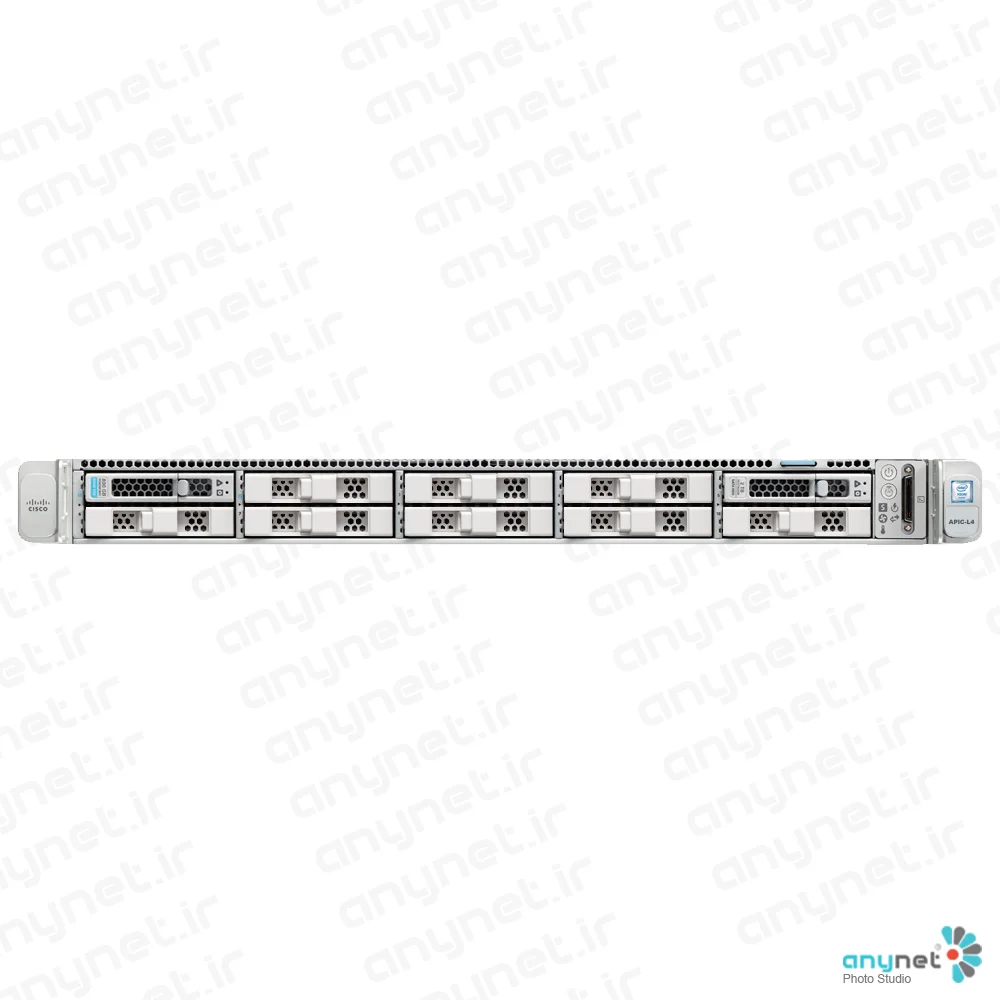

Cisco APIC-L4 Appliance
- Global Price List Information (GPL)
-
Model: APIC-L4
-
Description:
-
Price: USDLast Update:
- End-of-Sale and End-of-Life Information (EOL/EOS)
- Release Date:
- End-of-Sale Date:
- End-of-Support Date:
Cisco Application Centric Infrastructure (ACI) serves as a core component of Cisco’s intent-based networking framework, designed to bring agility and efficiency to modern data centers. By capturing high-level business and user intent, the system translates these requirements into specific network and security policies. This approach allows for the dynamic provisioning of infrastructure services, ensuring that the network remains responsive to the evolving needs of the business.
Built upon the robust Cisco N9000 platform, Cisco ACI integrates hardware and software through a holistic, systems-based design. It utilizes innovative ASICs and an open ecosystem to provide secure, scalable connectivity across physical and virtual environments. By shifting IT operations from a reactive to a proactive model, ACI helps organizations maintain reliability, optimize performance, and simplify the entire application deployment lifecycle across multifabric and multicloud environments.
Product overview
The Cisco ACI solution is composed of three primary building blocks: the Cisco Application Policy Infrastructure Controller (APIC), the Cisco N9000 Series spine and leaf switches, and the Cisco Nexus Dashboard. At the heart of this architecture is the APIC, which acts as the centralized point for automation, policy enforcement, and health monitoring. It is deployed as a cluster, with a minimum of three appliances required to manage the fabric effectively.
The APIC appliance is available in several hardware configurations, including the G5 combined appliance, as well as the M4 (Medium) and L4 (Large) models. For environments requiring flexibility, Cisco also offers a virtual APIC (vAPIC) option, which requires a DCN-vAPIC license. Regardless of the form factor, the controller cluster is designed to scale proportionally with the size of the deployment, allowing for the seamless addition or removal of controllers to meet transaction-rate demands.
Features and benefits
- Centralized Management: Provides a unified point for automation, policy enforcement, and health monitoring across the entire fabric.
- Application-Centric Policies: Enables the creation of network policies that align directly with application requirements.
- Declarative Provisioning: Uses a data-model-based approach to simplify the deployment of network services.
- Extensive Ecosystem Integration: Supports seamless interoperability with third-party platforms, including VMware vCenter, Nutanix, OpenShift, and various automation tools like Terraform, Ansible, Chef, and Puppet.
- Advanced Observability: Includes integration with Isovalent Cilium and eBPF for end-to-end visibility into network performance.
- Operational Efficiency: Features optimized cluster upgrades, faster reboot times, and support for mixed software versions to reduce operational risk.
- Proactive Monitoring: Delivers health scores for critical objects and provides comprehensive fault, event, and performance management.
- Flexible Deployment: Offers multiple hardware form factors (G5, M4, L4) and a virtual appliance option to suit diverse data center requirements.
- Scalable Connectivity: Facilitates secure, any-to-any connectivity between ACI and open-standard VXLAN EVPN fabrics.
About Cisco ACI
The Cisco Application Centric Infrastructure (Cisco ACI) is part of our intent-based networking framework to enable agility in the datacenter. It captures higher-level business and user intent in the form of a policy and translates this into the network constructs necessary to dynamically provision network, security, and infrastructure services.
Built on top of the industry-leading Cisco N9000 platform, Cisco ACI uses a holistic systems-based approach, with tight integration between hardware and software, between physical and virtual elements, an open ecosystem model, and innovative Cisco Application-Specific Integrated Circuits (ASICs) to enable unique business value for modern data centers. As part of the Cisco Nexus One architecture, Cisco ACI border gateways, implemented on Cisco N9000 series switches, provide scalable and secure Layer-3 connectivity between the ACI fabric and external networks using policy-based control and dynamic routing. This enables seamless any-to-any connectivity between ACI and open-standard VXLAN EVPN fabrics with consistent policy extension across environments.
Cisco ACI is the industry’s most secure, open, and comprehensive software-defined networking solution.
ACI enables automation that accelerates infrastructure deployment and governance, simplifies management to easily move workloads across a multifabric, multicloud framework, and proactively secures against risk arising from anywhere. It radically simplifies, optimizes, and expedites the application deployment lifecycle.
Modern data centers are dynamic. IT operations must meet the expectation of quality-of-service business needs in a rapidly changing environment. ACI transforms IT operations from reactive to proactive with a highly intelligent set of software capabilities that analyzes every component of the data center to ensure business intent, guarantee reliability, and identify performance issues in the network before they happen.
As application usage gets more pervasive across an enterprise’s network, IT professionals are looking to build solutions for consistent policy and encryption from the campus to the datacenter. With ACI integrations with SDA/DNA Center and SD-WAN, customers can now automate and extend policy, security, assurance, and insights across their entire networking ecosystem.
Cisco ACI components
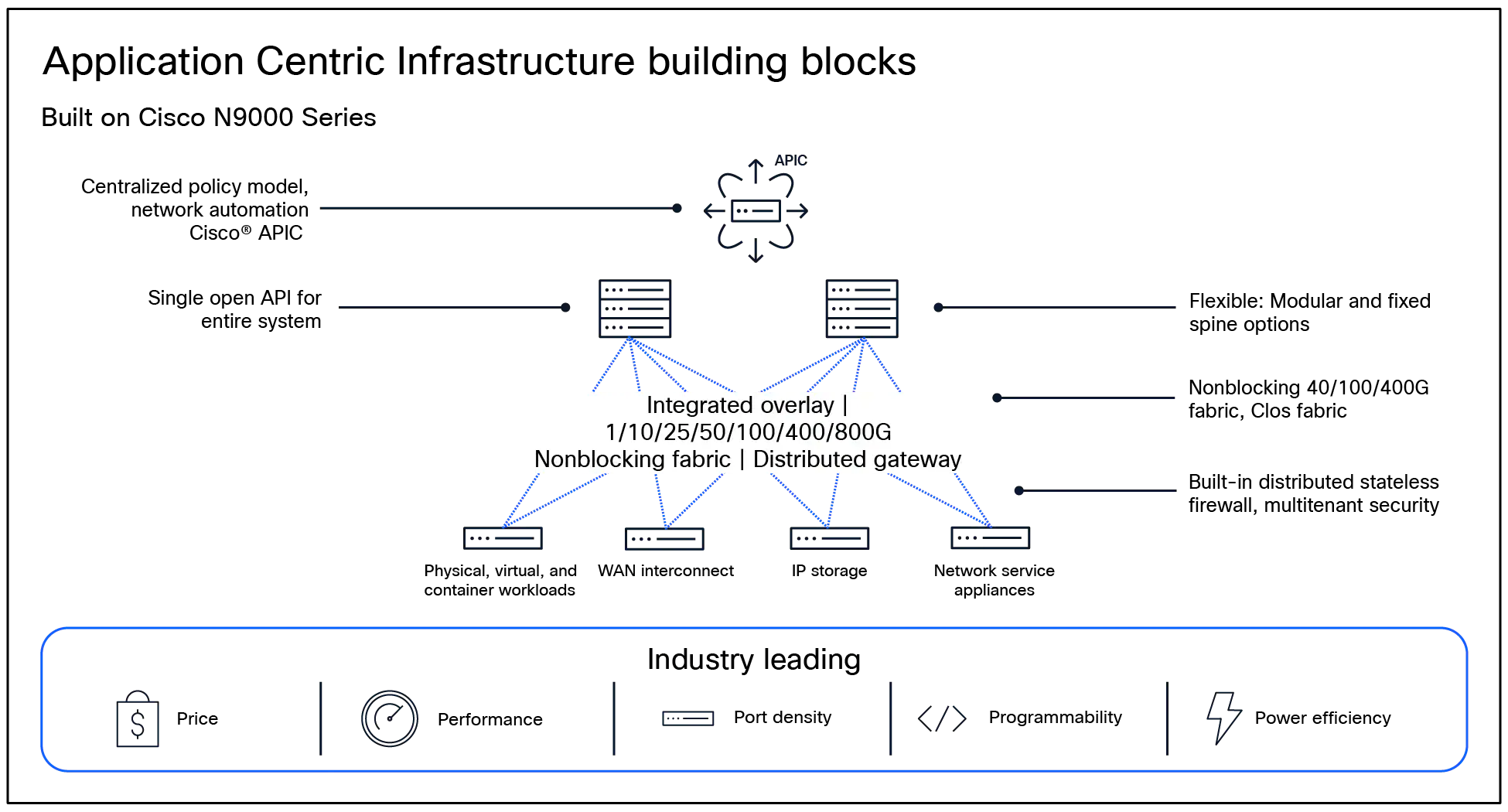
The Cisco ACI solution consists of the following building blocks (Figure 1):
●Cisco Application Policy Infrastructure Controller (APIC).
●Cisco N9000 Series spine and leaf switches for Cisco ACI.
●Cisco Nexus Dashboard, on-premises managed Nexus One.
Cisco ACI architectural building blocks
Cisco Application Policy Infrastructure Controller (APIC) features
The infrastructure controller isthe main architectural component of the Cisco ACI solution. It is the unified point of automation and management for the Cisco ACI fabric, policy enforcement, and health monitoring. The APIC appliance is a centralized, clustered controller that optimizes performance and unifies the operation of physical and virtual environments. The controller manages and operates a scalable multitenant Cisco ACI fabric.
The APIC provides enhanced lifecycle and operational capabilities, including optimized APIC cluster upgrades through a robust, centralized workflow and faster APIC reboot times. It also enables hybrid APIC cluster deployments, allowing seamless coexistence and interoperability between physical and virtual APICs. Operational efficiency is further improved through enhanced support for mixed (dual) software versions across ACI fabrics, enabling smoother upgrades and reduced operational risk.
The main features of the APIC include the following:
●Application-centric network policies.
●Data-model-based declarative provisioning.
●Application and topology monitoring and troubleshooting.
●Layer-4 through Layer-7 (L4-L7) services integration with APIC.
●Third-party integration.
◦VMware vCenter and vShield
◦Nutanix
◦Openshift container and virtualization platform
●Automation platform integrations.
◦Terraform
◦Ansible
◦Chef
◦Puppet
◦Python
◦ServiceNow
●Image management (spine and leaf).
●Cisco ACI inventory and configuration.
●Implementation on a distributed framework across a cluster of appliances.
●Health scores for critical managed objects (tenants, application profiles, switches, etc.).
●Fault, event, and performance management.
●Isovalent Cilium and eBPF integration for end-to-end observability.
The controller framework enables broad ecosystem and industry interoperability with Cisco ACI. It enables interoperability between a Cisco ACI environment and management, orchestration, virtualization, and L4-L7 services from a broad range of vendors.
Cisco APIC cluster
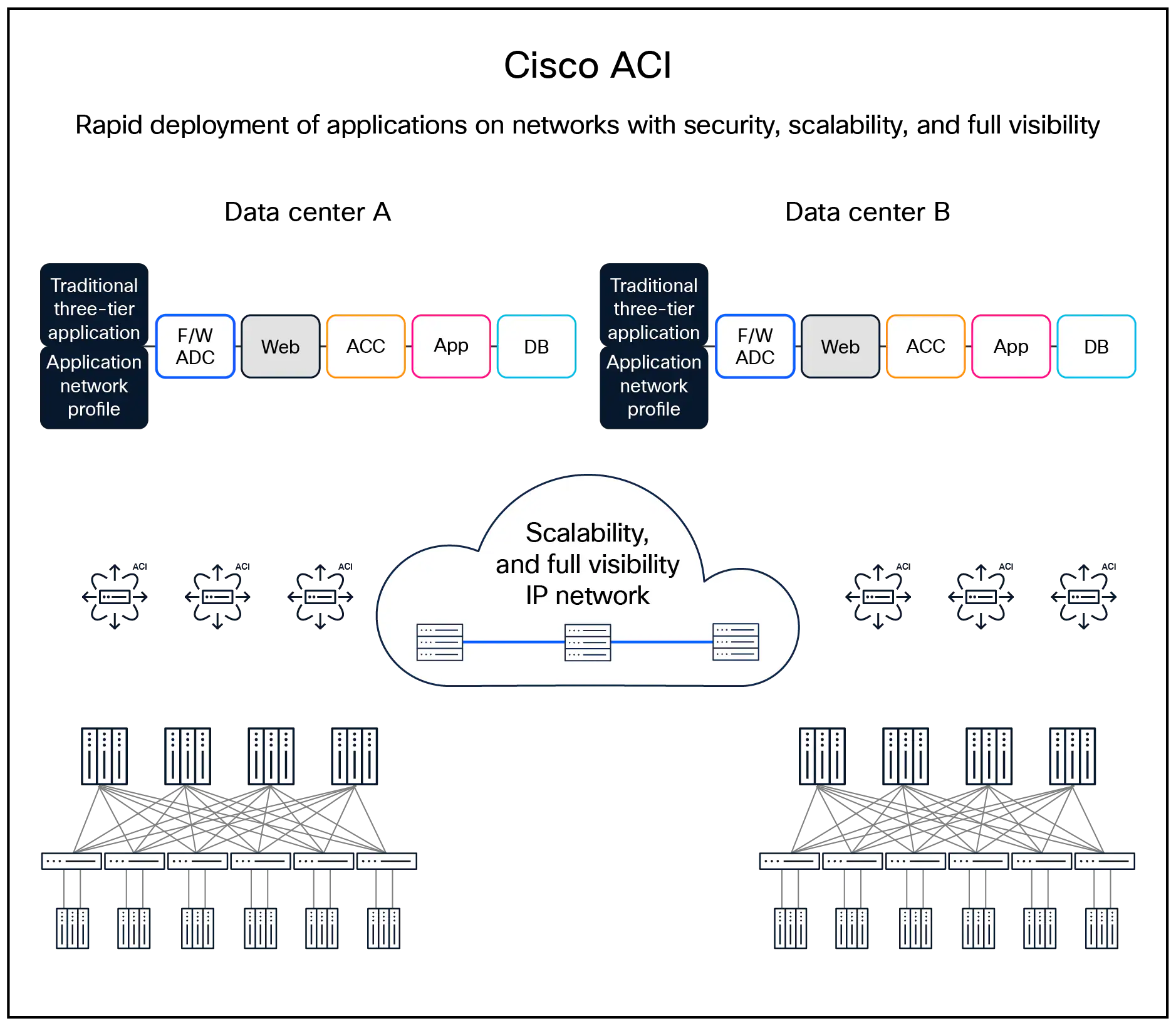
The APIC appliance is deployed as a cluster. A minimum of three infrastructure controllers are configured in a cluster to provide control of the scale-out Cisco ACI fabric (Figure 2). The ultimate size of the controller cluster is directly proportionate to the size of the Cisco ACI deployment and is based on the transaction-rate requirements. Any controller in the cluster can service any user for any operation, and a controller can be transparently added to or removed from the cluster.
Cisco APIC cluster
APIC appliance product specifications
The APIC appliance is available in different form factors (Table 1):
Table 1.Cisco APIC sizes
| Cisco APIC configuration |
Part number |
Description |
| Medium M4 |
APIC-M4 |
APIC with medium-size CPU, hard drive, and memory configurations (up to 1200 edge ports) |
| Large L4 |
APIC-L4 |
APIC with large CPU, hard drive, and memory configurations (more than 1200 edge ports) |
| Medium cluster M4 |
APIC-CLUSTER-M4 |
Cluster of 3 APIC-M4 with medium-size CPU, hard drive, and memory configurations (up to 1200 edge ports) |
| Large cluster L4 |
APIC-CLUSTER-L4 |
Cluster of 3 APIC-L4 with large CPU, hard drive, and memory configurations (more than 1200 edge ports) |
| APIC G5 node |
APIC-SERVER-G5 |
Fifth-Generation APIC (combined appliance; no medium/large with this generation) |
| APIC G5 cluster |
APIC-CLUSTERG5 |
Cluster of three Fifth-Generation APIC’s (combined appliance; no medium/large with this generation) |
Table 2.Specifications of the APIC G5 combined appliance. Note that at least three appliances need to be configured as a cluster.
| Cisco APIC appliance APIC G5 (combined appliance) |
Description |
Default units |
| Processor |
AMD 9354P 3.25GHz 280W 32C/256MB cache DDR5 4800MT/s |
1 |
| Memory |
32GB DDR5-5600 RDIMM 1Rx4 (16Gb) |
8 |
| Hard Drive |
1.6TB 2.5in U.3 15mm P7450 high-perf high-end NVMe (3X) |
2 |
| PCI Express (PCIe) slots |
Cisco VIC 15425 4x 10/25/50G PCIe C-Series w/secure boot |
1 |
| Power supply |
1200w AC titanium power supply for Cisco UCS C-Series rack servers |
2 |
Table 3.Cisco APIC G5 physical and environmental specs
| Overview |
Description |
| Physical dimensions (H x W x D) |
1 rack unit (1RU): 1.7 x 16.9 x 30 in. (4.3 x 42.9 x 76.2 cm) |
| Temperature: Operating |
41°F to 95°F (5°C to 35°C) (operating, at sea level, with no fan fail and no CPU throttling, and with turbo mode) |
| Temperature: Nonoperating |
Dry bulb temperature of -40°F to 149°F (-40°C to 65°C) |
| Humidity: Operating |
8% to 90% noncondensing |
| Humidity: Nonoperating |
5% to 93% noncondensing |
| Altitude: Operating |
0 to 10,006 ft (0 to 3050 meters); maximum ambient temperature decreases by 1°C per 300m |
| Altitude: Nonoperating |
0 to 39,370 ft (12,000m) |
Table 4.Specifications of the APIC M4 and L4 appliance. Note that at least three appliances need to be configured as a cluster

| Medium configuration: M4 |
Large configuration: L4 |
|||
| Description |
Default units |
Description |
Default units |
|
| Processor |
AMD 3.0GHz 7313P 155W 16C/128MB Cache DDR4 3200MHz |
1 |
AMD 2.85GHz 7443P 200W 24C/128MB Cache DDR4 3200MHz |
1 |
| Memory |
16GB RDIMM SRx4 3200 (8Gb) |
6 |
32GB RDIMM DRx4 3200 (8Gb) |
6 |
| Hard Drive |
480GB 2.5in Enterprise Performance 6GSATA SSD (3X endurance) 960GB 2.5in Enterprise performance 6GSATA SSD (3X endurance) |
1 each |
480GB 2.5in Enterprise Performance 6GSATA SSD(3X endurance) 1.6TB 2.5in U.2 WD SN840 NVMe Extreme Perf. High Endurance |
1 each |
| PCI Express (PCIe) slots |
Intel E810XXVDA2 2x25/10 GbE SFP28 PCIe NIC Intel X710T2LG 2x10 GbE RJ45 PCIe NIC |
None- Configurable Options |
Intel E810XXVDA2 2x25/10 GbE SFP28 PCIe NIC Intel X710T2LG 2x10 GbE RJ45 PCIe NIC |
None-Configurable Options |
| Power supply |
1050W (AC and DC) and 1600 W |
1 |
1050W (AC and DC) and 1600 W |
1 |
| FAN |
Eight hot-swappable fans |
|||
| Airflow |
Front to rear cooling |
|||
Table 5.Cisco APIC M4 and L4 Physical and Environmental Specs
| Overview |
Description |
| Physical Specifications |
1 Rack Unit (RU), Height (43.2 mm), Width 16.9 in. (429.0 mm), Depth (length) Server only: 29.5 in. (740.3 mm) |
| Temperature: Operating |
10° C to 35° C (50° F to 95° F) with no direct sunlight |
| Temperature: Nonoperating |
Below -40° C or above 65° C (below -40° F or above 149° F) |
| Humidity (RH): Operating |
8 to 90% and 24° C (75o F) maximum dew-point temperature, non-condensing environment |
| Humidity (RH): Nonoperating |
Below 5% or above 95% and 33o C (91o F) maximum dew-point temperature, |
| Altitude: Operating |
0 to 10,000 feet |
| Altitude: Nonoperating |
0 to 40,000 feet |
Table 6.Cisco medium form factor virtual APIC requirements
To use the APIC controller as a virtual form-factor or in AWS cloud, a DCN-vAPIC license is required. A minimum of three licenses are required for a cluster, and additional licenses can be ordered for expanding the cluster.
| Cisco Virtual APIC Requirements |
Description |
| Processor |
16 vCPU of 3 GHz or Higher |
| Memory |
96 GB of RAM |
| DiskSpace |
Disk 1: SSD or NVMe – 120GB (root disk) Disk 2: SSD or NVMe – 360GB (data disk) I/O latency of 20ms |
| ESxi |
7.0 |
For more information
Use the following links for additional information:
●Cisco ACI solution data sheet: Click here.
●Cisco ACI ordering guide: Click here.
●Cisco N9000 Series Switches data sheet: Click here.
●Cisco Nexus Dashboard data sheet: Click here.
●Cisco ACI solution general details: Click here.
●Technical white papers: Click here.
●Case studies: Click here.
●Solution overviews: Click here.
●YouTube video tutorials: Click here.
●Release notes for Cisco ACI and APIC solutions: Click here.
●Release notes for Cisco N9000 Series Switches: Click here.
●Download Cisco ACI software: Click here.
●Cisco Nexus One: Click here.
| Model | APIC-L4 |