


Cisco CP-8821-EX-K9 Wireless IP Phone
- Global Price List Information (GPL)
-
Model: CP-8821-EX-K9
-
Description:
-
Price: USDLast Update:
- End-of-Sale and End-of-Life Information (EOL/EOS)
- Release Date:
- End-of-Sale Date:
- End-of-Support Date:
The Cisco Wireless IP Phone 8821-EX is a specialized, ruggedized communication device engineered for mobile workers in demanding industrial environments. It provides reliable, secure, and cost-effective Voice over Wireless LAN (VoWLAN) capabilities, making it an ideal solution for staff in sectors such as manufacturing, oil and chemical processing, retail, and hospitality.
This handset is specifically built to operate safely in potentially combustible atmospheres, offering non-sparking support for hazardous locations. By combining the core functionality of the standard Cisco Wireless IP Phone 8821 with advanced safety certifications, it ensures that employees in high-risk areas can maintain seamless connectivity without compromising safety or performance.
Product overview
The 8821-EX is designed to withstand harsh conditions while maintaining a sleek and lightweight form factor. It is built to meet rigorous durability standards, including an IP67 rating for protection against dust and water, and MIL-STD-810G testing for shock resistance, ensuring it can survive accidental drops on concrete. For hazardous environments, the device carries specific certifications, including CSA Class I Division 2 and ATEX Zone 2, which allow for use in areas where explosive gases may occasionally be present.
Beyond its physical durability, the phone offers a high-quality user experience consistent with the Cisco 8800 Series desk phones. It features a high-resolution color display and supports modern wireless protocols to ensure clear, uninterrupted voice communication as users roam across a campus. The device also simplifies IT management through automated certificate renewal and enhanced encryption, while providing flexibility through Bluetooth integration and support for various XML-based applications.
Features and benefits
- Safety Certifications: Includes ATEX Zone 2 Group IIC and U.S./Canada Class I Division 2/Zone 2 certifications for use in hazardous, potentially combustible environments.
- Rugged Design: IP67-rated for dust and water resistance, and MIL-STD-810G compliant for shock and drop protection.
- High-Quality Audio: Supports High-Definition (HD) voice and includes a full-duplex speakerphone for clear hands-free communication.
- Advanced Connectivity: Features IEEE 802.11a/b/g/n/ac radio for robust VoWLAN performance and 802.11r for seamless roaming between access points.
- Enhanced Security: Supports SHA-2 encryption and SCEP for automated certificate management, ensuring secure device authentication.
- User-Friendly Interface: Equipped with a 2.4-inch color display and an intuitive interface similar to Cisco desk phones.
- Flexible Accessories: Supports Bluetooth 3.0 headsets and a 3.5-mm jack, with a full suite of available accessories like desktop and multi-chargers.
- Application Support: Includes an applications key for quick access to XML-based tools such as push-to-talk and Lone Worker functions.
- Battery Performance: Provides up to 9.5 hours of talk time, suitable for a standard work shift.
- Visual Identification: Features a distinct industry-standard yellow casing to ensure the device is easily recognizable in emergency situations.
The Cisco Wireless IP Phone 8821-EX is a ruggedized, resilient, and secure 802.11 wireless LAN handset that delivers cost-effective, on-premises, comprehensive Voice over Wireless LAN (VoWLAN) communications for the highly mobile in-campus worker.
The 8821-EX is specifically designed for workers whose roles are in more rigorous, industrial settings. Examples of ideal use cases include operations and engineering staff in manufacturing, customer service representatives in retail, service staff such as maids in hospitality, and workers on rigs in the oil and chemical industries.
The 8821-EX builds upon all of the features offered by the Cisco Wireless IP Phone 8821 and adds nonsparking support for temporary exposure within potentially combustible environments. It is certified for CSA Class I Division 2, as well as (pending) ATEX Zone 2 Group IIC.ATEX Zone 2 is defined as an area in which an explosive gas atmosphere is not likely to occur in normal operation and, if it does occur, is likely to do so only infrequently and will exist for a short period only (for example, less than 10 hours per year). Similarly, CSA Class I is a location where a quantity of flammable gas or vapor sufficient to produce an explosive or ignitable mixture may be present in the air. Division 2 is a location where a classified hazard does not normally exist but is possible under abnormal conditions. Zone 2 is an area in which an explosive gas atmosphere does not normally exist.
While the 8821-EX is sleek and lightweight, the design is hardened for users.It is Ingress Protection standard (IP67) rated for ordinary locations and is sealed for protection against dust, splash, and water. In addition, for use in hazardous locations, the phone has been certified to IP54. The device is also MIL-STD-810G tested, with a dozen drops onto concrete from heights of up to 5 feet (1.5m), to help ensure shock resistance and avoid breakage if dropped.
The 8821-EX enhances security and simplifies configuration management. Stronger encryption is supported for certificate management and policies enablement with the EX model’s support of Secure Hash Algorithm 2 (SHA-2). Simple Certificate Enrollment Protocol (SCEP) eases IT administration by enabling automatic certificate management on the device.
End users will enjoy a larger, higher-resolution color display (Figure 1) and a user experience that is common with Cisco IP Phone 8800 Series desk phones. In addition, roaming between access points within the campus will support more seamless voice communications with the 8821-EX’s support of Fast Transition (802.11r). This protocol was specifically designed for mobile Voice over IP (VoIP) communications devices within Wi-Fi networks. Bluetooth is supported for the user’s choice of third-party wireless headsets and adds freedom by untethering the user from the handset.
The 8821-EX supports Cisco and third-party XML applications such as push-to-talk.
A full suite of accessories, including desktop chargers, cases, holsters, and multicharger, are available from Cisco to support deployments. Consult the Cisco Wireless IP Phone 882x Series Accessory Guide options and details.
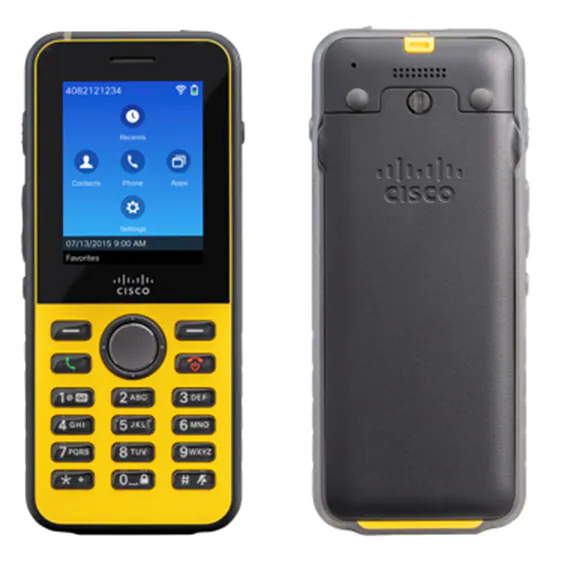
Cisco Wireless IP Phone 8821-EX
Features
The Cisco Wireless IP Phone 8821-EX (Figure 1) delivers all the capabilities of the Cisco Wireless IP Phone 8821 with the ruggedness and resiliency certification needed for deployment in environments such as chemical and manufacturing plants, utilities, and oil refineries.
Features include:
● ATEX Zone 2 Group IIC certification (pending)
● U.S. and Canada Class I Division 2 and Class I Zone 2 certification
● Industry-standard yellow styling offers fast recognition if an emergency occurs
● IEEE 802.11a/b/g/n/ac radio for VoWLAN communications support
● The large 2.4-inch (6 cm) color (240 x 320 pixels) display makes viewing easy
● IP67 rated for protection against dust, splash, and water
● Compliant with MIL-STD-810G standard for shock resistance
● Offers exceptional voice quality with High-Definition (HD) voice
● Built-in full-duplex speakerphone offers high-quality hands-free communications
● Supports third-party Bluetooth 3.0 headsets and a 3.5-mm headphone jack for added freedom
● Applications key provides direct access to XML applications such as push-to-talk and Lone Worker
● Battery life delivers up to 9.5 hours of talk time
● Enhanced encryption support for SHA-1 and SHA-2 signatures
● Fast, secure roaming using 802.11r and Cisco Centralized Key Management roaming
● Automatic certificate renewal – SCEP support
Table 1 provides a list of the phone’s features, Table 2 summarizes its wireless characteristics, Table 3 lists specifications, and Table 4 provides certification and compliance information.
Table 1. Features
| Item |
Description |
| Features |
● Six line appearances
● Abbreviated dialing
● Adjustable ringing and volume levels
● Adjustable display brightness and timeout
● Audible and vibrating ringers
● Auto-answer
● Auto-detection of headset and auto-answer from headset
● Automatic keypad lock
● Callback
● Call forward
● Call history lists
● Call park
● Call pickup
● Call timer
● Call waiting
● Caller ID
● cBarge
● Corporate directory
● Conference
● Direct transfer
● Extension mobility service
● Fast-dial service
● Group call pickup
● Hold
● Hotkey for keypad lock, ring silent mode, and voicemail access
● Immediate divert
● Join
● Last-number redial – green key
● Malicious caller
● Message-waiting indicator
● Meet-me conference
● Multilevel Precedence and Preemption (MLPP)
● Music on hold
● Mute
● Network profiles (4)
● OPickUp
● Personal directory
● Predialing before sending
● Privacy
● Presence
● Quality Report Tool (QRT)
● Redial
● Ring tone per line appearance
● Service URL
● Shared line
● Time and date display
● Transfer
● Network hold
● Hospitality
● Support for mutual-authentication TLS
● Cisco Unified Communications Manager WLAN profiles
● +Dialing
● Application launch pad
● Busy Lamp Field (BLF)
● BLF pickup
● BLF speed dial
● Call forward notification
● Forced authorization and client matter codes
● Intercom
● Mobility
● Silent monitoring and recording
● Speed dial
● Voicemail
● Whisper coaching
● Ring setting – phone active (ring, ring once, beep, flash)
● Predictive search on new call
|
| Buttons |
● Power button
● Volume up/down
● Two soft-key buttons to access screen-based applications, features, and functions
● Green key (answer/send/redial) and red key (power/end call)
● Application button
● Mute
● Speakerphone
● Five-way navigation support
● Numeric keypad (0-9, *, & #)
|
| Codecs |
● G.711a, G.711u
● G.729a, G.729ab
● G.722
● Internet Low Bitrate Codec (iLBC) audio-compression codecs
● iSAC
|
| LEDs |
● Ring, message waiting, Wi-Fi status, and charging LEDs
|
| Protocol |
● Session Initiation Protocol (SIP)
|
| Call control |
● Cisco Unified Communications Manager: 9.1(2), 10.5(2), 11.0(1), and later
● Cisco Unified Survivable Remote Site Telephony (SRST): 10.5, 11.0, 11.5, 11.7, and later
● Cisco Unified Communications Manager Express: 10.5, 11.0, 11.5, 11.7(native support) and later
● Cisco Hosted Collaboration Solution (HCS): 9.x, 10.x, 11.x, and later
|
| Security features |
● Certificates
● Image authentication
● Device authentication
● File authentication
● Signaling authentication
● Secure Cisco Unified SRST
● Media encryption using Secure Real-Time Protocol (SRTP)
● Signaling encryption using Transport Layer Security (TLS) Protocol
● Certificate Authority Proxy Function (CAPF)
● Simple Certificate Enrollment Protocol (SCEP) support for certificates renewal
● Secure profiles
● Encrypted configuration files
● Cryptography is not enabled by default and may be enabled only through a cryptographically enabled Cisco Unified Communications Manager
|
| Provisioning and management |
● Configuration via Unified Communications Manager, SRST, and Unified Communications Manager Express administration interfaces
● Bulk provisioning support via desktop charger and USB to Ethernet dongle combination
● Web server for configuration and statistics
● Capability to disable local phone settings
● Quality of Service (QoS) reporting: Jitter, delay, dropped packets, and latency on a per-call basis
● Real Time Control Protocol (RTCP) support and monitoring
● Syslog
|
| Configuration options |
● Dynamic Host Configuration Protocol (DHCP) client or static configuration
● Support for online firmware upgrades using Trivial File Transfer Protocol (TFTP)
● Domain Name System (DNS)
|
| Application framework |
● XML (support push-to-talk, paging, and other 3
rd party applications)
|
| User localization |
Arabic, Bulgarian, Catalan, Chinese (Hong Kong), Chinese (China), Chinese (Taiwan), Croatian, Czech, Danish, Dutch, English (United Kingdom), English (United States), Estonian, Finnish, French (Canada), French (France), German, Greek, Hebrew, Hungarian, Italian, Japanese, Korean, Latvian, Lithuanian, Norwegian, Polish, Portuguese (Brazil), Portuguese (Portugal), Romanian, Russian, Serbian, Slovak, Slovenian, Spanish (Spain), Spanish (Colombia), Swedish, Thai, and Turkish |
| Network localization |
Argentina, Australia, Austria, Belgium, Brazil, Canada, China, Colombia, Cyprus, Czech Republic, Denmark, Egypt, Finland, France, Germany, Ghana, Greece, Hong Kong, Hungary, Iceland, India, Indonesia, Ireland, Israel, Italy, Japan, Jordan, Kenya, Korea Republic, Lebanon, Luxembourg, Malaysia, Mexico, Nepal, Netherlands, New Zealand, Nigeria, Norway, Pakistan, Panama, Peru, Philippines, Poland, Portugal, Russian Federation, Saudi Arabia, Singapore, Slovakia, Slovenia, South Africa, Spain, Sweden, Switzerland, Taiwan, Thailand, Turkey, United Kingdom, United States, Venezuela, and Zimbabwe |
Table 2. Wireless Characteristics
| Item |
Specifications |
|||
| Protocols |
● IEEE 802.11a, 802.11b, 802.11g, 802.11n, 802.11ac
|
|||
| Frequency bands and operating channels |
● 2.412 to 2.472 GHz (channels 1 to 13)
● 5.180 to 5.240 GHz (channels 36 to 48)
● 5.260 to 5.320 GHz (channels 52 to 64)
● 5.500 to 5.700 GHz (channels 100 to 140)
● 5.745 to 5.825 GHz (channels 149 to 165)
● IEEE 802.11d can be used to identify available channels
|
|||
| Nonoverlapping channels |
● 2.4 GHz (20-MHz channels): up to 3 channels
● 5 GHz (20-MHz channels): up to 24 channels
● 5 GHz (40-MHz channels): up to 9 channels
● 5 GHz (80-MHz channels): up to 4 channels
|
|||
| Operating modes |
● Auto (preference to 5 GHz)
● 2.4 GHz only
● 5 GHz only
|
|||
| Data rates |
● 802.11a: 6, 9, 12, 18, 24, 36, 48, and 54 Mbps
● 802.11b: 1, 2, 5.5, and 11 Mbps
● 802.11g: 6, 9, 12, 18, 24, 36, 48, and 54 Mbps
● 802.11n: HT MCS 0, MCS 1, MCS 2, MCS 3, MCS 4, MCS 5, MCS 6, and MCS 7
● 802.11ac: VHT MCS 0, MCS 1, MCS 2, MCS 3, MCS 4, MCS 5, MCS 6, MCS 7, MCS 8, and MCS 9 (MCS 9 available with VHT40 and VHT80 only)
|
|||
| 2.4-GHz receiver sensitivity |
IEEE 802.11b:
● 1 Mbps: -98 dBm
● 2 Mbps: -96 dBm
● 5.5 Mbps: -93 dBm
● 11 Mbps: -91 dBm
|
IEEE 802.11g:
● 6 Mbps: -95 dBm
● 9 Mbps: -94 dBm
● 12 Mbps: -93 dBm
● 18 Mbps: -90 dBm
● 24 Mbps: -87 dBm
● 36 Mbps: -84 dBm
● 48 Mbps: -79 dBm
● 54 Mbps: -77 dBm
|
IEEE 802.11n HT20:
● MCS 0: -95 dBm
● MCS 1: -92 dBm
● MCS 2: -90 dBm
● MCS 3: -87 dBm
● MCS 4: -83 dBm
● MCS 5: -78 dBm
● MCS 6: -77 dBm
● MCS 7: -75 dBm
|
|
| 5-GHz receiver sensitivity |
IEEE 802.11a:
● 6 Mbps: -94 dBm
● 9 Mbps: -93 dBm
● 12 Mbps: -92 dBm
● 18 Mbps: -89 dBm
● 24 Mbps: -86 dBm
● 36 Mbps: -83 dBm
● 48 Mbps: -78 dBm
● 54 Mbps: -76 dBm
|
IEEE 802.11n HT20:
● MCS 0: -94 dBm
● MCS 1: -91 dBm
● MCS 2: -89 dBm
● MCS 3: -86 dBm
● MCS 4: -82 dBm
● MCS 5: -77 dBm
● MCS 6: -76 dBm
● MCS 7: -74 dBm
|
IEEE 802.11n HT40:
● MCS 0: -91 dBm
● MCS 1: -88 dBm
● MCS 2: -86 dBm
● MCS 3: -83 dBm
● MCS 4: -79 dBm
● MCS 5: -75 dBm
● MCS 6: -73 dBm
● MCS 7: -72 dBm
|
|
| IEEE 802.11ac VHT20:
● MCS 0: -93 dBm
● MCS 1: -90 dBm
● MCS 2: -87 dBm
● MCS 3: -84 dBm
● MCS 4: -81 dBm
● MCS 5: -76 dBm
● MCS 6: -75 dBm
● MCS 7: -74 dBm
● MCS 8: -70 dBm
|
IEEE 802.11ac VHT40:
● MCS 0: -90 dBm
● MCS 1: -87 dBm
● MCS 2: -85 dBm
● MCS 3: -82 dBm
● MCS 4: -79 dBm
● MCS 5: -73 dBm
● MCS 6: -72 dBm
● MCS 7: -72 dBm
● MCS 8: -67 dBm
● MCS 9: -66 dBm
|
IEEE 802.11ac VHT80:
● MCS 0: -87 dBm
● MCS 1: -83 dBm
● MCS 2: -81 dBm
● MCS 3: -78 dBm
● MCS 4: -75 dBm
● MCS 5: -73 dBm
● MCS 6: -68 dBm
● MCS 7: -68 dBm
● MCS 8: -64 dBm
● MCS 9: -62 dBm
|
||
| Transmitter output power |
2.4 GHz:
● 802.11b: up to 17 dBm
● 802.11g: up to 14 dBm
● 802.11n HT20: up to 13 dBm
|
5 GHz:
● 802.11a: up to 14 dBm
● 802.11n HT20: up to 13 dBm
● 802.11n HT40: up to 13 dBm
● 802.11ac VHT20: up to 12 dBm
● 802.11ac VHT40: up to 12 dBm
● 802.11ac VHT80: up to 12 dBm
|
||
| Antenna |
● 2.4 GHz: 2.4 dBi peak gain
● 5 GHz: 3.0 dBi peak gain
|
|||
| Access point support |
● Cisco unified access points
◦ Minimum: 8.0.121.0
● Cisco autonomous access points
◦ Minimum: 12.4(21a)JY
● Cisco Meraki access points
Note: Check deployment guide for more details around access point support and listing. |
|||
| Wireless security |
Authentication:
● Wi-Fi Protected Access (WPA) versions 1 and 2 Personal and Enterprise
● Extensible Authentication Protocol – Flexible Authentication via Secure Tunneling (EAP-FAST)
● Protected Extensible Authentication Protocol – Generic Token Card (PEAP-GTC)
● Protected Extensible Authentication Protocol – Microsoft Challenge Handshake Authentication Protocol Version 2 (PEAP-MSCHAPv2)
● Extensible Authentication Protocol – Transport Layer Security (EAP-TLS)
|
Encryption:
● 40-bit and 128-bit static Wired Equivalent Privacy (WEP)
● Temporal Key Integrity Protocol (TKIP) and Message Integrity Check (MIC)
● Advanced Encryption Standard (AES)
Note: The access point must support AES as TKIP can only be used as the broadcast/multicast cipher. |
||
| Fast secure roaming |
● 802.11r (FT)
● Cisco Centralized Key Management (CCKM)
|
|||
| Signature types |
● Secure Hash Algorithm 1 (SHA-1) and Secure Hash Algorithm 2 (SHA-2)
|
|||
| Bit key types |
● 1024, 2048, and 4096 bit keys
|
|||
| QoS |
● IEEE 802.11e and Wi-Fi Multimedia (WMM)
● Traffic Specification (TSPEC)
● Traffic Classification (TCLAS)
● Enhanced Distributed Channel Access (EDCA)
● QoS Basic Service Set (QBSS)
|
|||
Table 3. Specifications
| Item |
Specifications |
| Display |
● 2.4-in. (6-cm) color display with 240 x 320 pixel resolution
|
| Dimensions (HxWxD) |
● 5.2 x 2.2 x 0.7 in. (13.2 x 5.6 x 1.7 cm)
|
| Weight |
● Device 4.4 oz (126 g), battery 1.3 oz (37 g), total = 5.7 oz (163 g)
|
| Battery |
● Up to 9.5 hours of voice calling; up to 45 hours (continuous scan) or up to 145 hours (auto scan) standby
● Rechargeable Lithium ion 4.35V, 2060mAh smart battery (minimal capacity 3.8V, 2000mAh)
Note: For voice calling, battery hours are calculated by placing a call and measuring the time it takes for the battery to completely drain. Actual battery hours may vary depending on display and keypad activity, messaging from XSI application, roaming events and scan mode, and use of a Bluetooth headset. Under normal usage when guidelines for battery in the deployment guide are followed, battery hours should cover a typical work shift of eight hours. |
| Input power |
● Phone: 100 to 240 VAC, ~0.2A, and 50 to 60 Hz
● AC adapters (by geographical region)
|
| Operating temperature |
● Device: 14° to 122°F (-10° to 50°C)
● Battery: -4° to 140°F (-20° to 60°C)
|
| Storage temperature |
● Device: -22° to 140°F (-30° to 60°C)
● Battery: -4° to 113°F (-20° to 45°C)
|
| Relative humidity |
● 10% to 95% (noncondensing)
|
| Vibration |
● 1.5 Grms maximum, 0.1 in. (2.5 mm) double amplitude at 0.887 octaves per minute from 5-500-5 Hz sweep, and 10-minute dwell on three major peaks in each of the three major mutually perpendicular axes
|
| Thermal shock |
● -22°F (-30°C) 24 hours; 158°F (70°C) 24 hours
|
| Altitude |
● Certified for operation: 0 to 6500 ft. (0 to 2 km)
|
| Endurance |
● Ingress Protection IP67
● MIL-STD-810G Drop and Vibration procedures
|
| Drop specs |
● Withstand multiple drops of 5 feet (1.5m) on to concrete. 12 drops (6 faces, 4 edges, face and bottom)
|
| Headset |
● Wireless: Bluetooth SW 3.0 HW 4.0
● Wired: 3.5 mm stereo headphone/microphone jack
|
| Connector |
● Magnetic USB 2.0 On The Go (OTG) connector
|
Table 4. Certification and Compliance
| Item |
Specifications |
| Safety |
● UL 60950-1
● CAN/CSA 60950-1
● EN 60950-1
● IEC 60950-1
● AS/NZS 60950.1
● IEC 60529 (IP 67)
● ATEX Zone 2 Group IIC (pending)
● US/Canada CSA Class I Division 2
● US/Canada CSA Class I Zone 2
● ANSI/ISA 12.12.01 Class I Division 2, Groups A, B, C, and D
● CAN/CSA C22.2 No.213
● EN 60079-0
● EN 60079-7
|
| Electromagnetic Compatibility and Electromagnetic Interference (EMC/EMI) |
● 47 CFR Part 15 Class B
● ICES-003 Class B
● EN 55022 Class B
● AS/NZS CISPR 22 Class B
● CISPR 22 Class B
● VCCI Class B
● EN 61000-3-2
● EN 61000-3-3
● KN 22 Class B
● EN 55024
● EN 50082-1
● EN 61000-6-1
● EN 61000-6-3
● EN 300 386
● EN 60601-1-2
● KN Immunity Series
|
| Telecom |
● FCC Part 68 (CFR) (HAC)
● NZ PTC 220 DR
● AS/ACIF S004 and AS/ACIF S040 (Australia)
● TIA 810-B and TIA 920-A
● Canada-CS-03-HAC
|
| Radio |
● USA: FCC Part 15.247 (2.4 GHz), FCC Part 15.407 (5 GHz), and FCC Part 2
● Canada: RSS-210
● Japan: ARIB STD-T66 (2.4 GHz), ARIB STD-T70, and T71 (4.9/5 GHz)
● ETSI: EN 300.328 (2.4 GHz) and EN 301.893 (5 GHz)
● Australia and New Zealand: AS/NZS 4268
● Singapore: IDA TS SRD
● Hong Kong: HKTA1039
|
| RF exposure |
● OET-65C (01-01)
● ANSI C95.1 (91)
● RSS-102
● ACA Radio Communications (Electromagnetic Radiation - Human Exposure) Standard 2003
● EN 50360
● EN 301 489-1
● EN 301 489-17
|
Ordering Information
Note: All Cisco IP phones require the purchase of a phone technology license, regardless of the call protocol being used.
Tables 5 provide ordering information for the Cisco Wireless IP Phone 8821-EX.
Table 5. Product Ordering Information
| Item |
Specifications |
| CP-8821-EX-K9-BUN |
Cisco Wireless IP Phone 8821-EX World mode, battery, power cord, power adapter, and country clip |
| CP-8821-EX-K9= |
Cisco Wireless IP Phone 8821-EX World mode device ONLY |
| CP-BATT-8821= |
Cisco Wireless 8821 Battery ONLY |
| CP-PWR-8821-NA= |
Cisco Wireless 8821 Power Supply for North America, includes power cord and power adapter |
| CP-PWR-8821-AR= |
Cisco Wireless 8821 Power Supply for Argentina, includes power cord, power adapter, and country clip |
| CP-PWR-8821-AU= |
Cisco Wireless 8821 Power Supply for Australia, includes power cord, power adapter, and country clip |
| CP-PWR-8821-BZ= |
Cisco Wireless 8821 Power Supply for Brazil, includes power cord, power adapter, and country clip |
| CP-PWR-8821-CE= |
Cisco Wireless 8821 Power Supply for Europe, includes power cord, power adapter, and country clip |
| CP-PWR-8821-IND= |
Cisco Wireless 8821 Power Supply for India, includes power cord, power adapter, and country clip |
| CP-PWR-8821-KR= |
Cisco Wireless 8821 Power Supply for Korea, includes power cord, power adapter, and country clip |
| CP-PWR-8821-JP= |
Cisco Wireless 8821 Power Supply for Japan, includes power cord, power adapter, and country clip |
| CP-PWR-8821-SW= |
Cisco Wireless 8821 Power Supply for Switzerland, includes power cord, power adapter, and country clip |
| CP-PWR-8821-UK= |
Cisco Wireless 8821 Power Supply for UK, includes power cord, power adapter, and country clip |
Note: For information about the desktop charger, multichargers, and carrying cases, refer to the Cisco Wireless IP Phone 882x Series Accessory Guide.
Guidelines
● This product is not a medical device and may use an unlicensed frequency band that is susceptible to interference from other devices or equipment.
● A moist cloth can be used for simple cleaning.. Any cleaning solution containing a higher degree of isopropanol, including pure isopropanol, or an alternate alcohol-based liquid, could potentially damage the phone. Refer to the Cisco Wireless IP Phone 8821 and 8821-EX User Guide for detailed instructions.
● Carry cases can help protect the phone and provide drop protection.
● The Cisco Wireless IP Phone 8821-EX was tested under controlled laboratory conditions with a rating of IP67 under IEC standard 60529. Splash, water, and dust resistance are not permanent conditions, and resistance might decrease as a result of normal wear. Users are expected to take care of the Cisco Wireless IP Phone 8821-EX and should not deliberately expose the device to a hostile environment of dust, splash, or water immersion. Do not attempt to charge a wet Cisco Wireless IP Phone 8821-EX or dock it on a desktop or multicharger. Refer to the Cisco Wireless IP Phone 8821 and 8821-EX User Guide for cleaning and drying instructions. Liquid damage to the Cisco Wireless IP Phone 8821 is not covered under warranty.
● Use only batteries that are approved by Cisco. Use of unapproved batteries might be dangerous and will invalidate the warranty on your phone.
● The Cisco Wireless IP Phone 8821-EX shares firmware with the Cisco Wireless IP Phone 8821. Support for the Cisco Wireless IP Phone 8821-EX is in release 11.0(5) SR1 or higher.
● WARNING – EXPLOSION HAZARD. DO NOT REMOVE OR REPLACE BATTERY UNLESS THE AREA IS FREE OF IGNITIBLE.
| Model | CP-8821-EX-K9 |