


Cisco 1 Gigabit Transceiver CWDM-SFP-1550
- Global Price List Information (GPL)
-
Model: CWDM-SFP-1550
-
Description:
-
Price: USDLast Update:
- End-of-Sale and End-of-Life Information (EOL/EOS)
- Release Date:
- End-of-Sale Date:
- End-of-Support Date:
The Cisco Coarse Wavelength-Division Multiplexing (CWDM) Small Form-Factor Pluggable (SFP) solution provides a scalable and straightforward approach for enterprise companies and service providers to deploy Gigabit Ethernet and Fibre Channel services. It offers a cost-effective way to expand optical capacity across campus networks, data centers, and metropolitan-area access environments.
By maximizing the transmission efficiency of single-mode fiber, this solution enables organizations to significantly increase their network bandwidth without the heavy capital expense of laying additional fiber cables. It fits seamlessly into existing infrastructures, providing a reliable foundation for highly available, multiservice networks.
Product overview
The Cisco CWDM SFP solution consists of a modular product ecosystem designed for high performance and operational simplicity. The hardware portfolio includes hot-swappable Cisco CWDM SFP transceivers, Cisco CWDM passive multiplexer/demultiplexers, Optical Add/Drop Multiplexers (OADMs), and a dedicated Cisco CWDM chassis capable of rack-mounting up to two passive multiplexer units.
The transceiver line encompasses eight specific models operating across distinct ITU-T G.694.2 compliant wavelengths: 1470-nm (CWDM-SFP-1470=), 1490-nm (CWDM-SFP-1490=), 1510-nm (CWDM-SFP-1510=), 1530-nm (CWDM-SFP-1530=), 1550-nm (CWDM-SFP-1550=), 1570-nm (CWDM-SFP-1570=), 1590-nm (CWDM-SFP-1590=), and 1610-nm (CWDM-SFP-1610=). Each transceiver features a dual LC/PC connector interface designed for single-mode fiber patch cords.
These multirate SFP devices plug into standard SFP slots on supported Cisco switches, routers, and optical transport platforms. They facilitate full-duplex communication for both 1.25 Gbps Gigabit Ethernet and multi-rate Fibre Channel (1.06 Gbps and 2.12 Gbps) connections, linking equipment directly to the optical network with no software configuration required.
Features and benefits
- High Channel Scalability: Multiplexes up to eight distinct channels (Gigabit Ethernet or Fibre Channel) over single-mode fiber pairs, or up to four channels over a single fiber strand.
- Plug-and-Play Deployment: Transceivers fit standard IEEE 802.3z compliant SFP ports, while passive OADMs require no electrical power or complex initial setup.
- Versatile Network Topologies: Adapts flexibly to point-to-point (dual- or single-fiber), hub-and-spoke ring, and complex mesh architectures.
- Built-in Network Resiliency: Leverages Layer 2 and Layer 3 endpoint failover mechanisms alongside dual-path ring structures to ensure continuous protection against fiber cuts.
- Infrastructure Investment Protection: Expands total bandwidth on existing fiber lines and operates side-by-side with standard Cisco SFP modules on the same platform.
- Robust Optical Performance: Offers an optical link budget of 29 dB for 1.25 Gbps Gigabit Ethernet and 28 dB for 1.06/2.12 Gbps Fibre Channel traffic.
- Strict Industry Compliance: Adheres to the ITU-T G.694.2 CWDM grid, IEEE 802.3z 1000BASE-X specifications, Fibre Channel FC-PI 10.0 standards, and Laser Class I safety regulations.
Overview
The Cisco Coarse Wavelength-Division Multiplexing (CWDM) Small Form-Factor Pluggable (SFP) solution allows enterprise companies and service providers to provide scalable and easy-to-deploy Gigabit Ethernet and Fibre Channel services in their networks. The product set helps enable the flexible design of highly available, multiservice networks.
The Cisco CWDM SFP solution is a convenient and cost-effective solution for the adoption of Gigabit Ethernet and Fibre Channel in campus, data-center, and metropolitan-area access networks.
The Cisco CWDM SFP solution has two main components (Figure 1): a set of eight different pluggable transceivers (Cisco CWDM SFPs), and a set of different Cisco CWDM passive multiplexer/demultiplexer or optical add/drop multiplexers (OADMs). A Cisco CWDM chassis enables rack-mounting up to two of the Cisco CWDM passives. Both the transceivers and the passive multiplexers are compliant with the ITU-T G.694.2 standard defined CWDM grid.
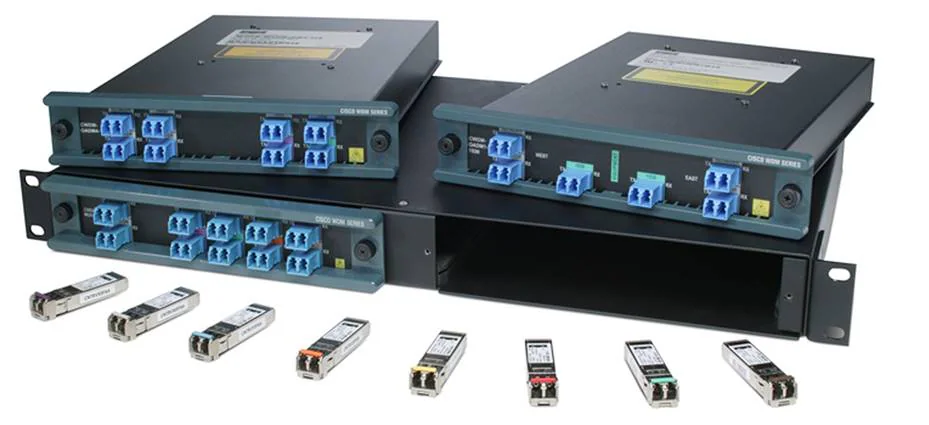
Cisco CWDM SFP Solution
Key features and benefits
Scalability
The Cisco CWDM SFP solution helps enable the transport of up to eight channels (Gigabit Ethernet or Fibre Channel) over single-mode fiber strands.
Easy Deployment and flexible implementation
The Cisco CWDM SFP fits into a standard SFP port supporting the IEEE 802.3z standard on the supported Cisco Systems platforms. The Cisco CWDM OADM is passive and requires no power. Neither the Cisco CWDM SFP nor the Cisco CWDM passives requires configuration.
The Cisco CWDM SFP solution allows for a variety of network configurations—from multichannel point-to-point to hub and meshed-ring configurations.
High availability
The Cisco CWDM SFP solution takes advantage of a multichannel architecture and the inherent protection of ring architectures. The solution helps enable:
● Use of Layer 2 and Layer 3 redundancy and failover mechanisms at the channel endpoints (Cisco CWDM SFP) to build highly available links
● Use of two-path link configurations in a ring architecture to provide protection from fiber cuts
Investment protection
The Cisco CWDM SFP solution helps enable enterprises and service providers to increase the bandwidth of an existing Gigabit Ethernet optical infrastructure without adding new fiber strands. The solution can be used in parallel with other Cisco SFP devices on the same platform.
Deployment scenarios
Point-to-point configuration
In a point-to-point configuration (Figure 2), two endpoints are directly connected through a fiber link. The Cisco CWDM SFP solution helps enable customers to add or drop as many as eight channels (Gigabit Ethernet or Fibre Channel) into a pair of single-mode fiber strands. As a result, the need for additional fiber is minimized. Redundant point-to-point links are possible by adding or dropping redundant channels into a second pair of single-mode fiber strands.
A single fiber point-to-point configuration also is possible (Figure 3). By using different wavelengths to transmit and receive signals, as many as four channels can be transported over a single fiber strand.
The main applications for the architecture are enterprise campus links and service provider Point-Of-Presence (POP) or hub interconnects across a metropolitan (metro) area.
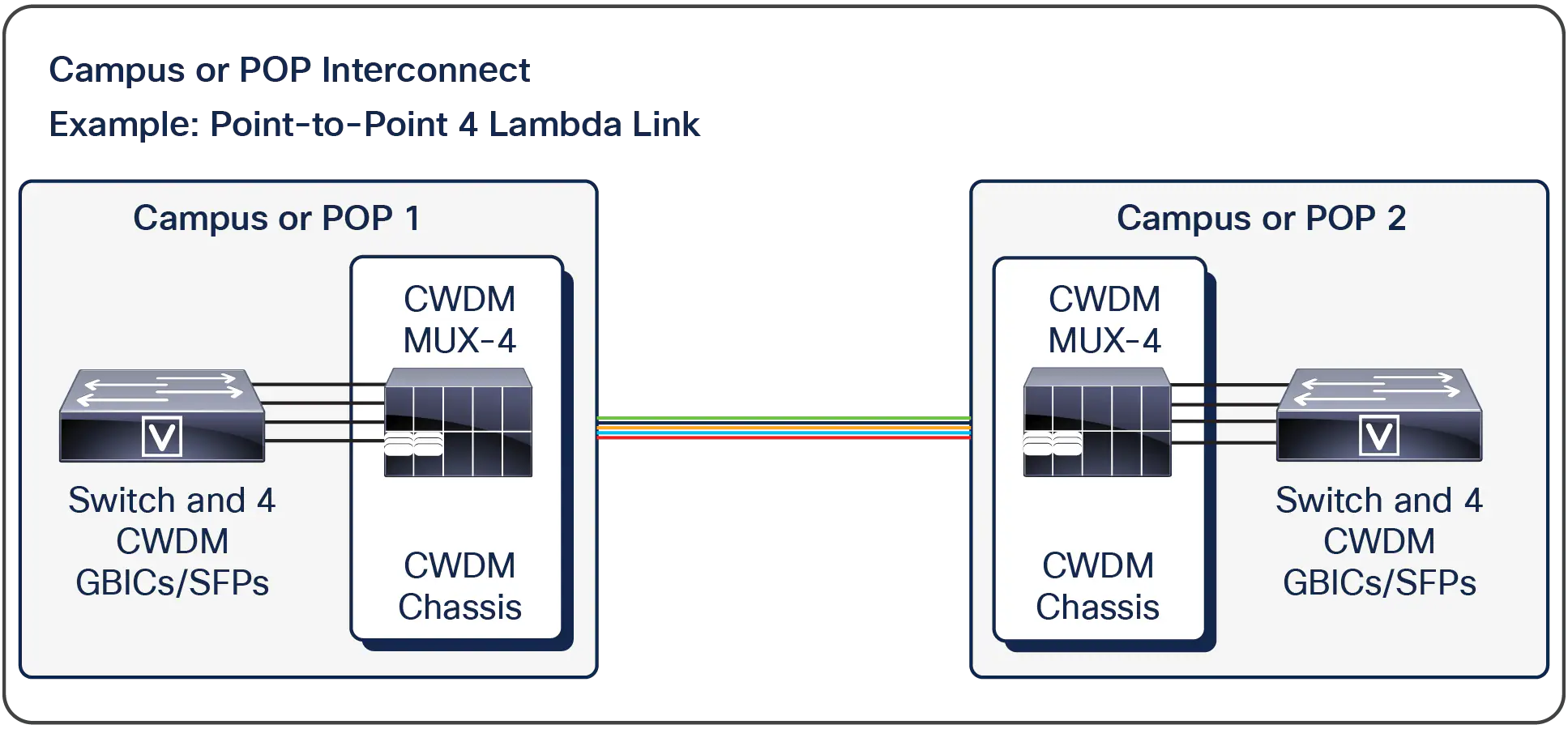
Point-to-point architecture (dual-fiber link)
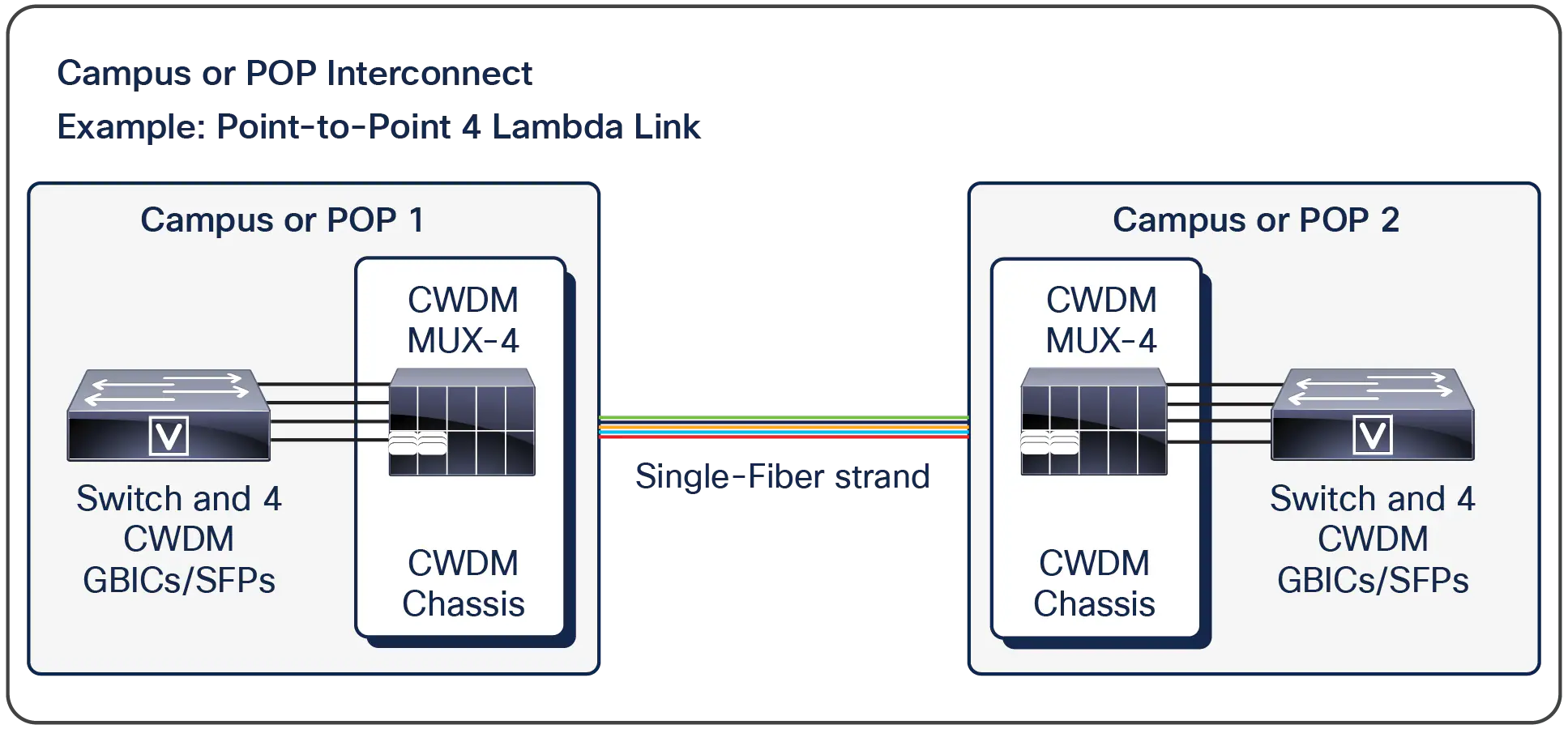
Point-to-point architecture (single-fiber link)
Hub-and-spoke (ring) configuration
In a hub-and-spoke configuration (Figure 4), multiple nodes (spokes) are connected with a hub location through a ring of single-mode fiber. Each hub-node connection can consist of a single or multiple channels. Protection from fiber cuts in the ring is achieved by connecting the hub and nodes through both directions of the optical ring. Service provider metro access rings are the main applications for this architecture.
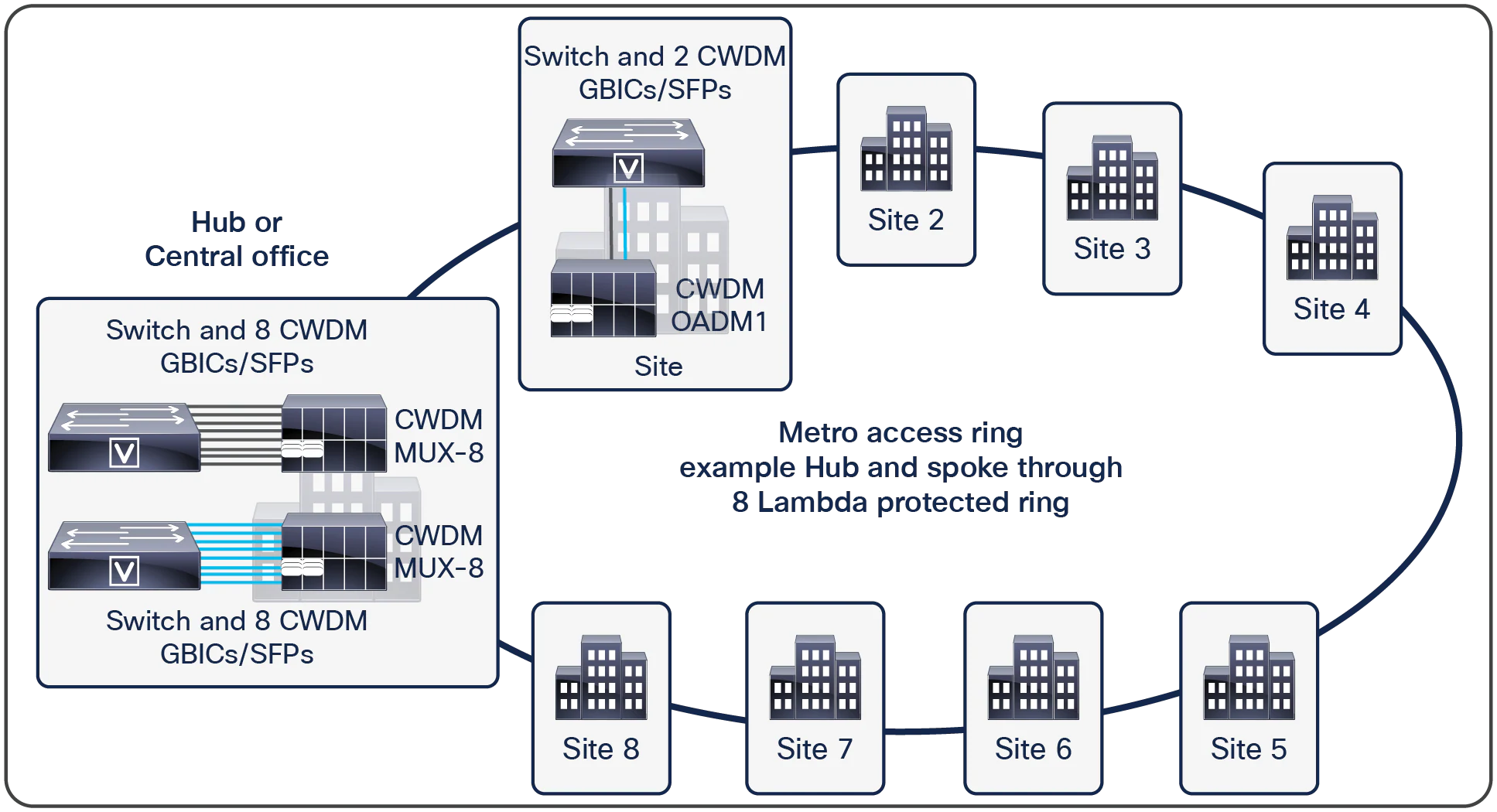
Hub-and-spoke (ring) architecture
Mesh (ring) configuration
Mesh deployments are a combination of hub-and-spoke and point-to-point or even multiple point-to-point connections in parallel on the same optical link. Deployment of the maximum eight wavelengths allows for different combinations of these scenarios.
Cisco CWDM SFPs
A Cisco CWDM SFP (Figure 5) is a hot-swappable input/output device that plugs into an SFP port or slot of a Cisco switch or router, linking the port with the fiber-optic network.
The Cisco CWDM SFPs are multirate parts that support both Gigabit Ethernet and Fibre Channel (1 gigabit and 2 gigabit).
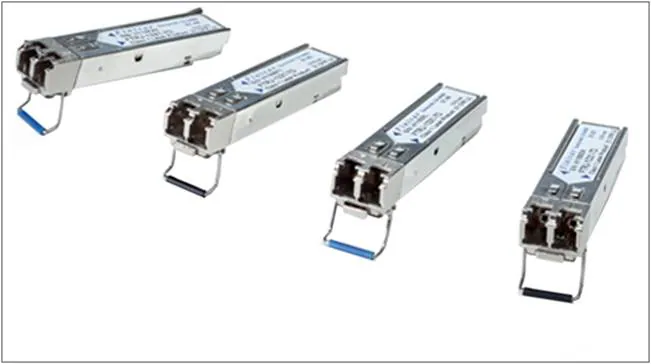
Cisco CWDM SFPs
Performance
● Gigabit Ethernet 1.25 Gbps full-duplex links with an optical link budget of 29 dB
● Fibre Channel 1.06 and 2.12 Gbps full-duplex links with an optical link budget of 28 dB
Platform support
The Cisco CWDM SFPs are supported across a variety of Cisco switches, routers, and optical transport devices. For more details, refer to the document Cisco CWDM SFP Compatibility Matrix.
Connectors and cabling
● Equipment: Standard SFP interface
● Network: Dual LC/PC connector
Note: Only connections with patch cords with PC or UPC connectors are supported. Patch cords with APC connectors are not supported.
Environmental conditions and power requirements
● Operating temperature range: 23 to 158°F (-5 to 70°C)
● Storage temperature range: –40 to 185°F (–40 to 85°C)
Table 1 describes the electrical power interface details, and Table 2 describes optical parameters.
Table 1. Electrical power interface data
|
Parameter |
Symbol |
Minimum |
Typical |
Maximum |
Units |
|
Supply Current |
Is |
220 |
300 |
mA |
|
|
Surge Current |
ISurge |
+30 |
mA |
||
|
Input Voltage |
Vmax |
3.1 |
3.3 |
3.5 |
V |
Table 2. Optical parameters
|
Parameter |
Symbol |
Minimum |
Typical |
Maximum |
Units |
Notes and Conditions |
|
Transmitter Center Wavelength |
wavelengthc |
(x–4) |
(x + 7) |
nm |
Available center wavelengths are 1470, 1490, 1510, 1530, 1550, 1570, 1590, and 1610 nm |
|
|
Side-Mode Suppression Ratio |
SMSR |
30 |
dB |
|||
|
Transmitter Optical Output Power |
Pout |
0 |
5.0 |
dBm |
Average power coupled into single-mode fiber |
|
|
Receiver Optical Input Power (BER <10–12 with PRBS 2–7—1) |
Pin |
–28.0 |
–7.0 |
dBm |
@ 2.12 Gbps, 140°F (60°C) case temperature |
|
|
Receiver Optical Input Power (BER <10–12 with PRBS 2–7—1) |
Pin |
–29.0 |
–7.0 |
dBm |
@ 1.25 Gbps, 140°F (60°C) case temperature |
|
|
Receiver Optical Input Wavelength |
wavelengthin |
1450 |
1620 |
nm |
||
|
Transmitter Extinction Ratio |
OMI |
9 |
dB |
|||
|
Dispersion Penalty at 100 km |
3 |
dB |
@ 2.12 Gbps |
|||
|
Dispersion Penalty at 100 km |
2 |
dB |
@ 1.25 Gbps |
Note: Parameters are specified over temperature and at end of life unless otherwise noted.
Note: When shorter distances of single-mode fiber are used, it may be necessary to insert an inline optical attenuator in the link to avoid overloading the receiver.
Ordering information
Refer to Table 3 for details about ordering Cisco CWDM SFPs.
Table 3. Cisco CWDM SFP product information
|
Product Number |
Description |
Color |
|
CWDM-SFP-1470= |
Cisco CWDM 1470-nm SFP; Gigabit Ethernet and 1 and 2 Gb Fibre Channel |
Gray |
|
CWDM-SFP-1490= |
Cisco CWDM 1490-nm SFP; Gigabit Ethernet and 1 and 2 Gb Fibre Channel |
Violet |
|
CWDM-SFP-1510= |
Cisco CWDM 1510-nm SFP; Gigabit Ethernet and 1 and 2 Gb Fibre Channel |
Blue |
|
CWDM-SFP-1530= |
Cisco CWDM 1530-nm SFP; Gigabit Ethernet and 1 and 2-Gb Fibre Channel |
Green |
|
CWDM-SFP-1550= |
Cisco CWDM 1550-nm SFP; Gigabit Ethernet and 1 and 2 Gb Fibre Channel |
Yellow |
|
CWDM-SFP-1570= |
Cisco CWDM 1570-nm SFP; Gigabit Ethernet and 1 and 2 Gb Fibre Channel |
Orange |
|
CWDM-SFP-1590= |
Cisco CWDM 1590-nm SFP; Gigabit Ethernet and 1 and 2 Gb Fibre Channel |
Red |
|
CWDM-SFP-1610= |
Cisco CWDM 1610-nm SFP; Gigabit Ethernet and 1 and 2 Gb Fibre Channel |
Brown |
Regulatory and standards compliance
● Compliant with the ITU-T G.694.2 CWDM grid
● Compatible with 1000BASE-X standard as specified in IEEE 802.3z
● Compatible with Fibre Channel Draft Physical Interface Specification (FC-PI 10.0)
● Safety: Laser Class I 21CFR1040
For more information
For more information about the Cisco CWDM products, visit https://www.cisco.com/en/US/products/hw/modules/ps4999/products_data_sheet09186a00801a557c.html.
| Model | CWDM-SFP-1550 |