
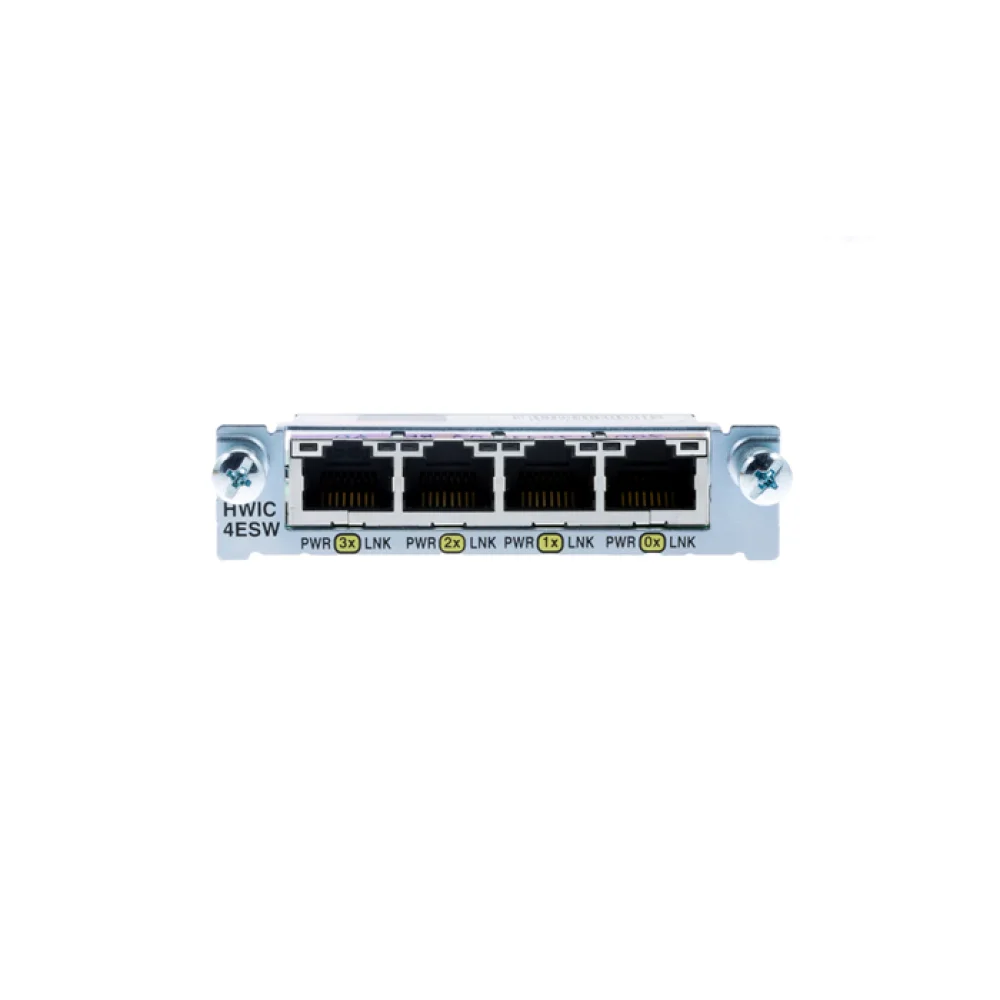

Cisco HWIC-4ESW Module
- Global Price List Information (GPL)
-
Model: HWIC-4ESW-RF
-
Description:
-
Price: USDLast Update:
- End-of-Sale and End-of-Life Information (EOL/EOS)
- Release Date:
- End-of-Sale Date:
- End-of-Support Date:
 Avijeh Fava
- 12-Month Avijeh Fava Warranty
- Shipping Method & Cost
- Same-day shipping (currently available in Tehran & Karaj)
The Cisco EtherSwitch High-Speed WAN Interface Cards (HWICs) represent a sophisticated networking solution designed to bridge the gap between routing and switching within a single, compact hardware footprint. These modules are engineered specifically for deployment within Cisco Integrated Services Routers (ISR), including the modular 1800, 1941, 2800, 2900, 3800, and 3900 series. By integrating Cisco Catalyst switching capabilities directly into the router architecture, these cards allow businesses of all sizes, from small offices to large enterprise branches, to streamline their network infrastructure.
This integration significantly simplifies the configuration, deployment, and ongoing management of network resources. Instead of maintaining separate devices for routing and switching, organizations can leverage the power of Cisco IOS software to handle both Layer 2 switching and Layer 3 routing tasks. This consolidation not only reduces the physical footprint of the networking equipment but also lowers the complexity of the network environment, making it an ideal choice for branch offices that require high-performance connectivity for data, voice, and video applications.
Product overview
The Cisco EtherSwitch HWIC family is available in two primary configurations: the 4-port HWIC-4ESW and the 9-port HWIC-D-9ESW. The 4-port model features a single-wide form factor, while the 9-port model utilizes a double-wide design. Both versions provide line-rate Layer 2 switching through 10/100 Ethernet ports, utilizing the robust Cisco IOS Catalyst software. For environments requiring power for connected devices, such as IP phones or wireless access points, Cisco offers Power over Ethernet (PoE) variants, specifically the HWIC-4ESW-POE and the HWIC-D-9ESW-POE.
These PoE-enabled modules include a daughter card that manages power detection, classification, and activation for devices compliant with the IEEE 802.3af standard. In the 9-port model, eight ports support inline power, while the ninth port functions as a standard switch port for trunking or general data traffic. To support these power-intensive features, specific field-replaceable power supplies are required for the host ISR routers. The modules also support advanced management features, including VLAN segmentation, which allows for the logical separation of voice and data traffic, even when sharing the same physical infrastructure. This is particularly beneficial for converged network deployments where IP telephony is a critical component of the branch office operations.
Features and benefits
- Integrated Switching: Combines routing and switching in one device, reducing management points and physical hardware requirements.
- Autosensing and Autonegotiation: Automatically detects device speed (10/100 Mbps) and optimizes duplex modes (half or full) for maximum bandwidth efficiency.
- Auto-MDIX: Simplifies cabling by automatically detecting and adjusting for straight-through or crossover cable types.
- VLAN Support (802.1Q): Enables the creation of up to 15 separate VLANs, allowing for efficient network segmentation and trunking.
- Voice VLAN: Facilitates the separation of voice and data traffic, ensuring quality of service for IP telephony.
- Spanning Tree Protocol (802.1D): Provides Layer 2 link management, ensuring path redundancy and preventing network loops.
- Quality of Service (QoS): Supports 802.1P standards for traffic prioritization, essential for maintaining performance in voice and video applications.
- PoE Capabilities (IEEE 802.3af): Provides inline power to IP phones and wireless access points, eliminating the need for external power injectors.
- Security (802.1x): Offers client-server based access control to prevent unauthorized devices from connecting to the LAN.
- Advanced Management: Includes SNMP support, RMON for traffic analysis, and CiscoWorks integration for comprehensive network oversight.
- Cisco SDM: Provides a web-based interface for simplified configuration, reducing the reliance on complex command-line interface (CLI) knowledge.
- Survivable Remote Site Telephony (SRST): Ensures voice service continuity in the event of a WAN failure by providing local call processing redundancy.
- Status LEDs: Offers real-time visual feedback for port status and inline power activity.
- Product Range: Includes HWIC-4ESW, HWIC-4ESW-POE, HWIC-D-9ESW, and HWIC-D-9ESW-POE to suit various port density requirements.
- Platform Compatibility: Fully supported across a wide range of Cisco ISR platforms, including the 1800, 1900, 2800, 2900, 3800, and 3900 series routers.
Product Overview
The 4- and 9-port Cisco EtherSwitch 10/100 high-speed WAN interface cards (HWICs) supported on the Cisco 1800 (modular)/1941, Cisco 2800/2900, and Cisco 3800/3900 series integrated services routers offer small-to-large-size businesses and enterprise branch office customers the option to integrate switching and routing in one device. This combination offers ease of configuration, deployment, and management while using the powerful characteristics of Cisco routing and Cisco Catalyst switching features.
The modular 4- and 9-port Cisco EtherSwitch HWICs provide line-rate Layer 2 switching across Ethernet ports using Cisco IOS Catalyst Software. The 4-port Cisco EtherSwitch HWIC has four 10/100 switched Ethernet ports, with options for inline power support on all four ports. The 9-port Cisco EtherSwitch HWIC has nine 10/100 switched Ethernet ports, with options for inline power support on 8 of the 9 ports. The ninth port does not support inline power but can be used as a regular switch port for trunking and other normal data applications. Features such as port autosensing, quality of service (QoS), VLAN support from 802.1P and 802.1Q standards, and 802.1D spanning tree protocols are standard on the Cisco EtherSwitch HWIC. The Cisco EtherSwitch HWICs are available in standard 4- or 9-port 10/100BASE-TX switch HWIC and Power-over-Ethernet (PoE) configurations. The PoE configurations consist of a 4- or 9-port 10/100BASE-TX switch and a 4- or 8-port inline power module daughter card. The power module daughter card houses a power controller for detecting, classifying, and enabling power on 802.3af-compliant powered devices attached to the HWICs. The inline powered version of the Cisco EtherSwitch HWIC can power Cisco IP phones, Cisco wireless access points, or any other IEEE 802.3af-compliant device. The optional inline power support on the 4- and 9-port HWICs on the Cisco 2800/2900 and Cisco 3800/3900 series of integrated services routers requires the use of a field-replaceable inline power supply. (Refer to Figure 1.)
Figure 1. 9- and 4-Port Cisco EtherSwitch HWICs

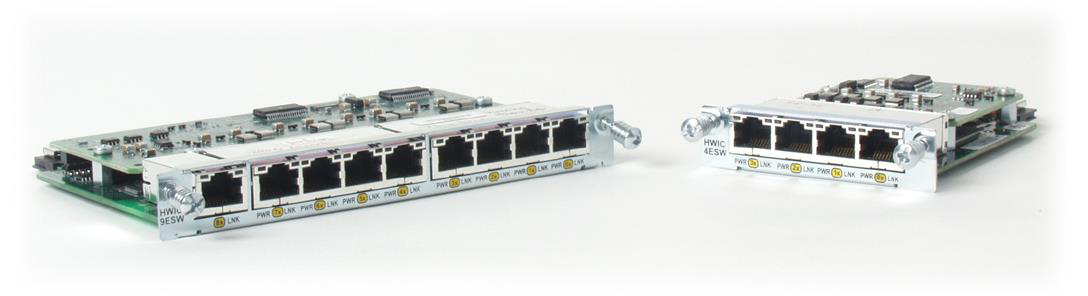
Cisco Etherswitch HWIC Summary
Table 1 gives the product numbers for the 4- and 9-port Cisco EtherSwitch HWICs.
Table 1. Product Numbers for 4- and 9-Port Cisco EtherSwitch HWICs
| Product Number | Description |
|---|---|
| HWIC-4ESW | 4-port Cisco EtherSwitch 10BASE-T/100BASE-TX autosensing HWIC |
| HWIC-4ESW-POE* | 4-port Cisco EtherSwitch 10BASE-T/100BASE-TX autosensing HWIC with power daughter card |
| HWIC-D-9ESW | 9-port Cisco EtherSwitch 10BASE-T/100BASE-TX autosensing HWIC |
| HWIC-D-9ESW-POE | 9-port Cisco EtherSwitch 10BASE-T/100BASE-TX autosensing HWIC with power daughter card |
Table 2 gives the power supply options for the Cisco Integrated Services Routers to support inline power on the 4- and 9-port HWICs.
Table 2. Power Supply Product Numbers
| Product Number | Description |
|---|---|
| PWR-2801-AC-IP= | Cisco 2801 AC inline power supply |
| PWR-2811-AC-IP= | Cisco 2811 AC inline power supply |
| PWR-2821-51-AC-IP= | Cisco 2821 and Cisco 2851 AC inline power supply |
| PWR-3825-AC-IP= | Cisco 3825 AC-IP power supply |
| PWR-3845-AC-IP= | Cisco 3845 AC-IP power supply |
| PWR-1941-POE= | Cisco 1941 POE Power Supply |
| PWR-2901-POE= | Cisco 2901 POE Power Supply |
| PWR-2911-POE= | Cisco 2911 POE Power Supply |
| PWR-2921-51-POE= | Cisco 2921 and 2951 POE Power Supply |
| PWR-3900-POE= | Cisco 3900 POE Power Supply |
Platform Support
Table 3 lists the supported platforms for the 4- and 9-port Cisco EtherSwitch HWICs.
Table 3. Supported Platforms for 4- and 9-Port Cisco EtherSwitch HWICs
| Chassis | 4-Port Cisco EtherSwitch HWIC | 9-Port Cisco EtherSwitch HWIC | Internal Inline Power Supply (optional) |
|---|---|---|---|
| Cisco 1841 | Yes, 2 HWICs per router | No | No |
| Cisco 2801 | Yes, 2 HWICs per router | Yes, 2 HWICs per router | Yes |
| Cisco 2811 | Yes, 2 HWICs per router | Yes, 2 HWICs per router | Yes |
| Cisco 2821 | Yes, 2 HWICs per router | Yes, 2 HWICs per router | Yes |
| Cisco 2851 | Yes, 2 HWICs per router | Yes, 2 HWICs per router | Yes |
| Cisco 3825 | Yes, 2 HWICs per router | Yes, 2 HWICs per router | Yes |
| Cisco 3845 | Yes, 2 HWICs per router | Yes, 2 HWICs per router | Yes |
| Cisco 1941 | Yes, 2 HWICs per router | Yes | Yes |
| Cisco 2901 | Yes, 2 HWICs per router | Yes, 2 HWICs per router | Yes |
| Cisco 2911 | Yes, 2 HWICs per router | Yes, 2 HWICs per router | Yes |
| Cisco 2921 | Yes, 2 HWICs per router | Yes, 2 HWICs per router | Yes |
| Cisco 2951 | Yes, 2 HWICs per router | Yes, 2 HWICs per router | Yes |
| Cisco 3925 | Yes, 2 HWICs per router | Yes, 2 HWICs per router | Yes |
| Cisco 3945 | Yes, 2 HWICs per router | Yes, 2 HWICs per router | Yes |
Applications
Small Branch Data Only
Figure 2 shows an example of a deployment for a small-to-large enterprise branch office.
Figure 2. Typical Data-Only Deployment for a Small-to-Large Enterprise Branch Office

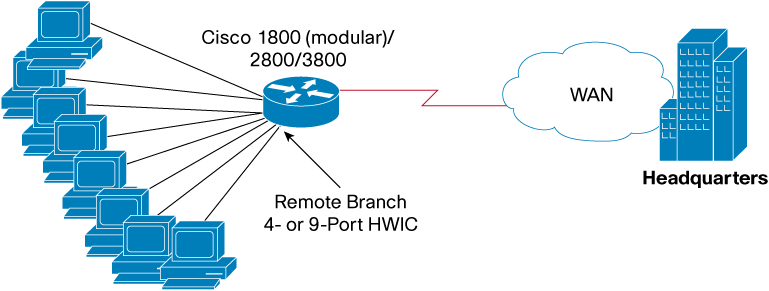
A Cisco EtherSwitch HWIC in an enterprise branch data deployment scenario provides the flexibility of integrated routing and switching functions in one unit for low port densities. This deployment provides high-speed connections between individual desktops, servers, and other network resources in a single unit for Layer 2 and allows WAN connection at Layer 3 through the router.
Figure 3 shows an example of a typical converged deployment for a small-to-large enterprise branch office with IP phones.
Figure 3. Typical Converged Deployment for a Small-to-Large Enterprise Branch Office with IP Phones
Converged IP Communications in a Small-to-Large Enterprise Branch Office with Data Devices and IP Phones

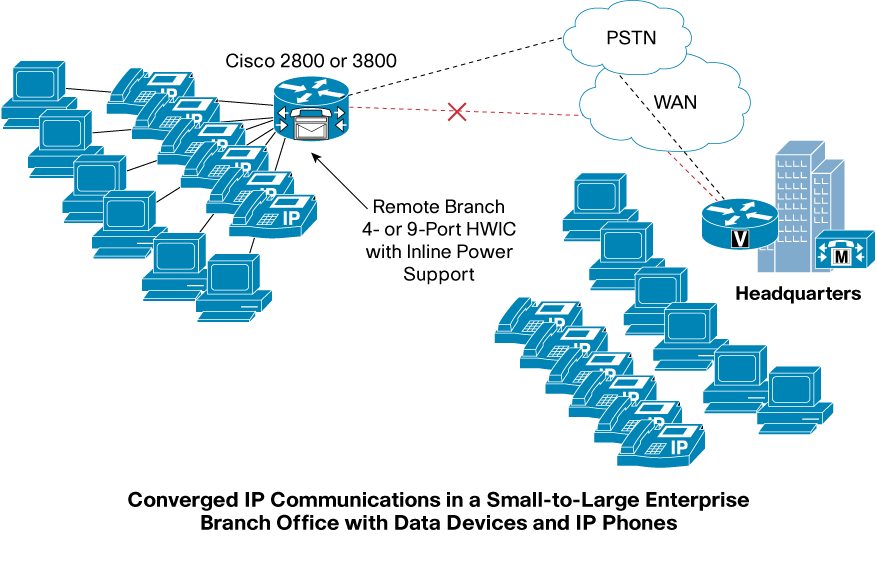
The 4- or 9-port Cisco EtherSwitch HWICs when combined with analog or digital voice modules for the Cisco Integrated Services Routers provide a small-to-large enterprise branch office infrastructure for IP telephony deployments. This solution can be combined with Cisco CallManager Express IP Telephony or the Cisco IOS Software Survivable Remote Site Telephony (SRST) solution. SRST runs on the local branch office router, allowing it to automatically detect a failure in the network, and initiates a process to intelligently autoconfigure the router to provide call-processing backup redundancy for the IP phones in that office. In the case of a Cisco CallManager Express deployment, call-processing features are offered on the branch router without a centralized call manager.
The Cisco EtherSwitch HWIC with the optional internal chassis provides IP phone power and phone discovery for IP phones. In addition, the Cisco EtherSwitch HWIC supports separate VLAN configuration for IP phones. The auxiliary VLAN feature allows network administrators to segment phones into separate logical networks, even though the data and voice infrastructures are physically the same. The phone discovery feature allows the Cisco 4- and 9-port EtherSwitch HWICs (product numbers HWIC-4ESW-POE or HWIC-D-9ESW-POE) to automatically detect the presence of an IP phone and supply inline power.
Features and Benefits
Table 4 gives the architecture, features, and benefits of the Cisco 4- and 9-port HWICs.
Table 4. Architecture, Features, and Benefits of 4- and 9-Port Cisco EtherSwitch HWICs
| Feature 4 or 9 10BASE-T/100BASE-TX Ports |
Benefit ● These ports deliver up to 200 Mbps of aggregate bandwidth (full duplex) for forwarding Layer 2 traffic on each port. |
|---|---|
| Autosensing, Autonegotiation, and Auto-MDIX (Automatic Media- Dependant Interface Crossed Over) |
● The Autosensing feature allows the switch to detect the speed of the attached device and automatically configure the port for 10- or 100-Mbps operation. ● The Autonegotiation feature allows the switch to automatically select half- or full-duplex transmission mode to optimize bandwidth on all the ports of the HWIC ● The Auto-MDIX feature allows the switch to automatically detect cable type (straight through vs. crossover) between the attached Ethernet device and switch line pairs. |
| Integrated Switching | ● Integrated switching provides fewer points of management for remote and small branch offices. |
| 802.1P QoS (Traffic Prioritization) | ● This feature provides support for QoS based on the IEEE class of service (CoS) and port-based prioritization, allowing the switch to change the CoS settings of tagged packets on a per-port basis. |
| 802.1Q Trunking | ● This feature allows the setup of separate VLANs with tagged and untagged framing; trunking is used to save ports when creating a link between two devices implementing VLANs; VLANs allow segmentation of the LAN. |
| 802.1D Spanning Tree Protocol | ● This Layer 2 link-management protocol provides path redundancy while preventing undesirable loops in the network; it simplifies network configuration and improves fault tolerance. |
| Voice VLAN (VVLAN) | ● VVLANs help enable Cisco IP phones to place voice and data in their own separate VLANs. The HWIC switch port is manually configured as a trunk port to support voice and data VLANs on the same port. The switch then uses Cisco Discovery to dynamically configure the Cisco IP phones. |
| 802.1x Authentication | ● This client-server-based access control and authentication protocol restricts unauthorized devices from connecting to a LAN through publicly accessible ports. |
| PoE (Option) | ● Cisco EtherSwitch technology with the appropriate inline power module and internal power supply can power Cisco IP phones and wireless access points. Support is provided for both IEEE 802.3af PoE and Cisco prestandard inline powered devices. The ninth port of the 9-port HWIC (part number HWIC-D- 9ESW-POE) cannot be used for PoE applications. The PoE option is not available on the Cisco 1841 router. |
| Multicast Management Support | ● This feature offers Internet Group Management Protocol (IGMP) snooping in hardware for management support. |
| Simple Network Management Protocol (SNMP) Management |
● SNMP allows management of the MIB through a MIB browser. |
| Cisco IOS Software Command-Line Interface (CLI) |
● This feature provides configuration through the Cisco IOS Software CLI and provides a common user interface for all the router functions. |
| CiscoWorks Support | ● CiscoWorks network management software helps enable manageability on a per-port and per-switch basis, providing a common management interface for Cisco routers, switches, and hubs. ● SNMPv1, v2, and v3 (noncryptographic) and Telnet interface support delivers comprehensive in-band management, and a CLI management console provides detailed out-of-band management. ● Cisco Discovery Protocol Versions 1 and 2 help enable a CiscoWorks network management station to automatically discover the switch in a network topology. |
| Feature | Benefit |
|---|---|
| ● Support is provided by the CiscoWorks LAN Management Solution. | |
| Cisco Discovery Protocol Versions 1 and 2 |
● This protocol enables a CiscoWorks network management station to automatically discover the switch in a network topology. |
| VLAN Trunking Protocols (Client, Server, and Transparent Modes) |
● The Cisco Virtual Lan Trunking Protocol (VTP) supports dynamic VLAN configuration across Cisco switches. |
| Cisco Secure Router and Device Manager (SDM)-Based Configuration and Device Management |
● This feature simplifies initial configuration of a switch through a Web browser, eliminating the need for more complex terminal emulation programs and CLI knowledge. ● Cisco SDM reduces the cost of deployment by helping less-skilled personnel set up switches quickly and simply. |
| Status LEDs | ● Two LEDs per port provide convenient visual indication of the switch port and inline power status. |
Summary and Conclusion
The 4- and 9-port Cisco EtherSwitch HWICs (part numbers HWIC-4ESW and HWIC-D-9ESW) are managed 10/100BASE-T Layer 2 switches in a HWIC form factor for the Cisco Integrated Services Routers. The 4-port HWIC comes in a single-wide form factor, and the 9-port HWIC in a double-wide form factor. The switch supports the IEEE 802.1D Spanning Tree Protocol and can be used to connect up to 4 or 9 LANs with up to 15 IEEE 802.1Q-based VLANs (802.1Q). Note: Both HWICs-the 4- and 9-port HWICs-support up to 15 VLANs. They also can be optionally configured to provide 4 or 8 ports of inline power for 802.3af- or Cisco PoE-capable devices. The PoE support is not available on the Cisco 1841 router.
Specifications
Table 5 gives product specifications of the 4- and 9-port Cisco EtherSwitch HWICs.
Table 5. Product Specifications of 4- and 9-Port Cisco EtherSwitch HWICs (HWIC-4ESW, HWIC-4ESW-POE, HWIC-D9ESW, and HWIC-D-9ESW-POE)
| Feature | Benefit |
|---|---|
| Target Applications | Data, voice, and video |
| Supported Router Platforms | ● Cisco 1800 (modular), Cisco 2800, and Cisco 3800 series integrated services routers: ● Cisco 1841 (supports HWIC-4ESW only; no PoE support) ● Cisco 2801 ● Cisco 2811 ● Cisco 2821 ● Cisco 2851 |
| ● Cisco 3825 | |
| ● Cisco 3845 | |
| ● Cisco 1941 | |
| ● Cisco 2901 | |
| ● Cisco 2911 | |
| ● Cisco 2921 | |
| ● Cisco 2951 | |
| ● Cisco 3925 ● Cisco 3945 |
|
| Form Factor | ● HWIC-4ESW = Single-wide HWIC form factor ● HWIC-D-9ESW = Double-wide HWIC form factor |
| Dimensions (W x D x H) | ● HWIC-4ESW = 3.08 x 4.74 x 0.76 in. ● HWIC-D-9ESW = 6.20 x 4.74 x 0.76 in. |
| Weight | ● HWIC-4ESW = 79 grams (0.17 lb) ● HWIC-4ESW-POE = 108 grams (0.24 lb) ● HWIC-D-9ESW = 149 grams (0.33 lb) ● HWIC-D-9ESW-POE = 196 grams (0.43 lb) |
| Standards | |
| IEEE Protocols | ● Ethernet: IEEE 802.3, 10BASE-T |
| ● Fast Ethernet: IEEE 802.3u, 100BASE-TX |
| Feature | Benefit ● IEEE 802.1d Spanning Tree Protocol ● IEEE 802.1p CoS for Traffic Prioritization ● IEEE 802.1q VLAN ● IEEE 802.1x Security ● IEEE 802.3x Full Duplex ● IEEE 802.3af Power over Ethernet Standard |
|
|---|---|---|
| RFC | RFC 2284, PPP Extensible Authentication Protoco | l (EAP) |
| MIBs | ● RFC 1213 ● IF MIB ● RFC 2037 ENTITY MIB ● CISCO-CDP-MIB ● CISCO-IMAGE-MIB ● CISCO-FLASH-MIB ● OLD-CISCO-CHASSIS-MIB ● CISCO-VTP-MIB ● CISCO-HSRP-MIB ● OLD-CISCO-TS-MIB ● CISCO-ENTITY-ASSET-MIB ● CISCO-ENTITY-FRU-CONTROL-MIB ● BRIDGE MIB (RFC 1493) |
● CISCO-VLAN-MEMBERSHIP-MIB ● CISCO-VLAN-IFINDEX-RELATIONSHIP-MIB ● RMON1-MIB ● PIM-MIB ● CISCO-STP-EXTENSIONS-MIB ● OSPF MIB (RFC 1253) ● IPMROUTE-MIB ● CISCO-MEMORY-POOL-MIB ● ETHER-LIKE-MIB (RFC 1643) ● CISCO-ENTITY-FRU-CONTROL-MIB.my ● CISCO-RTTMON-MIB ● CISCO-PROCESS-MIB ● CISCO-COPS-CLIENT-MIB |
| To obtain lists of supported MIBs by platform and Ci modules, go to the Cisco MIB Website on Cisco.com http://www.cisco.com/public/sw-center/netmgmt/cmt |
sco IOS Software release, and to download MIB at the following URL: k/mibs.shtml |
|
| Manageability | ● SNMP and Telnet interface support delivers com management console provides detailed out-of-b ● An embedded Remote Monitoring (RMON) softw statistics, alarms, and events) for enhanced traffi ● A Switched Port Analyzer (SPAN) port can mirro monitoring all nine RMON groups with an RMON ● Trivial File Transfer Protocol (TFTP) reduces the downloading from a centralized location. ● Network Timing Protocol (NTP) provides an accu the intranet. ● Two LEDs per port provide convenient visual ind ● Crash information support helps enable a switch ● Show-interface capabilities provide information a ● The Response Time Monitoring (RTTMON) MIB the HWIC switch and a remote device. |
prehensive in-band management, and a CLI and management. are agent supports four RMON groups (history, c management, monitoring, and analysis. r traffic from one or many ports to another port for probe or network analyzer. cost of administering software upgrades by rate and consistent time stamp to all switches within ication of the port link and inline power status. to generate a crash file for improved troubleshooting. bout the configuration capabilities of any interface. allows users to monitor network performance between |
| Connectors and Cabling | ● 10BASE-T ports: RJ-45 connectors, two-pair Ca ● 100BASE-TX ports: RJ-45 connectors; two-pair |
tegory 3, 4, or 5 unshielded twisted-pair (UTP) cabling Category 5 UTP cabling |
| Indicators | ● Link status LED: One LED per port for indicating ● Inline power LED: One LED per port system for i |
link status nline power status indication |
| Power Requirements | ||
| Internal Power Supply | Optional PoE system power supply available for all | Cisco 2800 and Cisco 3800 series routers |
| External Redundant Power Supply (RPS2300) |
Optional for the Cisco 2800 series and Cisco 2900 | Series routers |
| Internal Redundant Power Supply | For the Cisco 3845, 3925 and 3945 router only | |
| DC Power Support | ● DC system power input available on the Cisco 2 3825/3925, and Cisco 3845/3945 routers; PoE o |
811/2911, Cisco 2821/2921, Cisco 2851/2951, Cisco ption not available with DC system power input |
| Software Support | ● Minimum Cisco IOS Software Release 12.3(8)T IP Base image. ● Minimum Cisco IOS Software Release 15.0(1)M Cisco 3900 Series routers: IP Base License of th |
for 1841. 280 Series and 3800 Series routers: for Cisco 1900 Series, Cisco 2900 Series and e Universal image. |
| Environmental | ||
| Operating Temperature | 32 to 104°F (0 to 40°C) | |
| Operating Humidity | 10 to 85% noncondensing operating; 5 to 95% non | condensing, nonoperating |
| Nonoperating Temperature | -4 to 149°F (-20 to 65°C) |
| Feature | Benefit |
|---|---|
| Operating Altitude | (Moderate 1.5°C per 1000 feet) |
| Regulatory Compliance, Safety, EMC | ● When installed in a Cisco 1841, Cisco 2800, or Cisco 3800 router, the Cisco EtherSwitch HWIC meets the standards (regulatory compliance, safety, EMC) of the router itself. Refer to the data sheets for the Cisco 1841, Cisco 2800, and Cisco 3800 series routers for more details |
Ordering Information
To place an order, visit the Cisco Ordering Home Page.
For more information about the Cisco Integrated Services Routers, visit:
- http://www.cisco.com/go/1800
- http://www.cisco.com/go/2800
- http://www.cisco.com/go/3800
- http://www.cisco.com/go/1900
- http://www.cisco.com/go/2900
- http://www.cisco.com/go/3900
Table 6 provides ordering information for the 4- and 9-port Cisco EtherSwitch HWICs.
Table 6. Ordering Information for 4- and 9-Port Cisco EtherSwitch HWICs (part numbers HWIC- 4ESW and HWIC-D-9ESW)
| Product Number | Product Description |
|---|---|
| Ethernet HWICs | |
| HWIC-4ESW | 4-port 10/100 Ethernet switch |
| HWIC-4ESW= | 4-port 10/100 Ethernet switch, spare |
| HWIC-4ESW-POE | 4-port 10/100 Ethernet switch with 4-port inline power daughter card |
| HWIC-4ESW-POE= | 4-port 10/100 Ethernet switch with 4-port inline power daughter card, spare |
| HWIC-D-9ESW | 9-port 10/100 Ethernet switch |
| HWIC-D-9ESW= | 9-port 10/100 Ethernet switch, spare |
| HWIC-D-9ESW-POE | 9-port 10/100 Ethernet switch with 8-port inline power daughter card |
| HWIC-D-9ESW-POE= | 9-port 10/100 Ethernet switch with 8-port inline power daughter card, spare |
| Daughter Card Modules for In | line Power Support |
| ILPM-4= | 4-port inline power module for PoE applications, spare |
| ILPM-8= | 8-port Inline power module for PoE applications, spare |
| Cisco 2800 and Cisco 3800 Ro | uters with Inline Power Supply Bundles |
| CISCO2801-AC-IP | Cisco 2801 router with inline power, 2 Fast Ethernet ports, 4 slots, IP BASE, 64F/128D |
| CISCO2811-AC-IP | Cisco 2811 with AC+PoE, 2 Fast Ethernet ports, 4 HWICs, 2 packet voice DSP modules (PVDMs), 1 enhanced network module [ (NME), 2 advanced integration modules (AIMs), IP BASE, 64F/256D |
| CISCO2821-AC-IP | Cisco 2821 with AC+PoE, 2 Gigabit Ethernet ports, 4 HWICs, 3 PVDMs, 1 NME-X, 2 AIMs, IP BASE, 64F/256D |
| CISCO2851-AC-IP | Cisco 2851 with AC+PoE, 2 Gigabit Ethernet ports, 4 HWICs, 3 PVDMs, 1 NME-XD, 2 AIMs, IP BASE, 64F/256D |
| CISCO3825-AC-IP | 2 Gigabit Ethernet router with 1 Small Form-Factor Pluggable (SFP), 2 NME-XHDs, 4 HWICs, IP BASE, power supply |
| CISCO3845-AC-IP | 2 Gigabit Ethernet router with 1 SFP, 4 NME-XHDs, 4 HWICs, IP BASE, power supply |
Also, check with your Cisco representative regarding the Cisco 1800 (modular), Cisco 2800, and Cisco 3800 series bundle offerings for security, voice, DSL, and other solutions.
Cisco IOS Software Support
The Cisco EtherSwitch HWICs are supported in all Cisco IOS Software feature sets. Table 7 lists the first Cisco IOS Software release the 4- and 9-port HWICs are supported on for the respective routing platforms.
Table 7. Minimum Supported Cisco IOS Software Release
| Integrated Services Router Version | Minimum Cisco IOS Software Release |
|---|---|
| Cisco 1800 (Modular) Series | 12.3(8)T (fourth release of Cisco IOS Software Release 12.3T): IP Base Image |
| Cisco 2800 Series | 12.3(8)T (fourth release of Cisco IOS Software Release 12.3T): IP Base Image |
| Cisco 3800 Series | 12.3(11)T (fifth release of Cisco IOS Software Release 12.3T): IP Base Image |
| Cisco 1941 | 15.0(1)M: IP Base License of the Universal Image |
| Cisco 2900 Series | 15.0(1)M: IP Base License of the Universal Image |
| Cisco 3900 Series | 15.0(1)M: IP Base License of the Universal Image |
For More Information
For more information about the Cisco 1800 Series Integrated Services Router, visit http://www.cisco.com/go/1800.
| Model | HWIC-4ESW-RF |