
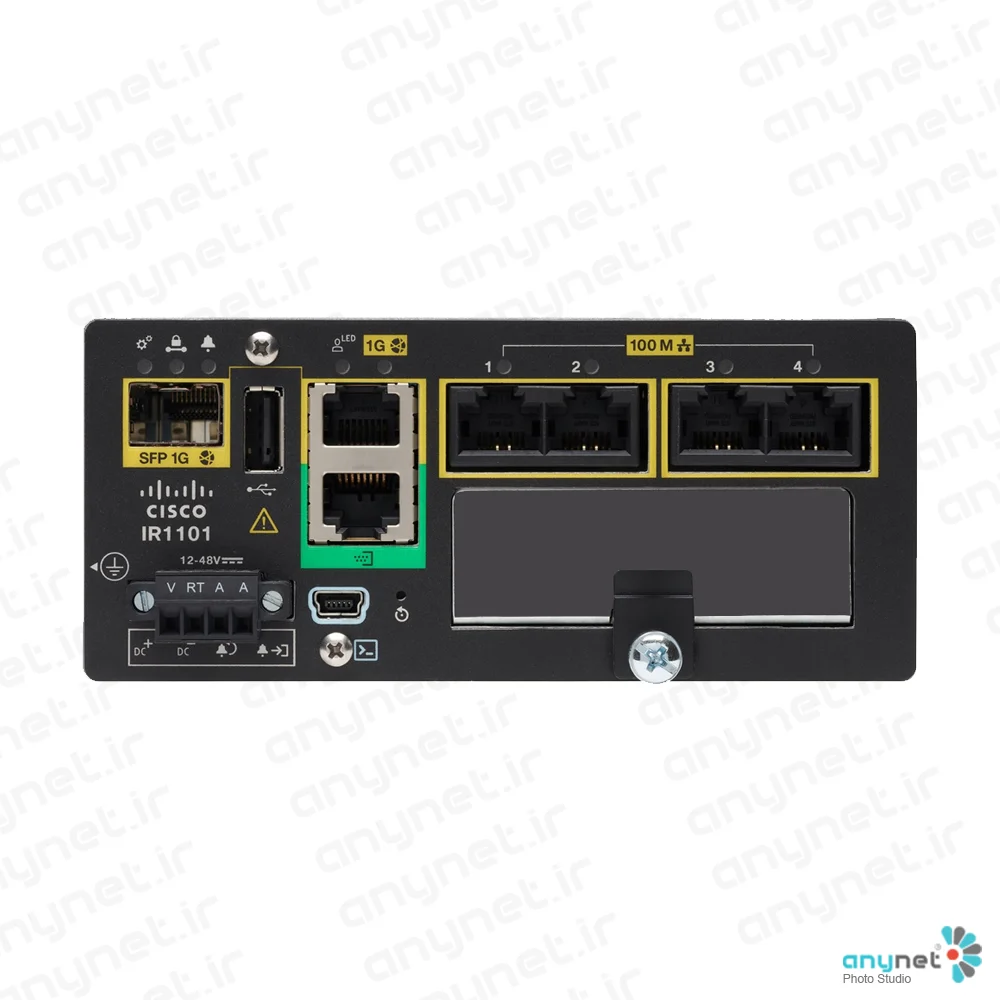

Cisco IR1101-K9 Industrial Router
- Global Price List Information (GPL)
-
Category: Cisco 800 SeriesSubcategory: Cisco 800 Series Chassis
-
Model: IR1101-K9
-
Description: Cisco IR1101 Industrial Integrated Services Router Rugged
-
Price: 1,105.50 USDLast Update: 2021-08-09
- End-of-Sale and End-of-Life Information (EOL/EOS)
- Release Date:
- End-of-Sale Date:
- End-of-Support Date:
The Cisco 1101 Industrial Integrated Services Router (ISR) represents a significant advancement in edge computing and secure connectivity for industrial environments. As organizations increasingly rely on the Internet of Things (IoT) to drive operational efficiency, the need for robust, reliable, and secure networking hardware has never been more critical. This router is specifically engineered to withstand the harsh conditions often found in manufacturing plants, utility substations, and remote field sites, where traditional enterprise-grade equipment would likely fail. By integrating advanced routing, switching, and security capabilities into a compact, fanless form factor, Cisco provides a versatile solution that bridges the gap between operational technology and information technology.
The primary objective of the Cisco 1101 ISR is to simplify the deployment of complex industrial networks while maintaining the highest standards of security and performance. It is designed to support a wide range of connectivity options, ensuring that businesses can maintain constant communication with their critical assets regardless of the physical environment. This device is not merely a router; it is a comprehensive platform that enables edge intelligence, allowing data to be processed closer to the source. This reduces latency, minimizes bandwidth consumption, and provides real-time insights that are essential for modern industrial automation and predictive maintenance strategies.
Furthermore, the Cisco 1101 ISR is built with the future in mind, offering modularity and scalability that allow it to adapt to evolving network requirements. Whether an organization is looking to implement a private 5G network, enhance its cybersecurity posture, or deploy containerized applications at the edge, this router provides the necessary foundation. By focusing on ease of management and seamless integration with existing Cisco ecosystems, the 1101 ISR empowers IT and OT teams to collaborate more effectively, reducing operational overhead and ensuring that industrial networks remain resilient against both physical and cyber threats.
Product overview
The Cisco 1101 Industrial Integrated Services Router is a cornerstone of the Cisco Industrial IoT portfolio, designed to address the unique challenges of industrial networking. It is a ruggedized, modular platform that supports a variety of WAN and LAN connectivity options, including Gigabit Ethernet, Wi-Fi, and cellular technologies. The device is housed in a compact, fanless chassis that is IP30 rated, making it suitable for deployment in environments with extreme temperatures, high vibration, and electromagnetic interference. This physical durability ensures long-term reliability in mission-critical applications where downtime is not an option.
At the heart of the 1101 ISR is the Cisco IOS XE operating system, which provides a consistent, programmable, and secure foundation across the entire Cisco networking portfolio. This allows administrators to leverage familiar management tools and automation scripts, significantly reducing the learning curve and deployment time. The router supports advanced security features, including Cisco Trust Anchor technologies, which ensure that the hardware and software remain authentic and untampered. Additionally, the device is equipped with high-performance processing capabilities, enabling it to run edge applications via Cisco IOx, which supports Docker containers for localized data processing and analytics.
The product lineup includes several variations of the 1101 ISR, each tailored to specific connectivity needs. These include models with integrated LTE Advanced Pro capabilities, which provide high-speed wireless backhaul for remote sites where wired infrastructure is unavailable or impractical. The router also features multiple Gigabit Ethernet ports, allowing for flexible local connectivity to industrial sensors, PLCs, and other IoT devices. By combining these hardware features with comprehensive software support, Cisco has created a versatile platform that can be deployed as a standalone gateway or as part of a larger, software-defined wide area network (SD-WAN) architecture, providing end-to-end visibility and control.
Features and benefits
- Ruggedized design with IP30 protection ensures reliable operation in harsh industrial environments, including extreme temperatures and high-vibration settings.
- Cisco IOS XE software provides a unified, programmable operating system that simplifies network management and enables advanced automation across the enterprise.
- Integrated LTE Advanced Pro connectivity offers high-speed, reliable wireless WAN options, perfect for remote locations or as a secondary failover link.
- Cisco IOx support allows for the deployment of containerized applications directly on the router, enabling edge computing and real-time data analytics.
- Advanced security features, including Cisco Trust Anchor, secure boot, and hardware-based encryption, protect the network from unauthorized access and cyber threats.
- Fanless cooling architecture reduces maintenance requirements and increases the overall lifespan of the device by preventing the intake of dust and debris.
- Support for Cisco SD-WAN allows for centralized management, improved application performance, and simplified policy enforcement across distributed industrial sites.
- Modular design provides flexibility to add or upgrade interfaces as network requirements evolve, protecting the initial investment for long-term use.
- Comprehensive quality of service (QoS) capabilities ensure that mission-critical industrial traffic is prioritized over less important data, maintaining operational stability.
- Low power consumption and compact form factor make it an ideal choice for space-constrained installations, such as utility cabinets or small control rooms.
- Extensive support for industrial protocols ensures seamless integration with existing operational technology (OT) equipment and legacy industrial systems.
- Zero-touch provisioning capabilities allow for rapid deployment and configuration of new routers, significantly reducing the time and cost associated with large-scale rollouts.
Easily scale connectivity to remote industrial assets with this highly modular 5G router— which also gives you advanced security capabilities. The Cisco Catalyst IR1101 Rugged Series Router or IR1101, is Cisco’s most compact, FirstNet Capable industrial router. Designed in a highly modular form factor makes it an ideal solution for remote asset management across multiple industrial vertical markets.
The IR1101 has an integrated 9.6 to 60V DC power input and is designed to withstand hostile environments, including shock, vibration, dust, humidity and Electrostatic Discharge (ESD). The IR1101 also supports a wide temperature range: –40 to 60°C standard operation, –40 to 75°C in a forced air enclosure with 200 LFM of air, and type-tested at 85°C for 16 hours. This durability makes it ideal for harsh industrial and distributed IoT deployments such as transportation, oil and gas, distribution substations, industrial automation, and financial institutions.
Product highlights
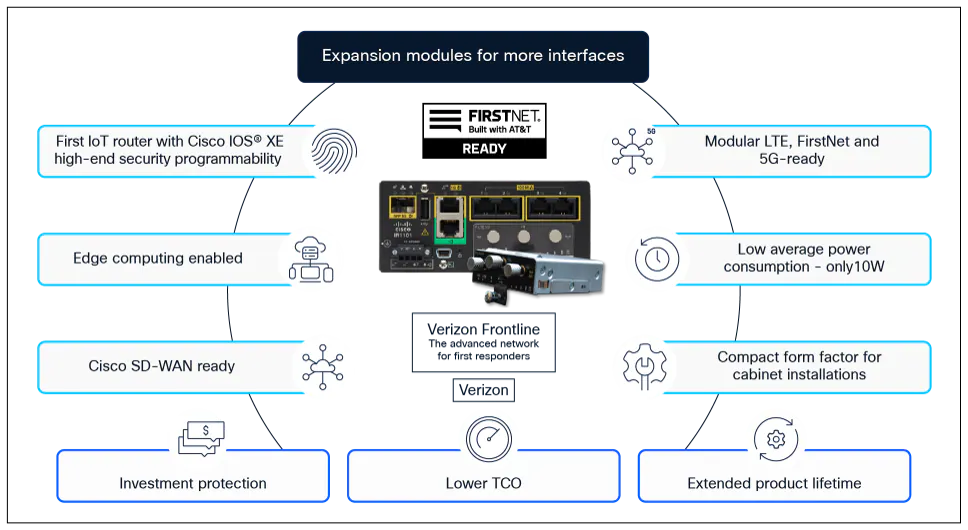
Product highlights
Figures 2, 3, and 4 offer visual views of product components and expansion modules.
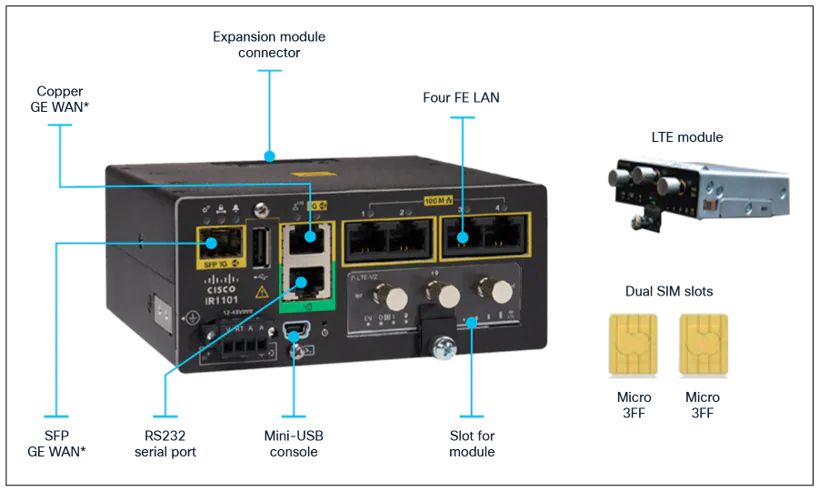
Cisco IR1101 base platform front view
The IR1101 offers even more flexibility to add or upgrade WAN and storage components through an expansion module.
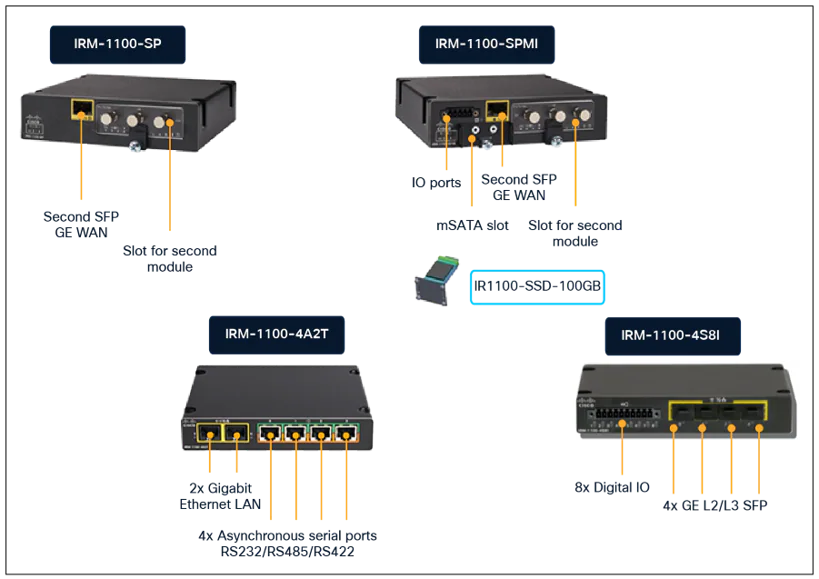
Expansion Modules
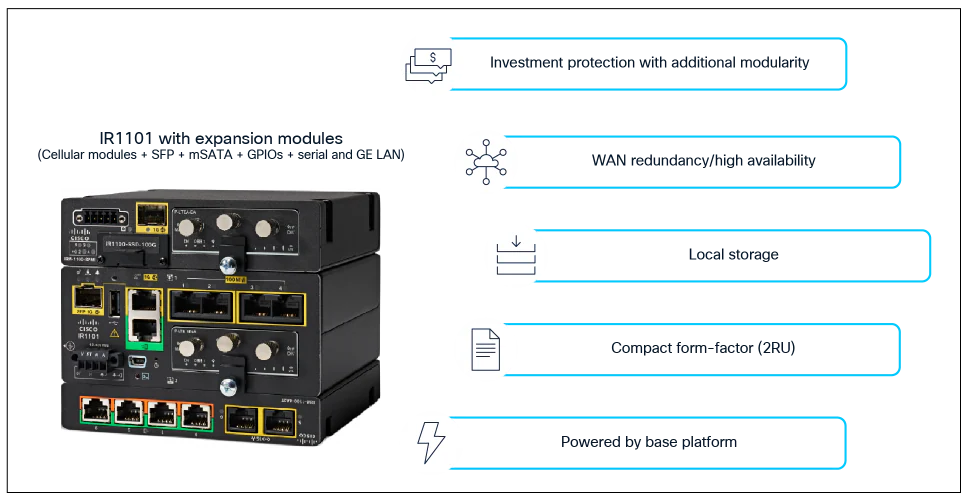
IR1101 with expansion module offering more flexibility
Product overview
The Cisco Catalyst IR1101 Rugged Series Router offers a broad range of features for the Internet of Things (IoT).
Table 1. Key features and benefits
|
Feature |
Benefit |
|
|
Modularity and investment protection. A single form factor with multiple WAN (LTE, LTEAdvanced, SFP Ethernet) and storage options enable flexibility to add or upgrade modules as technologies evolve. |
|
|
Dual active LTE-capable With two LTE modules (LTE and LTE-Advanced with carrier aggregation), the IR1101 enables concurrent connectivity to two cellular networks for WAN redundancy, enhanced data throughputs, load balancing, and differentiated services, making it a highly reliable and high-performance platform. |
|
|
Cisco IOS XE Software. IOS XE is a highly secure, standards-based and flexible operating system for a new era of IoT deployment. It’s an enterprise-class OS with advanced routing and security. |
|
|
Software Defined WAN (SDWAN) capable. For high WAN availability and simplicity for large-scale distributed networks. |
|
|
Industrial security. With Cisco Trust Anchor Technologyensuring authenticity of hardware and software, hardware-accelerated Next Generation Encryptionand Quantum Computer Resistant algorithms, firewall and VPN services, and alerts and notifications enabling physical and cyber security, the IR1101 offers a multi-layer security for mission-critical deployments. |
|
|
Edge computing. Speed up awareness and response to events and conserve network bandwidth by analyzing the most time-sensitive data at the network edge, close to where it is generated. A highly secure, extensible environment for hosting applications ensures authenticity of applications. An optional mSATA SSD field-replaceable unit on the expansion module enables storage of application data for recording and analysis. |
|
|
Supervisory Control and Data Acquisition (SCADA). Supports migration of data from legacy control systems in an industrial environment to an IP-based network using DNP3 serial–to–DNP3/IP and IEC 60870 T101–to–T104 protocol translations. |
|
|
Smart grid-compliant. Designed for installation in harsh secondary substation environments. Complies with IEEE 1613 and IEC 61850-3 for distribution automation. |
|
|
GPS. Location-based services for tracking assets and protecting from theft and intrusion. |
|
|
Ease of management. On-premises and cloud-based network management solutions cater to businesses across multiple industry verticals. Tools such as Cisco Catalyst SD-WAN, Cisco Catalyst Center, Cisco IoT Field Network Director (FND), simplify deployment and offer the breadth of cross-network management and the depth of multi-layer visibility. |
|
|
Multiple Packet Data Network (PDN). Gain connectivity to different Access Point Names (APNs) for traffic segregation over a cellular link. For example, public Internet traffic can be kept separate from mission-critical traffic emerging from the sensors and devices connected to the router. |
|
|
4G LTE/5G multiple-bearer QoS. Differentiated treatment of traffic with multiple simultaneous bearers as per 3GPP standards for an enhanced user experience. Multi-bearer QoS depends on the cellular carrier’s ability to support the service in their network. |
|
|
Network Segmentation. Multi-VRF, VLAN, and VPN enable businesses to configure and maintain more than one instance of a routing and forwarding table within the same customer edge device, enabling dynamic changes in the network with a minimal maintenance window. Service providers can enable this feature to support two or more VPNs with IP addresses that overlap across the VPNs. |













Business benefits and application examples
Industrial customers are looking for real-time monitoring and control of industrial assets to help increase operation efficiency.
Utilities
Utilities are seeking the capability to monitor tens of thousands of miles of electric distribution lines or water infrastructure often located in harsh environments over cellular networks to provide remote assets monitoring and reliable and secure SCADA traffic backhauling. In many cases, these are power constrained and space-constrained environments. Devices that enable this connectivity need to be highly reliable and able to be remotely monitored and configured. They also need to support traditional serial interfaces to interconnect with existing monitoring devices and fiber overlay for long-distance, intranetwork connectivity. Needless to say, the device is expected to have a long lifetime to support such a massive scale of deployment.
Oil and gas
Oil and gas companies need to monitor pipeline infrastructure across wide geographic areas and remote locations using 4G LTE and 5G cellular networks to collect data from remote terminal units and securely transport SCADA traffic to a Network Operations Center (NOC).
Transportation
Highways and transportation agencies require reliable, always-on communication between speed cameras, monitoring cameras, ticket terminals, and so on. Wireless devices to support such continuous communication need to support 4G LTE and 5G networks to help ensure good, wide coverage; continuous operation in very harsh environments; compact form factor for deployment in roadside cabinets and ticketing machines; local decision-making for a rapid response time; and serial interfaces to existing traditional devices.
Additional features and benefits
Table 2. Additional features and benefits of the Cisco IR1101
|
Features |
Benefits |
|
IoT enablement |
|
|
Lightweight, compact, modular, and ruggedized form factor |
Designed for tight installation inside cabinets. All the Input/Output (I/O) ports and connectors are located on the front panel for easy wiring inside cabinets. |
|
No additional power supply for the expansion module |
Easily add an expansion module without requiring an additional power input. |
|
Raw socket transport and SCADA |
The raw socket can be used to transport SCADA data from RTUs. This method is an alternative to the Block Serial Tunnel (BSTUN) protocol. The Cisco IR1101 also supports DNP3 serial–to–DNP3/IP and IEC 60870 T101–to–IEC 60870 T104 protocol translations, serving as a SCADA gateway. |
|
Multiple mounting options |
Surface and DIN rail mounting in horizontal or vertical orientations. |
|
Increased performance to run concurrent services |
The multi-core processor architecture allows businesses to take advantage of network-supported speeds. |
|
Multiple WAN and LAN connections |
|
|
Four fast Ethernet interfaces |
● Allows multiple Ethernet devices (sensors, Remote Terminal Unit [RTU], PLCs) in an industrial environment to connect for visibility and management of assets
● IEEE 802.1Q VLANs
● Layer 3 support through VLAN interfaces
● 4KV isolation for Electrostatic Discharge (ESD) protection
|
|
WAN diversity |
● Multiple WAN links for high reliability: Gigabit Ethernet layer 3 SFP (copper and fiber) and 4G LTE/5G provides WAN diversity and business continuity
● Gigabit Ethernet WAN interface can be configured for layer 3 routing or layer 2 switching
|
|
Dual active LTE interfaces |
Concurrent connectivity to two cellular networks for high reliability, load balancing, and differentiated services. |
|
Serial interface |
A RS-232 asynchronous serial interface (RJ45 DTE) can be used with raw socket, protocol translation, and connections to locate Remote Terminal Unit (RTU), sensors, and PLCs for SCADA transport and management. |
|
Transparent roaming between wireless networks |
|
|
Dual Subscriber-Identity-Module (SIM) over cellular |
Provides active and backup connectivity for high reliability over LTE and HSPA networks. |
|
Cisco IOS mobile IP |
● Transparent roaming for mobile networks, enabling mission-critical applications to stay connected, even when moving between networks
● The assigned IP addresses to the home network are maintained in private and public networks
● Supports Proxy Mobile IP (PMIPv6) and Network Mobility (NEMO)
|
|
Cellular fallback |
Multiple technologies (5G, 4G LTE, 3G, and 2G) are available to support connectivity to the best one available. 2G fallback is not supported in North America. |
|
Software |
|
|
Cisco IOS XE |
Designed to enable businesses to deploy services more quickly with lower TCO and complexity. ● Openness and programmability: Standards-based programmable interfaces enable process and workflow automation. NETCONF, RESTCONF, IETF YANG, Python scripting, and custom libraries enable automation of event-based workflows
● Modular: Enables patching of software bug fixes and graceful insertion and removal of software modules for ease of maintenance
● Common software stack: Reduces business and network complexity while managing an array of Cisco devices
|
Table 3. Network management solutions
|
Operational phase |
Application |
Description |
|
Device staging and configuration for a few routers |
Cisco WebUI |
● A GUI-based device-management tool that simplifies provisioning of devices for a small-scale deployment through easy-to-use wizards.
|
|
Deploy, manage, monitor, and maintain IoT routers and assets at scale |
Cisco IoT Field Network Director (FND) for hosting on premises |
● Rapid scaling - zero-touch deployment and secure enrollment for tens of thousands of gateways
● Enhanced security – role-based access and user audit trail and secure communications for data transport across networks, VPN tunnels, geo-fencing, alerts, and notifications for data and physical security
● Increased reliability – reliable communications over cellular or Ethernet networks, lifecycle management, and 24/7 real-time monitoring and alerts
|
|
Extend your enterprise network to configure, monitor, and manage industrial assets |
Cisco Catalyst Center or Cisco Catalyst SD- WAN Manager |
● Cisco Catalyst Center offers a network infrastructure that is not only fully programmable and open to third–party innovation, but can also fully and seamlessly integrate the cloud as an infrastructure component
● Simplifies and automates processes and workflow by bringing the notion of user-aware and application–aware policies into the foreground of network operations
● With Cisco Catalyst Center, the network can provide continuous feedback to simplify and optimize network operations
● Single management dashboard for configuration and management of WAN, that includes advanced security capabilities.
● Cisco SD-WAN automates application flexibility over multiple connections, such as the Internet, MPLS, and wireless 4G LTE/5G
|
Table 4. Embedded management capabilities
|
Feature |
Description |
|
Cisco IOS Embedded Event Manager (EEM) |
A distributed and customized approach to event detection and recovery. Provides the ability to monitor events and take corrective or any other desired action when the monitored events, such as a high or low threshold, occur. |
|
Cisco IOS XE IP Service- Level Agreements (IP SLA) |
Helps assure the performance of new, business-critical IP applications as well as IP services by actively monitoring and reliably reporting traffic statistics such as jitter, response time, packet loss, and connectivity. |
|
Simple Network Management Protocol (SNMP), Syslog, NetFlow |
Open-standards-based network monitoring and accounting tools, such as SNMP for 3G, 4G and, provide a common management platform for many different devices. |
|
LTE network management and diagnostics |
A dedicated diagnostic port on a cellular module enables logging of data during debugging sessions that can be analyzed by industry-standard tools such as Qualcomm CDMA Air Interface Tester (CAIT) and Spirent Universal Diagnostic Monitor (UDM). |
Product specifications
Table 5. Cisco IOS XE Software Features on the IR1101
|
Feature |
Description |
|
Cisco IOS Software requirements |
● Cisco IOS XE Software: Universal Cisco IOS Software image
● Cisco IOS XE Software Release 16.10.1 or later
|
|
IPv4 and IPv6 services features |
● Routing Information Protocol Versions 1 and 2 (RIPv1 and RIPv2)
● Generic Routing Encapsulation (GRE) and Multipoint GRE (MGRE)
● Standard 802.1d Spanning Tree Protocol (STP)
● Network Address Translation (NAT)
● Dynamic Host Configuration Protocol (DHCP) server, relay, and client
● Dynamic DNS (DDNS)
● DNS proxy
● DNS spoofing
● Access Control Lists (ACLs)
● IPv4 and IPv6 multicast
● IP Service-Level Agreement (IP SLA)
● Open Shortest Path First (OSPFv2 and OSPFv3)
● Border Gateway Protocol (BGP)
● Enhanced Interior Gateway Routing Protocol (EIGRP)
● Virtual Route Forwarding (VRF) Lite
● Next-Hop Resolution Protocol (NHRP)
● Serial data encapsulation and relay
● L2TPv3 over sub-interfaces and VLAN
|
|
Security features |
Secure connectivity ● Secure Sockets Layer (SSL) VPN for secure remote access
● Hardware-accelerated encryption with minimal impact to system performance
● Next Generation Encryption (NGE) and Quantum Computing Resistant (QCR) algorithms such as AES-256, SHA-384, and SHA-512
● Public-Key-Infrastructure (PKI) support
● IPsec tunnels
● NAT transparency
● Dynamic Multipoint VPN (DMVPN)
● Tunnel-less Group Encrypted Transport VPN
● Flex VPN
● IPsec stateful failover
● VRF-aware IPsec
● IPsec over IPv6
Cisco IOS-XE Application Aware Firewall ● Zone-based policy firewall
● VRF-aware stateful inspection routing firewall
● Stateful inspection transparent firewall
● Advanced application inspection and control
● Secure HTTP (HTTPS), FTP, and Telnet Authentication Proxy
● Dynamic and static port security
● Firewall stateful failover
● VRF-aware firewall
● Integrated Threat Control
● Control-Plane Policing (CoPP)
● Flexible packet matching
● Network foundation protection
|
|
QoS features |
● Provides LTE QoS with support for up to 8 concurrent bearers on each cellular WAN interface for traffic classification and prioritization
● Provides traffic precedence to delay-sensitive and mission-critical services
● Facilitates low-latency routing of delay-sensitive industrial applications
● Supported on all LAN and WAN interfaces, including cellular
● Low Latency Queuing (LLQ)
● Weighted Fair Queuing (WFQ)
● Class-Based WFQ (CBWFQ)
● Class-Based Traffic Shaping (CBTS)
● Class-Based Traffic Policing (CBTP)
● Policy-Based Routing (PBR)
● Class-Based QoS MIB
● Class of Service (CoS) to Differentiated Services Code Point (DSCP) mapping
● Class-Based Weighted Random Early Detection (CBWRED)
● Resource Reservation Protocol (RSVP)
● Real-Time Transport Protocol (RTP) header compression (cRTP)
● Differentiated Services (DiffServ)
● QoS pre-classify and pre-fragmentation
● Hierarchical QoS (HQoS)
|
|
High-availability features |
● Dual active LTE backhaul with expansion module
● Virtual Router Redundancy Protocol (VRRP) (RFC 2338)
● Hot Standby Router Protocol (HSRP)
● Dual SIM support on the LTE module for cellular failover
|
|
IPv6 features |
● IPv6 addressing architecture
● IPv6 unicast and multicast forwarding
● IPv6 ACLs
● IPv6 over cellular
● IPv6 routing
● IPv6 domain name resolution
|
Software licensing
The IR1101 offers two software tiers - network Essential and Network Advantage. The Network Essential license offers the essential elements of routing and security necessary for typical IoT deployments. The Network Advantage license enables advanced features, including Multiprotocol Label Switching (MPLS) for a highly scalable and cost-effective solution; mobile IP for seamless migration between networks; and application-aware QoS policies for built-in intelligence. The Network Advantage license also entitles users to Cisco Edge Intelligence, starting in EI Release 2.0.
A single Cisco IOS XE universal image encompassing all functions gets delivered with the product. Software feature licenses are pre-installed in the factory depending on the selection made at the time of purchase, thereby simplifying software delivery and decreasing operational costs of the deployment.
Licenses can be upgraded after deployment by going through the Cisco Smart License activation process.
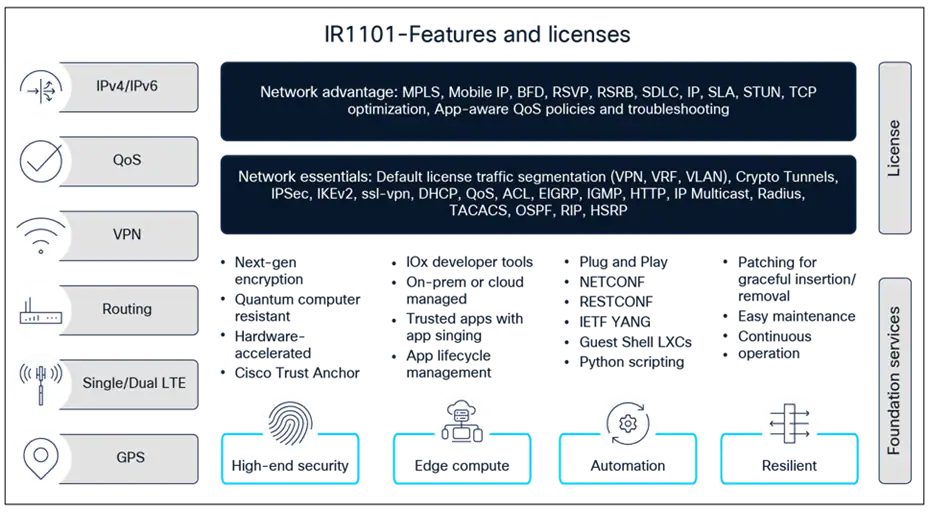
Cisco IOS XE software features and benefits
Table 6. System specifications for Cisco Catalyst IR1101 Rugged Series Router
|
Feature |
Specification |
|
Memory |
|
|
Default and maximum DRAM |
4 GB |
|
Default and maximum Flash memory |
4 GB (usable) |
|
Ingress protection rating |
IP30 |
|
Physical characteristics |
|
|
Physical dimensions (H x W x D) Chassis Expansion Module (IRM-1100-SP or IRM-1100-SPMI) Expansion Module (IRM-1100-4A2T or IRM-1100-4S-8I) |
2.36 in. x 5.22 in. x 4.92 in. (60 x 132.5 x 124.9 mm) 1.3 in. x 5.2 in. x 4.9 in. (33 x 132 x 124 mm) 0.9 in. x 5.2 in. x 4.9 in. (23 x 132 x 124 mm) |
|
Weight Chassis Expansion Module IRM-1100-SPMI: IRM-1100-SP: IRM-1100-4A2T or IRM-1100-4S8I: |
2.25 lbs (1.02 kg) 1.65 lbs (0.75 kg) 1.45 lbs (0.66 kg) 0.94 lbs (0.43 kg) |
|
Mounting options |
Panel, wall, and din rail (vertical and horizontal) mount |
|
Power specifications |
Nominal voltage: +/-12V to +/-48V DC Minimum and maximum input voltage: 9.6-60V DC Maximum and minimum input current: 1.24A (9.6V DC) and 0.26A (60V DC) |
|
Power consumption |
At idle: 6.6W Typical: 9.8W Maximum: 12W Additional 10W (typical) with -SP or -SPMI expansion module and 2nd cellular Additional 6.4W with IRM-1100-4S8I expansion module |
|
Interfaces on the base platform |
|
|
Console |
Mini type-B USB |
|
WAN interfaces |
Combo 10/100/1000 Gigabit Ethernet port (RJ45 and SFP) on the base platform An additional 10/100/1000 Gigabit Ethernet SFP on the expansion module. Refer to Table 8 for supported SFPs 5G/LTE: Modular with options for single and dual active LTE and LTE-Advanced |
|
LAN interfaces |
● Four 10/100BASE-T Fast Ethernet ports
|
|
Input and output |
● ALARM input port
|
|
Interfaces on Serial and Ethernet Expansion Module |
|
|
Serial Interfaces |
● 4 x Isolated asynchronous serial ports (RS232/RS485/RS422)(DCE)
|
|
Ethernet Interfaces |
● 2 x GE RJ45 LAN ports on serial expansion module
|
|
LEDs |
● System OK
● Link for Ethernet WAN ports
● VPN
● Tricolor user-configurable LED
● ALARM
|
|
Serial interface |
Isolated RS-232 RJ45 DTE port Support for asynchronous mode with speeds up to 115,200 baud |
|
Serial protocols |
SCADA, DNP3, T101-104, Raw Socket TCP, and UDP |
|
Interfaces on SFP and GPIO Expansion Module |
|
|
SFP Interfaces |
● 4 x GE L2/L3 SFP ports
|
|
GPIO Interfaces |
● 8 x dry/wet contact GPIO ports
|
|
Environmental characteristics |
|
|
Environmental operating temperature range |
● –40 to 140°F (–40 to 60°C) in a sealed NEMA cabinet with no airflow
● –40 to 158°F (–40 to 70°C) in a vented cabinet with 40 Linear Feet per Minute (LFM) of air
● –40 to 167°F (–40 to 75°C) in a forced air enclosure with 200 LFM of air
● Type tested at 85°C for 16 hours
|
|
Operating altitude |
● 40°C up to 13,800 ft (operating) per IEC 68-2-41
|
|
Non-operating temperature |
● -40 to 185°F (-40 to 85°C)
|
|
Non-operating shock and vibration |
● 50-60G (3.76 m/s minimum)
● 3-500Hz at 1.12 GRMS (BP at 10 and 100 Hz)
|
|
Standard safety certifications |
● UL 60950-1, 2 nd edition
● CAN/CSA C22.2 No. 60950-1, 2 nd edition
● EN 60950-1, 2 nd edition
● CB to IEC 60950-1, 2 nd edition with all group differences and national deviations
|
|
Hazardous locations standards |
● ANSI/ISA 12.12.01 (Class 1, Div 2 A-D)
● CSA 213 (Class 1, Div 2 A-D)
● IEC 60079-0 and -15 IECEx test report (Class I, Zone 2, gas groups IIC)
● EN 60079-0 and -15 ATEX certification (Class I, Zone 2, gas groups IIC)
|
|
Industry standards |
Public Safety:
● FirstNet Capable
● Verizon Frontline
Smart Grid:
● IEC 61850-3
● IEEE 1613
Railway:
● EN 50121-4 Security:
● FIPS 140-2
● Common Criteria
Department of Defense
● DoDIN APL
IPv6
● USGv6
|
|
EMC emissions CLASS A |
● 47 CFR Part 15 B
● EN 55032:2015
● CISPR 32 Edition 2
● CNS13438: 2006
● EN 300 386 V1.6.1
● ICES-003 Issue 6: 2016
● KN 32: 2015
● TCVN 7189: 2009
● V-2/2015.04
● V-3/2015.04
● AS/NZ CISPR32
|
|
EMC immunity |
● EN 61000-4-2, 3, 4, 5, 6, 8, 9, 16, 17, 18, and 29
● CISPR24: 2010 + A1: 2015
● EN 300 386 V1.6.1
● EN 55024: 2010 + A1: 2015
● EN 55035:2017
● KN35: 2015
● TCVN 7317:2003
● QCVN 18:2014
|
Cellular Modules
Table 7. LTE (3GPP Category 4) Modules Available with IR1101
|
Features |
P-LTE-GB |
|
Countries/Regions |
Europe |
|
LTE Bands |
LTE Bands B1, B3, B7, B8, B20, B28 FDD LTE 700 MHz (B28), 800 MHz (B20), 900 MHz (B8), 1800 MHz (B3), 2100 MHz (B1), and 2600 MHz (B7) |
|
Backward Compatibility |
UMTS, HSPA+ (B1, B8), EDGE, GSM, GPRS (900/1800) |
|
Theoretical Download and Upload Speeds1 |
150 Mbps/50 Mbps |
|
Carrier(s) Certified |
Europe - Generic Carrier Firmware (GCF) |
|
FirstNet Capable (B14) |
- |
Table 8. LTE Advanced (3GPP Category 7) Modules Available with IR1101
|
Features |
P-LTEA7-NA |
P-LTEA7-EAL |
P-LTEA7-JP |
|
Countries /Regions |
United States, Canada, North America |
Europe, LATAM, Australia, New Zealand, India, Singapore, Malaysia, United Arab Emirates |
Japan |
|
LTE Bands |
B2, B4, B5, B7, B12, B13, B14, B25, B26, B41, B42, B43, B48, B66, B71 |
B1, B3, B7, B8, B20, B28, B32, B38, B40, B41, B42, B43 |
B1, B3, B5, B8, B18, B19, B39, B41, B42, B43 |
|
3G HSPA+ Bands |
B2, B4, B5 |
B1, B5, B8 |
B1, B5, B6, B19 |
|
Theoretical Download and Upload Speeds1 |
300 Mbps/150Mbps |
300 Mbps/150Mbps |
300 Mbps/150Mbps |
|
Carrier(s) Certified |
US - Verizon, AT&T, T-Mobile, PTCRB6 Canada – Rogers, Bell, Telus |
LATAM, Europe, APJC - Generic Carrier Firmware (GCF) |
- |
|
Carrier(s) Coming Soon |
Australia - Telstra |
NTT Docomo, KDDI, Softbank |
|
|
FirstNet Capable (B14) |
Approved by AT&T FirstNet |
- |
- |
Table 9. 5G NR RedCap (3GPP Release 17) Modules Available with IR1101
|
Features |
P-5GS6-RC-GL |
|
Countries/Regions |
United States, Canada, LATAM, Europe, Australia, New Zealand, Japan, Hong Kong, Indonesia, Singapore, India, China |
|
RF Bands |
5G NR Sub-6 n1, n2, n3, n5, n7, n8, n12, n13, n14, n18, n20, n25, n26, n28, n30, n38, n40, n41, n48, n66, n70, n71, n77, n78, n79 LTE Bands B1, B2, B3, B4, B5, B7, B8, B12, B13, B14, B17, B18, B19, B20, B25, B26, B28, B30, B34, B38, B39, B40, B41, B42, B43, B48, B66, B70, B71, B106 |
|
Theoretical Download and Upload Speeds1 |
5G DL/UL: ~220 Mbps / ~120 Mbps LTE: DL/UL: ~195 Mbps / ~75 Mbps |
|
Carrier(s) Certified |
US - AT&T, T-mobile, PTCRB, Verizon LATAM, Europe, APJC - Generic Carrier Firmware (GCF) |
|
Carrier(s) Coming Soon |
Canada - Bell, Telus, Rogers Australia - Telstra Japan - NTT Docomo, KDDI |
|
FirstNet Capable (B14) |
Coming soon with AT&T FirstNet |
|
Frontline Capable (B13) |
Coming soon with Verizon Frontline |
|
eSIM SGP.32 Capable |
Supports GSMA SGP.32 remote SIM profile swaps OTA via 3FF removable eSIMs (eUICC) |
|
GPS/GNSS Capable |
ANT-3-5G2G1-P-O (3-1 antenna) ANT-GNSS-P-OUT-SMA (single port) Designed for passive GPS/GNSS antenna as part of low-power architecture. Active antennas requiring bias voltage are not supported. |
Table 10. Standalone/Non-Standalone 5G Sub 6 GHZ Module Available with IR1101
|
Features |
P-5GS6-R16SA-GL5 |
|
Countries/Regions |
United States, Canada, LATAM, Europe, Australia, New Zealand, Japan, Hong Kong, Indonesia, Singapore, India, China |
|
RF Bands |
5G FR1 n1, n2, n3, n5, n7, n8, n12, n13, n14, n18, n20, n25, n26, n28, n29-n30, n38, n40, n41, n48, n66, n70, n71, n75, n76, n77, n78, n79 LTE Bands B1, B2, B3, B4, B5, B7, B8, B12, B13, B14, B17, B18, B19, B20, B25, B26, B28, B29, B30, B32, B34, B38, B39, B40, B41, B42, B43, B46 (LAA), B48 (CBRS), B66, B71 |
|
Theoretical Download and Upload Speeds1 |
4.9 Gbps/660 Mbps |
|
Carrier(s) Certified |
US - AT&T, Verizon, T-mobile, PTCRB6 LATAM, Europe, APJC - Generic Carrier Firmware (GCF) |
|
Carrier(s) Coming Soon |
Canada - Bell, Telus, Rogers Australia - Telstra Japan - NTT Docomo, KDDI |
|
FirstNet Capable (B14) |
Approved by AT&T FirstNet |
450MHz LTE Module
Extending connectivity to remote sites can be challenging, especially when connectivity requirements differ depending on location and use case. As organizations are automating and establishing remote operations, Cisco is expanding the capabilities of the Catalyst IR1100 Rugged Series Router (1101-A-K9 only) to meet the connectivity requirements of businesses wherever they operate. Network Advantage license is required.
Cellular communications in the 400-450MHz band, also called 450MHz LTE, have a longer wavelength, lower frequency and lower energy requirements compared to the traditional LTE and 5G. Due to the physical properties of the frequencies, it has benefits of covering a larger geographical area. It has been employed across several parts of Europe for connecting utility grids, maritime and other mission critical networks.
Cisco has partnered with Intelliport, a Hungary based technology provider in developing a module for the IR1101 to meet the market needs. The 450MHz LTE band provides high resiliency and deep indoor signal penetration to connect the Catalyst IR1101 anywhere onsite. Datasheet for the module is available here - https://www.intelliport.hu/dinamic/P-LTE-450%20datasheet%20v1dot0.pdf.
Cisco Small Form-Factor Pluggable (SFPs) modules
The IR1101 Ethernet SFP module provides connections to other devices. These field-replaceable transceiver modules provide the uplink interfaces. Local connectors provide the fiber-optic connection. RJ-45 connectors allow for copper connections.
Table 11. Supported Ethernet SFP modules
|
GE SFP |
Distance |
Fiber |
Classification |
|
GLC-SX-MM-RGD |
220-550 m |
MMF |
Industrial (-40C to +85C) |
|
GLC-LX-SM-RGD |
550m/10 km |
MMF/SMF |
Industrial (-40C to +85C) |
|
GLC-ZX-SM-RGD |
70 km |
SMF |
Industrial (-40C to +85C) |
|
GLC-SX-MMD |
220-550m |
MMF |
Extended (-5C to +85C) |
|
GLC-LH-SMD |
550m/10 km |
MMF/SMF |
Extended (-5C to +85C) |
|
GLC-ZX-SMD |
70 km |
SMF |
Extended (-5C to +85C) |
|
GLC-BX-U |
10 km |
SMF |
Commercial (0C to +70C) |
|
GLC-BX-D |
10 km |
SMF |
Commercial (0C to +70C) |
|
GLC-LH-MMD |
550m/10km |
MMF/SMF |
Extended (-5C to +85C) |
|
GLC-EX-SMD |
40 km |
SMF |
Extended (-5C to +85C) |
|
GLC-FE-100FX-RGD |
2 km |
MMF |
Industrial (-40C to +85C) |
|
GLC-FE-100LX-RGD |
10 km |
SMF |
Industrial (-40C to +85C) |
|
GLC-FE-100FX |
2 km |
MMF |
Commercial (0C to +70C) |
|
GLC-FE-100LX |
10 km |
SMF |
Commercial (0C to +70C) |
|
GLC-FE-100EX |
40 km |
SMF |
Commercial (0C to +70C) |
|
GLC-FE-100ZX |
80 km |
SMF |
Commercial (0C to +70C) |
|
GLC-FE-100BX-U |
10 km |
SMF |
Commercial (0C to +70C) |
|
GLC-FE-100BX-D |
10 km |
SMF |
Commercial (0C to +70C) |
|
GLC-TE |
100m |
NA (RJ45) |
Extended (-5C to +85C) |
Note: The IR1101 is designed to operate in the industrial temperature range (-40C to +85C internal component temperature range) and therefore, using a non-industrial or commercial-rated SFP modules could bring down the temperature profile of the system.
Ordering information
Table 12. Ordering information for Cisco Catalyst IR1101 Rugged Router
|
Hardware |
Description |
|
|
IR1101-K9 |
Cisco Catalyst IR1101 Rugged Series Router with SL-IR1101-NE software license |
|
|
IR1101-A-K9 |
Cisco Catalyst IR1101 Rugged Series Router with SL-IR1101-NA software license |
|
|
Management |
SKU |
Description |
|
Cisco IoT Field Network Director (FND) for hosting on premises |
IOTFND-SOFTWARE-K9 IOTFND-IR1100 |
FND Top Level Subscription IoT FND License for Managing IR1101 Router |
|
Cisco Catalyst SD-WAN Manager and Catalyst Center |
IOT-IRDNA |
Cisco IoT DNA Subscription License for IR1101 with Catalyst SD-WAN Manager or Catalyst Center |
|
FirstNet Bundle |
Hardware PID |
Cloud manager (subscription PID) |
|
FirstNet Capable LTE Module |
Description |
RF band information |
|
Expansion Module |
Description |
|
|
IRM-1100-SPMI |
Expansion module for dual active LTE, local storage for applications, SFP and input/output ports |
|
|
IRM-1100-SP |
Expansion module for dual active LTE and SFP |
|
|
IRM-1100-4A2T4 |
Serial and Ethernet Expansion Module for Asynchronous Serial and GE interfaces |
|
|
IRM-1100-4S8I |
Expansion module enabling 4 L2/L3 SFP ports and GPIO expansion |
|
|
Software license |
Description |
|
|
SL-IR1101-NE |
Network Essentials for core routing and security features |
|
|
SL-IR1101-NA |
Network Advantage for advanced routing and app-based policy management |
|
|
SL-IR1101-NE-NPE |
Network Essentials tied for No Payload Encryption software |
|
|
SL-IR1101-NA-NPE |
Network Advantage for No Payload Encryption software |
|
|
SL-IR1101-NA= |
Upgrade license from Network Essentials to Network Advantage |
|
|
Cellular module |
Description |
|
|
P-5GS6-RC-GL (=) |
5G Reduced Capbility module for North America, LATAM, Europe and Asia Pacific |
|
|
P-5GS6-R16SA-GL(=) |
5G (SA/NSA) Sub 6 GHZ module for North America, LATAM, Europe and Asia Pacific |
|
|
P-LTEA7-NA(=) |
Category 7 LTE module for North America |
|
|
P-LTEA7-EAL(=) |
Category 7 LTE module for Europe, LATAM, Australia, New Zealand, India, Singapore, Malaysia, Thailand, United Arab Emirates, China |
|
|
P-LTEA7-JP(=) |
Category 7 LTE module for Japan |
|
|
P-LTE-GB(=) |
Category 4 LTE module for Europe |
|
|
Mounting |
Description |
|
|
IR1101-DINRAIL(=) |
Din-rail clip for vertical or horizontal mounting |
|
|
IR1101-WALLMNT(=) |
Wall-mount kit |
|
|
IRM-1100-DINRAIL(=) |
Din-rail kit for Expansion Module |
|
|
Power supply |
Description |
|
|
PWR-IE50W-AC-L= |
AC power adapter for 110/220V AC and 88-300V DC input (temperature profile: -40C to 60C) |
|
|
PWR-IE50W-AC= |
Expansion power module: Input AC 100-240V/1.25A or DC 125-250V/1A, Output DC 24V/2.1A, DIN-Rail Mount. |
|
|
PWR-IE50W-AC-IEC= |
Power Module supporting input AC 100-240V/1.25A 50-60Hz, Output DC 24V/2.1A, IEC Plug, DIN-Rail Mount |
|
|
Antenna and lightening arrestors |
Description |
|
|
Refer to the Cisco Antenna and Options Guide Note: Antennas and other accessories are not included automatically with the IR1101. |
||
For more information
For more information about the Cisco Catalyst IR1100 Rugged Series Routers visit https://www.cisco.com/go/IR1101.
Footnotes reference
| Model | IR1101-K9 |
| Category | Cisco 800 Series |
| Subcategory | Cisco 800 Series Chassis |
| Description | Cisco IR1101 Industrial Integrated Services Router Rugged |
| Price | 1,105.50 USD |
| Last Update | 2021-08-09 |