
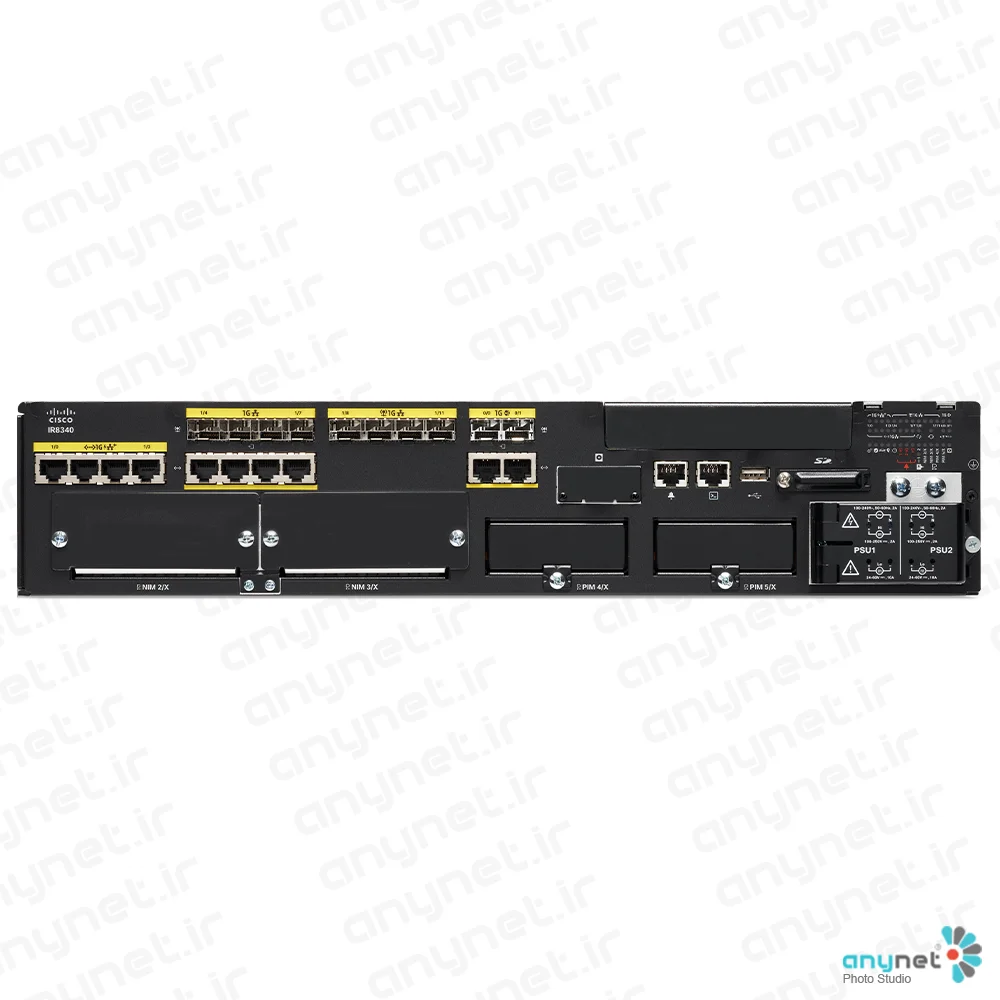

Cisco IR807G-LTE-GA-K9 Industrial ISR
- Global Price List Information (GPL)
-
Model: IR8340-K9
-
Description:
-
Price: USDLast Update:
- End-of-Sale and End-of-Life Information (EOL/EOS)
- Release Date:
- End-of-Sale Date:
- End-of-Support Date:
The Cisco Catalyst IR8340 Rugged Series Router represents a significant leap forward in industrial networking, specifically engineered to meet the rigorous demands of modern edge computing and critical infrastructure. As industries increasingly shift toward digital transformation, the need for robust, high-performance connectivity in harsh environments has become paramount. This router is designed to bridge the gap between traditional operational technology and advanced information technology, providing a secure and scalable foundation for diverse industrial applications. By integrating powerful processing capabilities with modular connectivity, it addresses the challenges of remote deployment where reliability is non-negotiable.
This series is built to withstand extreme conditions, including wide temperature fluctuations, high vibration, and electromagnetic interference, which are common in sectors like utilities, transportation, and manufacturing. Beyond its physical durability, the IR8340 serves as a versatile platform that supports a wide array of software-defined networking features. It is designed to simplify the management of complex network architectures, allowing organizations to deploy services rapidly while maintaining strict security protocols. The architecture focuses on providing a consistent user experience, whether the device is located in a climate-controlled data center or a remote, exposed outdoor cabinet.
Furthermore, the Cisco Catalyst IR8340 is deeply integrated into the broader Cisco ecosystem, ensuring seamless interoperability with existing network management tools. This integration is crucial for IT and OT teams who require visibility and control over their distributed assets. By leveraging Cisco’s proven networking expertise, the IR8340 provides a future-proof solution that adapts to evolving bandwidth requirements and security threats. It is not merely a hardware component but a strategic asset that empowers businesses to harness the power of data at the edge, driving operational efficiency and enabling innovative new services in the most challenging environments imaginable.
Product overview
The Cisco Catalyst IR8340 Rugged Series Router is a modular, high-performance platform that serves as the backbone for industrial edge networks. At its core, the device is powered by a high-performance processor capable of handling intensive workloads, including edge analytics and containerized applications. The modular design is a standout feature, allowing users to customize the router with various interface modules, such as 5G, LTE, and diverse fiber or copper Ethernet options. This flexibility ensures that the router can be tailored to specific site requirements, whether the need is for high-speed cellular backhaul or traditional wired connectivity.
The hardware architecture is specifically hardened to meet industrial standards, ensuring long-term reliability in environments where standard enterprise routers would fail. The fanless design and ruggedized chassis are complemented by advanced power management features, which are essential for sites with unstable power grids or solar-powered installations. The IR8340 also incorporates a comprehensive suite of security features, including hardware-based encryption and secure boot, which protect the device and the data it transmits from sophisticated cyber threats. This focus on security is integrated into every layer of the hardware and software stack.
In terms of software, the IR8340 runs on the Cisco IOS XE operating system, which is the same robust platform used in Cisco’s enterprise-grade routers. This provides a familiar interface for network administrators and ensures consistency across the entire network fabric. The platform supports advanced routing protocols, quality of service (QoS) mechanisms, and comprehensive monitoring tools that allow for real-time diagnostics. By combining this powerful software foundation with modular, ruggedized hardware, the IR8340 offers a unique balance of performance, flexibility, and durability that is essential for the next generation of industrial networking deployments.
Features and benefits
- Modular Connectivity: Offers a wide range of field-replaceable modules, including 5G and LTE Advanced Pro, allowing for seamless upgrades as cellular technologies evolve.
- Ruggedized Design: Engineered to operate in extreme temperatures ranging from -40°C to +75°C, with high resistance to shock, vibration, and electromagnetic interference.
- Cisco IOS XE Integration: Leverages the industry-standard IOS XE operating system, providing a consistent management experience and support for advanced automation and programmability.
- Edge Computing Capabilities: Features a powerful CPU and memory architecture that supports the deployment of containerized applications directly on the router, enabling local data processing and reduced latency.
- Enhanced Security: Includes Cisco Trust Anchor technologies, secure boot, and hardware-based encryption to ensure the integrity of the device and the confidentiality of sensitive industrial data.
- SD-WAN Support: Fully compatible with Cisco SD-WAN, enabling centralized management, automated policy enforcement, and optimized traffic routing across distributed industrial sites.
- Flexible Power Options: Supports multiple power input configurations, including DC and AC, with features designed to handle power fluctuations common in industrial settings.
- Comprehensive Management: Integrates with Cisco DNA Center and vManage, providing deep visibility into network performance and simplifying the deployment of large-scale industrial networks.
- High-Speed Interfaces: Provides multiple high-density Gigabit Ethernet ports, supporting both copper and fiber connections for versatile local area network connectivity.
- Future-Proof Architecture: The modular nature of the IR8340 ensures that as new communication standards or processing requirements emerge, the hardware can be adapted without requiring a complete system replacement.
The Cisco 807 Industrial Integrated Services Router (IR807) offers compact, low-power, secure connectivity for deployment in harsh, power-constrained industrial environments.
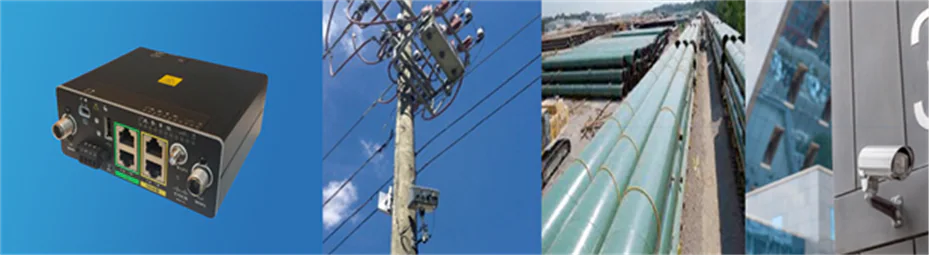
The Cisco IR807 (Figure 1) compact multimode 3G and 4G LTE wireless router provides an ideal solution for power-constrained needs in energy applications such as distribution automation as well as remote asset management across industry segments. The router has integrated 9.6 to 60V DC power input and withstands hostile environments, including shock, vibration, dust, and humidity, and supports a wide temperature range (–40 to 60°C and type-tested at 85°C for 16 hours). Key capabilities of the Cisco IR807 include:
● Compact, low-power, rugged design to meet space-constrained and power-constrained environments.
● Enterprise-class security and services such as Quality of Service (QoS).
● Seamless integration to the SCADA systems and diverse assets with the support for DNP3 serial to DNP3 IP and IEC 60870 T101 to T104 protocol translations.
● Cisco advanced Virtual Private Network (VPN) technologies (such as Dynamic Multipoint VPN [DMVPN] and Flexible VPN [FlexVPN]).
● Multiple Virtual Routing and Forwarding (VRF) instances for highly secure data, voice, and video communications over cellular WAN.
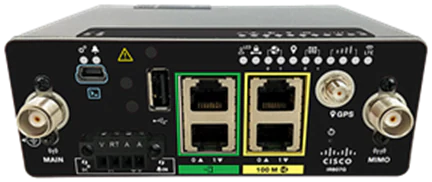
Cisco 807 Low-Power Industrial Integrated Services Routers with 4G LTE
Product overview
The Cisco 807 Industrial Integrated Services Router supports the latest Third-Generation Partnership Project (3GPP) Release 13 Category 3 and Category 3 LTE standards. The routers provide persistent, reliable LTE connectivity transparent hand-offs between LTE and 3G networks:
● IR807G-LTE-NA-K9: Multimode 4G, 3G, and 2G connectivity to cellular networks operating in LTE 1900 MHz (band 2 PCS), 1700/2100 MHz (band 4 AWS), 850 MHz (band 5), 700 MHz (band 12), 700 MHz (band 17), 1900 MHz (band 25 extended PCS), and 850 MHz (band 26 extended CLR) frequencies; backward-compatible with UMTS and HSPA+ 850 MHz (band 5), 1900 MHz (band 2 PCS), and 1700/2100 MHz (band 4 AWS) and CDMA BC0, BC1, and BC10.
● IR807G-LTE-VZ-K9: 4G connectivity to cellular networks operating in LTE 700 MHz (band 13) and 1700/2100 MHz (band 4 AWS).
● IR807G-LTE-GA-K9: Multimode 4G, 3G, and 2G connectivity to cellular networks operating in LTE 800 MHz (band 20), 900 MHz (band 8), 1800 MHz (band 3), 2100 MHz (band 1), and 2600 MHz (band 7) frequencies; backward-compatible with UMTS and HSPA+ 900 MHz (band 8) and 2100 MHz (band 1) and EDGE/GSM/GPRS 900 MHz and 1900 MHz.
These routers offer a broad range of features for industrial and enterprise Internet of Things (IoT), as listed in Figure 2.
Table 1. Cisco 807 Industrial Integrated Services Router Features
|
|
LTE connectivity: LTE offers a cost-effective alternative in areas where broadband services either are not available or are very expensive. Quality of Service (QoS): QoS enables differentiated treatment of traffic for mission-critical services and load balancing for a better user experience. |
|
|
Supervisory Control And Data Acquisition (SCADA) applications: DNP3 serial–to–DNP3/IP translation and IEC 60870 T101–to–T104 protocol translation serves as a SCADA gateway and raw socket transport for managing Remote Terminal Units (RTUs). |
|
|
Smart-grid compliant: The routers comply with IEEE 1613 and IEC 61850-3 for distribution automation and secondary substation deployments. |
|
|
Industrial security: Services include area firewall and VPN services, which require no additional hardware or client software. |
|
|
GPS: The routers support remote tracking asset management in a distributed network. |
|
|
Network management: Tools such as Cisco IoT Operations Dashboard, Cisco IoT Field Network Director (FND), Cisco Prime, Cisco Plug and Play (PnP), and Cisco Application Policy Infrastructure Controller Enterprise Module (APIC-EM) simplify deployment of a secure network. |
|
|
Multiple Packet Data Network (PDN) feature: This feature allows the router to connect to different Access Point Names (APNs), enabling traffic segregation. For example, public Internet traffic can be kept separate from mission-critical traffic emerging from the sensors and devices connected to the router. |
|
|
4G LTE multiple-bearer QoS for cellular: The IR807 supports 4G LTE multiple bearers, enabling differentiated treatment of traffic based on the QoS policies. The QoS feature depends on a service provider’s ability to classify and enforce QoS policies and hence requires providers to launch this service in their networks. |
|
|
Multi-VRF: The IR807 supports the multi-VRF feature, which allows customers to configure and maintain more than one instance of a routing and forwarding table within the same Customer Edge (CE) device. For service providers, this feature enables them to support two or more VPNs, and the IP addresses can overlap several VPNs. |









Business benefits and application examples
Industrial customers are looking for real-time monitoring and control of industrial assets to help increase operation efficiency.
Utilities
Utilities are seeking the capability to monitor thousands of miles of electrical or water infrastructure, often located in harsh environments through 3G and 4G cellular networks to provide remote assets monitoring and reliable and secure SCADA traffic backhauling. In many cases, these are power-constrained and space-constrained environments. Devices that enable this connectivity need to consume low power and monitor and manage the assets remotely. They also need to support traditional serial interfaces to interconnect with existing monitoring devices.
Oil and Gas
Oil and gas companies need to monitor pipeline infrastructure across wide geographic areas and remote locations in a power-constrained environment using 3G and 4G cellular networks to collect data from remote terminal units and securely transport SCADA traffic to a Network Operations Center (NOC).
Transportation
Highways and transportation agencies require reliable always-on communication between speed cameras, monitoring cameras, ticket terminals, and so on. Wireless devices to support such continuous communication need to support 3G and 4G networks to help ensure good, wide coverage; support continuous operation in very harsh environments; be very compact for deployment in roadside cabinets and ticketing machines; and support serial interfaces to existing traditional devices.
Primary Features and Benefits
Table 2 lists the features and benefits of the IR807.
Table 2. Features and Benefits of Cisco 807 Industrial Integrated Services Router
|
Features |
Benefits |
|
IoT enablement |
|
|
Lightweight, compact, and ruggedized form factor |
In addition to being compact in size, the IR807 carriers all the Input/Output (I/O) ports and connectors on the front panel for easy installation inside cabinets. The router is hardened and ingress protection (IP) 30-rated for deployment in harsh environments for remote assets monitoring and machine-to-machine (M2M) communications. |
|
Low power consumption |
With a typical power consumption of 6.7W with traffic, the IR807 is designed to work in power-constrained environments. |
|
Raw socket transport and SCADA |
Rawsocket can beused to transport SCADA datafromRTUs. This method isan alternative to the Block Serial Tunnel (BSTUN) protocol. TheIR807 provide DNP3 serial–to–DNP3/IPtranslation and IEC60870 T101–to–IEC 60870 T104 protocol translation to serve as a SCADA gatewayto do the following: ● Receive data from RTUs (T101 or DNP3 serial) and relay configuration commands from the control center (T104 or DNP3 IP) SCADA applications
● Receive configuration commands from the control center and relay RTU data to the control center
● Terminate incoming T104 or DNP3 IP requests from the control center when an RTU is offline
|
|
IoT field network director |
Available as an optional industrial operations kit. This software platform manages amultiservice network and securityinfrastructure forIoTapplications such as transportation,smartgrid,services, distributionautomation, andsubstation automation. |
|
Cisco IoT Operations Dashboard |
Cisco IoT Operations Dashboard is a cloud-based dashboard that enables OT staff to reduce downtime and improve safety by simply deploying, managing, monitoring and maintaining critical IoT-powered networks, assets and data using built-in IT-managed standards. By streamlining collaboration between IT and OT, this dashboard enables organizations to manage secure IoT connectivity at massive scale with existing staff. |
|
Multiple mounting options |
● Supports a variety of mounting options: floor mount, wall mount, and DIN rail mount
|
|
Increased performance to run concurrent services |
● Performance allows customers to take advantage of broadband network speeds while running highly secure, concurrent data, voice, and video services
|
|
Enhanced security |
● An integrated state-full and application inspection firewall provides network perimeter security, hardware-assisted high-speed IP Security (IPsec), Triple Data Encryption Standard (3DES), and next-generation encryption protocols such as Advanced Encryption Standard (AES) and Secure Hash Algorithm (SHA) offer data privacy over the Internet
● Intrusion prevention enforces security policies in a larger enterprise or service provider network
|
|
Multiple WAN and LAN connections |
|
|
Two fast Ethernet interfaces |
● Allows multiple Ethernet device connectivity in a small office or other remote location with the capability to designate a port as the network edge
● Provides VLANs for Layer 3 IP sub-interfaces
|
|
Transparent roaming between wireless networks |
|
|
Dual subscriber-identity-module (SIM)support |
● The dual SIM feature provides active/backup connectivity option for high reliability and multi-homing capabilities over LTE and HSPA networks
|
|
Cisco IOSmobile IP features |
● Mobile IP offers transparent roaming for mobile networks, establishing a transparent Internet connection regardless of location or movement. This feature enables mission-critical applications to stay connected even when roaming between networks
● Assigned IP addresses to the home network are maintained in private and public networks
● Both proxy mobile IP (PMIPv6) and network mobility (NEMO) are supported
|
|
Cisco IOS mobile network features |
● This feature allows an entire subnet or mobile network to maintain connectivity to the home network while roaming
|
|
Multiple wireless WAN technologies |
● Users can use the best wireless (4G LTE, 3.7G, 3.5G, 3G, or 2G) technology or network available. IR807G-LTE-VZ-K9 does not support 3G and 2G. IR807G-LTE-NA-K9 does not support 2G
|
|
Advanced IP services in standards-based Cisco IOS Software |
|
|
Advanced security features |
● Authorization and authentication determine which individuals and devices have access to the network
● Firewall protection provides perimeter security when public networks are used
● 3DES and AES encryption provide highly secure VPNs when data is transmitted and received over public networks
● The next-generation protocol suites enable users to monitor potential malicious activity on the network
● IPsec over IPv4 & IPv6, IPsec stateful failover, VRF-aware IPsec, DMVPN, FlexVPN and PMIPv6
|
|
Routing |
● Enables advanced routing capabilities using Enhanced Interior Gateway Routing Protocol (EIGRP), Multiprotocol Border Gateway Protocol (MP-BGP), IPv4 and IPv6 on all interfaces including cellular, IPv4/IPv6 Multicast, Generic Routing Encapsulation (GRE) and Multipoint GRE (MGRE), Network Address Translation (NAT), Domain Name System (DNS) proxy and spoofing, IP service-level agreement (SLA), and QoS
|
|
QoS features |
● Provides traffic precedence to delay-sensitive and mission-critical services
● Facilitates low-latency routing of delay-sensitive industrial applications
● Supported on all LAN and WAN interfaces including cellular
● Provides LTE QoS with support for up to 8 concurrent bearers on each cellular WAN interface for traffic classification and prioritization
|
|
Management and manageability |
● Network managers can remotely manage and monitor networks with Simple Network Management Protocol Versions 1, 2, and 3 (SNMPv1, v2, and v3); Telnet; and HTTP/HTTPS and Secure Shell Version 2 (SSHv2). They can also manage and monitor networks locally through a console port
● Support for extensive 3G and 4G LTE-based MIBs allows centralized management of remote devices and gives network managers visibility into and control over the network configuration at the remote site
● Network managers can reset to a predesignated golden image, as well as configure an IR807 through Cisco IOS Software or through an external reset button
● Network managers can upgrade 3G, 3.5G, 3.7G, and 4G LTE firmware and router configurations remotely
● The tight integration with Cisco IOS Software enables the router to self-monitor the LTE WAN link and automatically recover from a radio link failure
● Network management tools such as Cisco IoT Operations Dashboard, Cisco IoT Field Network Director (FND), Cisco Prime , Cisco Plug and Play (PnP), and Cisco Application Policy Infrastructure Controller Enterprise Module (APIC-EM) simplify deployment of a secure network.
|
Product specifications
Table 3 provides 4G LTE specifications for IR807.
Table 3. 4G LTE Specifications for Cisco 807 Industrial Integrated Services Routers
|
Region theaters |
IR807G-LTE-GA-K9 |
IR807G-LTE-NA-K9 |
IR807G-LTE-VZ-K9 |
|
Bands |
LTE bands 1, 3, 7, 8, and 20; UMTS/HSPA+ bands 1 (2100 MHz) and 8 (900 MHz); EDGE/GSM/GPRS 900 MHz and 1900 MHz |
LTE bands 2, 4, 5, 12, 17, 25, and 26; UMTS/HSPA+ 2 (1900 MHz), 4 (1700 MHz) and 5 (850 MHz); |
LTE bands 4 and 13 |
|
Theoretical download and upload speeds* |
100 and 50 Mbps |
100 and 50 Mbps |
150 and 50 Mbps |
|
Australia |
No |
No |
No |
|
Europe |
Yes |
No |
No |
|
Middle East |
No |
No |
No |
|
Latin America (LATAM) and Asia-Pacific (APAC) |
No |
No |
No |
|
United States |
No |
Yes (ATT) |
Yes (Verizon) |
|
Canada |
No |
In the future |
No |
|
Feature |
Description |
|
Key cellular features |
● Dual SIM for failover from active to backup network for high reliability
● LTE QoS with support for up to 8 concurrent bearers on each cellular WAN interface for traffic classification and prioritization
● Multiple Packet Data Networks (PDNs)
● Automatic switchover and failover between primary and backup links
● IPv4 and IPv6 support
● Multichannel Interface Processor (MIP) profile configuration
● Send and receive Short Message Service (SMS; maximum 160 characters)
● 4G and 3G MIB with extension and traps
● Remotely initiated data callback using SMS
● Remote firmware upgrade over 4G LTE
● Virtual diagnostic monitoring
● Mobile Equipment Personalization (MEP) lock and unlock capabilities
● SIM lock and unlock capabilities
|
|
Dual SIM support
|
● High reliability and cellular multi-homing support for dual SIM card socket; compliant with ISO-7816-2 (SIM mechanical). This feature is not available on IR809G-LTE-VZ-K9
● Capability for the two SIMs to operate in active-backup mode
|
|
Global Positioning System (GPS)
|
● Standalone GPS and National Marine Electronics Association (NMEA) streaming
|
|
SMS
|
● Send and receive SMS for alerts and notifications
|
|
MIBs
|
● Enhanced 3G MIB with 4G MIB extension (4G LTE parameters are covered with 3G MIB and 3G MIB extension)
● ENTITY MIB
● IF MIB
● 3G Wireless WAN (WWAN) MIB persistence
|




|
Item |
Specification |
|
4G LTE network management and diagnostics |
● In-band and out-of-band management using Telnet (Cisco IOS Software command-line interface [CLI]) and SNMP, including MIB II and other extensions
● Industry-standard 4G LTE diagnostics and monitoring tools (QUALCOMM CDMA Air Interface Tester [CAIT] and Spirent Universal Diagnostic Monitor [UDM])
|
|
Programming interfaces |
● Cisco IOS Software CLI
|
|
Wireless technologies supported (performance and throughput) |
IR807G-LTE-GA-K9 Cisco LTE 800 MHz (band 20), 900 MHz (band 8), 1800 MHz (band 3), 2100 MHz (band 1), and 2600 MHz (band 7) at Category 3 LTE speeds2 Backward compatibility: ● UMTS and HSPA+: 900 and 2100 MHz
● Quad-band EDGE, GPRS, and GSM: 900 and 1900 MHz
● HSPA+ speed DL up to CAT 20 (42.2 Mbps) and UL up to CAT 6 (5.76 Mbps)
● DC-HSPA+ speed DL with CAT 24 (42.2 Mbps) and UL up to CAT 6 (5.76 Mbps)
IR807G-LTE-NA-K9 Cisco LTE 1900 MHz (band 2 PCS), 1700/2100 MHz (band 4 AWS), 850 MHz (band 5 and band 26 Extended CLR) and 700 MHz (band 12 and 17) at Category 3 LTE speeds2 Backward compatibility: ● UMTS and HSPA+: 850 (band 5), 1700/2100 (band 4 AWS) and 1900 (band 2)
● CDMA: BC0, BC1, and BC10
● HSPA+ speed DL up to CAT 20 (42.2 Mbps) and UL up to CAT 6 (5.76 Mbps)
● DC-HSPA+ speed DL with CAT 24 (42.2 Mbps) and UL up to CAT 6 (5.76 Mbps)
IR807G-LTE-VZ-K9 Cisco LTE 700 MHz (band 13) and 1700/2100 MHz (band 4 AWS) at Category 4 LTE speeds2 |
|
LED indicators |
● SYS (green and yellow)
● VPN (green)
Cellular LEDs: ● Received-signal-strength indication (RSSI; green)
● WWAN (green)
● SIM status (green)
● GPS (green)
|
Table 4 lists the software features supported on IR807.
Table 4. Cisco IOS Software features on Cisco 807 Industrial Integrated Services Routers
|
Feature |
Description |
|
Cisco IOS Software requirements |
● Cisco IOS Software feature set: Universal Cisco IOS Software image
● Cisco IOS Software Release 15.7(3)M1 or later
|
|
IPv4 and IPv6 services features |
● Routing Information Protocol Versions 1 and 2 (RIPv1 and RIPv2)
● Generic Routing Encapsulation (GRE) and Multipoint GRE (MGRE)
● Cisco Express Forwarding
● Standard 802.1d Spanning Tree Protocol
● Network Address Translation (NAT)
● Dynamic Host Configuration Protocol (DHCP) server, relay, and client
● Dynamic DNS (DDNS)
● DNS proxy
● DNS spoofing
● Access Control Lists (ACLs)
● IPv4 and IPv6 multicast
● Open Shortest Path First (OSPF)
● Border Gateway Protocol (BGP)
● Enhanced Interior Gateway Routing Protocol (EIGRP)
● Virtual Route Forwarding (VRF) Lite
● Next-Hop Resolution Protocol (NHRP)
|
|
Security features |
Secure connectivity ● Secure Sockets Layer (SSL) VPN for secure remote access
● Hardware-accelerated DES, 3DES, AES 128, AES 192, and AES 256
● Public-Key-Infrastructure (PKI) support
● 20 IPsec tunnels
● Cisco Easy VPN Solution client and server
● NAT transparency
● Dynamic Multipoint VPN (DMVPN)
● Tunnel-less Group Encrypted Transport VPN
● Flex VPN
● IPsec state-full failover
● VRF-aware IPsec
● IPsec over IPv6
Cisco IOS Firewall ● Zone-based policy firewall
● VRF-aware state-full inspection routing firewall
● State-full inspection transparent firewall
● Advanced application inspection and control
● Secure HTTP (HTTPS), FTP, and Telnet Authentication Proxy
● Dynamic and static port security
● Firewall state-full failover
● VRF-aware firewall
Integrated Threat Control ● Control-Plane Policing (CoPP)
● Flexible packet matching
● Network foundation protection
|
|
QoS features |
● Low Latency Queuing (LLQ)
● Weighted Fair Queuing (WFQ)
● Class-Based WFQ (CBWFQ)
● Class-Based Traffic Shaping (CBTS)
● Class-Based Traffic Policing (CBTP)
● Policy-Based Routing (PBR)
● Class-Based QoS MIB
● Class of Service (CoS)–to–Differentiated Services Code Point (DSCP) mapping
● Class-Based Weighted Random Early Detection (CBWRED)
● Resource Reservation Protocol (RSVP)
● Real-Time Transport Protocol (RTP) header compression (cRTP)
● Differentiated Services (DiffServ)
● QoS pre-classify and pre-fragmentation
● Hierarchical QoS (HQoS)
|
|
Management features |
● Cisco IoT Field Network Director
● Cisco IoT Operations Dashboard
● Cisco Configuration Professional Express *
● Cisco Plug and Play (PnP)
● Cisco Application Policy Infrastructure Controller Enterprise Module (APIC-EM)
● Cisco Prime
● Cisco Control Center
● IP Service-Level Agreement (IP SLA)
● Cisco IOS Embedded Event Manager (EEM)
● Telnet, SNMPv3, SSH Protocol, CLI, and HTTP management
● RADIUS and TACACS+
* - Support available in Q1 2018 |
|
High-availability features |
● Virtual Router Redundancy Protocol (VRRP) (RFC 2338)
● Hot Standby Router Protocol (HSRP)
● Dual SIM support for cellular failover (not supported on IR807G-LTE-VZ-K9)
|
|
IPv6 features |
● IPv6 addressing architecture
● IPv6 unicast and multicast forwarding
● IPv6 ACLs
● IPv6 over cellular
● IPv6 routing
● IPv6 domain name resolution
|
Table 5 lists the system specifications, and Table 5 lists antenna specifications for the IR807.
Table 5. System Specifications for Cisco 807 Industrial Integrated Services Routers
|
Feature |
Specification |
|
Memory |
|
|
Default and maximum DRAM |
1 GB |
|
Default and maximum flash memory |
4 GB |
|
IP rating |
IP30 |
|
Physical characteristics |
|
|
Physical dimensions (H x W x D) |
1.84” x 5.07” x 4.37” (46.74 x 128.78 x 110.99 mm) |
|
Weight |
1 lb 5 oz. (0.6 kg) |
|
Mounting options |
Panel, wall, and DIN rail (vertical and horizontal) mount |
|
Power consumption |
At idle: 4.5W Typical: 6.7W Maximum: 10W |
|
Interface support |
|
|
Console |
Mini type-B USB |
|
WAN interfaces |
WWAN with multimode 4G LTE, 3.7G, 3.5G, 3G, and 2G speeds; IR807G-LTE-VZ-K9 does not support 3G and 2G. IR807G-LTE-NA-K9 does not support 2G |
|
LAN and WAN interfaces |
Two 10/100BASE-T fast Ethernet ports |
|
LEDs |
● System OK
● WWAN
● Link for Ethernet WAN ports
● GPS
● RSSI
● VPN
● User-configurable LED
● SIM presence
● ALARM
|
|
Serial interface |
● 2 isolated RS-232 ports
● Support for asynchronous mode with speed up to 115,200 baud
|
|
Serial protocol support |
SCADA, DNP3, T101-104, Raw Socket TCP and UDP, and SLIP |
|
Diagnostics |
Mini type-B USB for remote cellular WAN diagnostics and monitoring |
|
Environmental characteristics |
|
|
Environmental operating temperature range |
–40 to 140°F (–40 to 60°C) in a sealed NEMA cabinet with no airflow –40 to 158°F (–40 to 70°C) in a vented cabinet with 40 Linear Feet per Minute (LFM) of air –40 to 167°F (–40 to 75°C) in a forced air enclosure with 200 LFM of air Type tested at 85°C for 16 hours |
|
Operating altitude |
50°C up to 5000 ft (above 5000 ft derate maximum operating temperature 1.50°C per 1000 ft) Maximum altitude: 10,000 ft |
|
Standard safety certifications |
● UL 60950-1, 2 nd edition
● CAN/CSA C22.2 No. 60950-1, 2 nd edition
● EN 60950-1, 2 nd edition
● CB to IEC 60950-1, 2 nd edition with all group differences and national deviations
|
|
Hazardous locations standards |
● ANSI/ISA 12.12.01 (Class 1, Div 2 A-D)
● CSA 213 (Class 1, Div 2 A-D)
● IEC 60079-0 and -15 IECEx test report (Class I, Zone 2, gas groups IIC)
● EN 60079-0 and -15 ATEX certification (Class I, Zone 2, gas groups IIC)
|
|
Industry standards |
● IEC 61850-3
● IEEE 1613
|
|
EMC emissions |
FCC 47 CFR Part 15 Subpart C Class A EN 55032/CISPR 32 Class A, EN 55022 Class A CISPR 11 Class A, ICES 003 Class A, CNS 13438 Class A EN 300 386 |
|
EMC immunity |
CISPR 35, EN 55024 EN 61000-4-2, 3, 4, 5, 6, 8, 9, 16, 17, 18, and 29 |
|
Radio cellular |
EN 301 908 -1, 2, and 13 EN 301 511 FCC 47 CFR Part 22 FCC 47 CFR Part 15 Subpart C FCC 47 CFR Part 2 MPE RSS 102/247 |
|
Power specifications |
Minimum and maximum voltage: 9.6 to 60V DC input Maximum and minimum current: 1.04A (9.6V DC) and 0.17A (60V DC) |
Ordering information
For more information about ordering the IR807, visit the Cisco Ordering homepage and refer to Table 6.
Table 6. Ordering Information for Cisco 807 Industrial Integrated Services Routers
|
Product |
Description |
|
Cisco IR807G 4G LTE Integrated Services Routers |
|
|
IR807G-LTE-GA-K9 |
Compact Cisco IR807 Ruggedized Secure Multi-Mode 4G LTE Industrial ISR for Europe: Multimode 4G, 3G, and 2G connectivity to cellular networks operating in LTE 800 MHz (band 20), 900 MHz (band 8), 1800 MHz (band 3), 2100 MHz (band 1), and 2600 MHz (band 7) frequencies Backward-compatible with UMTS and HSPA+ 900 MHz (band 8) and 2100 MHz (band 1) and EDGE/GSM/GPRS 900 MHz and 1800 MHz |
|
IR807G-LTE-NA-K9 |
Compact Cisco IR807 Ruggedized Secure Multi-Mode 4G LTE Industrial ISR for North America: Multimode 4G and 3G, connectivity to cellular networks operating in LTE 1900 MHz (band 2 PCS), 1700/2100 MHz (band 4 AWS), 850 MHz (band 5), 700 MHz (band 12), 700 MHz (band 17), 1900 MHz (band 25 extended PCS) and 850 MHz (band 26 extended CLR) frequencies Backward-compatible with UMTS and HSPA+ 850 MHz (band 5), 1900 MHz (band 2 PCS), and 1700/2100 MHz (band 4 AWS), and CDMA BC0, BC1 and BC10 |
|
IR807G-LTE-VZ-K9 |
Compact Cisco IR807 Ruggedized Secure 4G LTE Industrial ISR for Verizon in North America: LTE connectivity to cellular networks operating in LTE 700 MHz (band 13) and 1700/2100 MHz (band 4 AWS) |
|
Power supplies and mounting brackets |
|
|
PWR-IE50W-AC-L(=) |
AC power adapter with 110/240V AC and 90-264V input (operating temperature: -20C to +70C) For more details on this power supply, visit: https://www.cisco.com/c/en/us/products/collateral/switches/industrial-ethernet-switches/datasheet-c78-742180.html |
|
IR807-DINRAIL(=) |
DIN rail kit |
|
IR807-WALLMNT(=) |
Wall mount kit |
|
Antenna and lightning arrestors |
|
|
Refer to Cisco IR800 Series Antenna Install Guide at https://www.cisco.com/c/dam/en/us/td/docs/routers/access/800/829/ir800_antenna_install_guide.pdf. Note: None of the antennas are included by default along with the IR807. |
|
For more information
For more information about the Cisco 807 Industrial Integrated Services Routers, visit: https://www.cisco.com/go/ir807.
| Model | IR8340-K9 |