
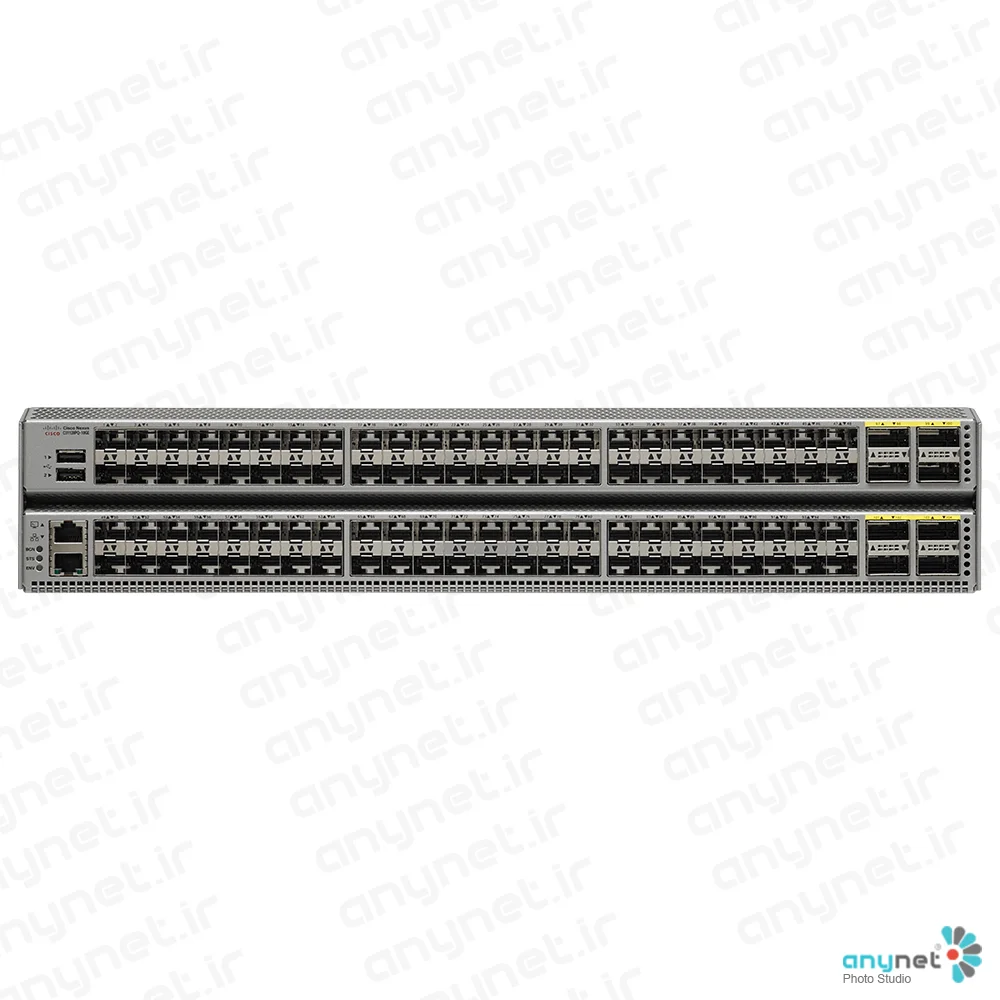

Cisco Nexus N3K-C31128PQ-10GE Switch
- Global Price List Information (GPL)
-
Category: Cisco Nexus 3000 SeriesSubcategory: Cisco Nexus 3000 Series Switches
-
Model: N3K-C31128PQ-10GE
-
Description: Nexus 31128PQ switch 96p SFP + 8p QSFP
-
Price: 34,648.12 USDLast Update: 2021-08-09
- End-of-Sale and End-of-Life Information (EOL/EOS)
- Release Date:
- End-of-Sale Date:
- End-of-Support Date:
The Cisco Nexus 31128PQ Switch is a high-performance, dense Layer 2 and 3 networking solution designed as part of the second-generation Cisco Nexus 3000 series. Built to meet the demands of modern data centers, this switch offers significant improvements in port density, scalability, and overall feature set compared to its predecessors. It is housed in a compact two-rack-unit (2RU) form factor, making it an ideal choice for environments that require a power-efficient and cost-effective leaf or access switch.
The device operates on the industry-standard Cisco NX-OS Software, which provides a robust and reliable foundation for mission-critical operations. It is engineered to support flexible deployment scenarios, including both forward and reverse airflow options, and accommodates various power input requirements. By combining high-speed connectivity with advanced management capabilities, the Nexus 31128PQ helps organizations maintain continuous availability and operational flexibility in their data center infrastructures.
Product overview
The Cisco Nexus 31128PQ is specifically designed to provide line-rate performance for both 10-Gbps and 40-Gbps connectivity. The hardware configuration features 96 fixed 10-Gbps SFP+ ports and 8 fixed 40-Gbps QSFP+ ports, allowing for seamless transitions between different speed requirements. This high-density design ensures that the switch can handle demanding workloads, such as High-Frequency Trading (HFT) and High-Performance Computing (HPC), while maintaining low nominal latency.
Beyond its physical capabilities, the switch is supported by a comprehensive ecosystem of management tools, including the Cisco Data Center Network Manager (DCNM). The system is built for resilience, featuring hot-swappable power supply units and redundant fan modules to ensure maximum uptime. With its support for advanced routing protocols and automation features, the Nexus 31128PQ serves as a versatile building block for scalable, high-performance data center networks.
Features and benefits
- High-Performance Switching: Delivers wire-rate Layer 2 and 3 switching with a capacity of up to 2.5 Terabits per second (Tbps) and 1.4 billion packets per second (bpps).
- Advanced High Availability: Utilizes Virtual PortChannel (vPC) technology for multipathing and 64-way Equal-Cost Multipath (ECMP) routing to prevent bottlenecks and increase network resiliency.
- Automation and Programmability: Supports PowerOn Auto Provisioning (POAP), Python scripting, and an XML interface to streamline configuration and reduce manual provisioning time.
- Enhanced Monitoring: Includes advanced buffer monitoring for real-time traffic analysis, the Ethanalyzer packet analyzer for troubleshooting, and Precision Time Protocol (PTP) for accurate clock synchronization.
- Flexible Software Licensing: Ships with a comprehensive Layer 2 feature set, with optional licenses available for advanced Layer 3 routing, VXLAN, and Policy-Based Routing (PBR).
- Operational Efficiency: Features hot-swappable, redundant power supplies and fans, along with support for both port-side exhaust and port-side intake airflow to suit various data center cooling designs.
- Robust Security: Offers Role-Based Access Control (RBAC), Access Control Lists (ACLs), DHCP snooping, and Control-Plane Policing (CoPP) to protect network integrity.
Product overview
The Cisco Nexus 31128PQ Switch is a dense, high-performance Layer 2 and 3, 10- and 40-Gbps switch that is a member of the Cisco Nexus 3100 switches. The Nexus 3100 switches are the second-generation Cisco Nexus 3000 series switches and offer improved port density, scalability, and features compared to the first-generation switches. The Cisco Nexus 31128PQ comes in a compact two-rack-unit (2RU) form factor and runs the industry-leading Cisco NX-OS Software operating system, providing customers comprehensive features and functions that are widely deployed. It supports both forward and reverse (port side exhaust and port side intake) airflow schemes with AC and DC power inputs. The Cisco Nexus 31128PQ is well suited for data centers that require a cost-effective, power-efficient line-rate Layer 2 and 3 access or leaf switch.
The Cisco Nexus 31128PQ (Figure 1) is a 10-Gbps Enhanced Small Form-Factor Pluggable (SFP+) and 40-Gbps Quad Small Form-Factor Pluggable (QSFP+) based switch with 96 SFP+ ports and 8 QSFP+ ports.
Cisco Nexus 31128PQ Switch
Main benefits
The Cisco Nexus 31128PQ provides the following main benefits:
● Wire-rate Layer 2 and 3 switching on all ports [1]
◦ Layer 2 and 3 switching of up to 2.5 Terabits per second (Tbps) and up to 1.4 Billion packets per second (bpps) is provided in a compact 2RU form-factor switch.
● High availability
◦ Virtual PortChannel (vPC) technology provides Layer 2 multipathing through the elimination of Spanning Tree Protocol and enables fully utilized bisectional bandwidth and simplified Layer 2 logical topologies without the need to change the existing management and deployment models.
◦ The 64-way Equal-Cost Multipath (ECMP) routing enables the use of Layer 3 fat-tree designs and allows organizations to prevent network bottlenecks, increase resiliency, and add capacity with little network disruption.
◦ Hot swappable Power-Supply Units (PSUs) and fans.
● High Performance
◦ The Cisco Nexus 31128PQ delivers low nominal latency, which enables customers to implement high-performance infrastructure for High-Frequency Trading (HFT) and High-Performance Computing (HPC) workloads.
● Purpose-built Cisco NX-OS operating system with comprehensive, proven innovations
◦ PowerOn Auto Provisioning (POAP) enables touchless bootup and configuration of the switch, drastically reducing provisioning time.
◦ Cisco Embedded Event Manager (EEM) and Python scripting enable automation and remote operations in the data center.
◦ Advanced buffer monitoring reports real-time buffer utilization per port and per queue, which allows organizations to monitor traffic bursts and application traffic patterns.
◦ Ethanalyzer is a built-in packet analyzer for monitoring and troubleshooting control-plane traffic and is based on the popular Wireshark open source network protocol analyzer.
◦ Precision Time Protocol (PTP; IEEE 1588) provides accurate clock synchronization and improved data correlation with network captures and system events.
◦ Complete Layer 3 unicast and multicast routing protocol suites are supported, including Border Gateway Protocol (BGP), Open Shortest Path First (OSPF), Enhanced Interior Gateway Routing Protocol (EIGRP), Routing Information Protocol Version 2 (RIPv2), Protocol Independent Multicast Sparse Mode (PIM-SM), Source-Specific Multicast (SSM), and Multicast Source Discovery Protocol (MSDP).
Configuration
The Cisco Nexus 31128PQ has the following configuration:
● 96 fixed 10 Gigabit Ethernet SFP+ ports
● 8 fixed 40 Gigabit Ethernet QSFP+ ports
● Locator, Status and Environment LEDs
● Dual redundant power supplies
● Redundant (1+1) fans (2 rotors per fan)
● One 10/100/1000-Mbps management port
● One RS-232 serial console port
● Two USB ports
Both forward (port-side exhaust) and reversed (port-side intake) airflow schemes are supported.
Transceiver and cabling options
The Cisco Nexus 31128PQ has 8 QSFP+ ports. QSFP+ technology allows a smooth transition from 10 to 40 Gigabit Ethernet infrastructures in data centers. This switch supports both fiber and copper cabling solutions for these two modes. For low-cost cabling, copper-based 40-Gbps Twinax cables can be used, and for longer cable reaches, short-reach optical transceivers are excellent.
For details about the optics modules available and the minimum software release required for each supported optics module, please visit: https://www.cisco.com/en/US/products/hw/modules/ps5455/products_device_support_tables_list.html.
For more information about the transceiver types, see https://www.cisco.com/en/US/products/hw/modules/ps5455/prod_module_series_home.html.
Cisco NX-OS Software Overview
Cisco NX-OS is a data center-class operating system built with modularity, resiliency, and serviceability at its foundation. Cisco NX-OS helps ensure continuous availability and sets the standard for mission-critical data center environments. The self-healing and highly modular design of Cisco NX-OS makes zero-impact operations a reality and enables exceptional operation flexibility.
Focused on the requirements of the data center, Cisco NX-OS provides a robust and comprehensive feature set that meets the networking requirements of present and future data centers. With an XML interface and a Command-Line Interface (CLI) like that of Cisco IOS Software, Cisco NX-OS provides state-of-the-art implementations of relevant networking standards as well as a variety of true data center-class Cisco innovations.
Cisco NX-OS Software Benefits
Table 1 summarizes that benefits that Cisco NX-OS offers.
Table 1. Benefits of Cisco NX-OS Software
| Feature |
Benefit |
| Common software throughout the data center: Cisco NX-OS runs on all Cisco data center switch platforms (Cisco Nexus 9000, 7000, 6000, 5000, 4000, 3000 and 1000V Series Switches and Cisco Nexus 2000 Series Fabric Extenders). |
● Simplification of data center operating environment
● End-to-end Cisco Nexus and Cisco NX-OS fabric
● No retraining necessary for data center engineering and operations teams
|
| Software compatibility: Cisco NX-OS interoperates with Cisco products running any variant of Cisco IOS Software and also with any networking OS that conforms to the networking standards listed as supported in this data sheet. |
● Transparent operation with existing network infrastructure
● Open standards
● No compatibility concerns
|
| Modular software design: Cisco NX-OS is designed to support distributed multithreaded processing. Cisco NX-OS modular processes are instantiated on demand, each in a separate protected memory space. Thus, processes are started and system resources allocated only when a feature is enabled. The modular processes are governed by a real-time preemptive scheduler that helps ensure timely processing of critical functions. |
● Robust software
● Fault tolerance
● Increased scalability
● Increased network availability
|
| Troubleshooting and diagnostics: Cisco NX-OS is built with unique serviceability functions to enable network operators to take early action based on network trends and events, enhancing network planning and improving Network Operations Center (NOC) and vendor response times. Cisco Smart Call Home and Cisco Online Health Management System (OHMS) are some of the features that enhance the serviceability of Cisco NX-OS. |
● Quick problem isolation and resolution
● Continuous system monitoring and proactive notifications
● Improved productivity of operations teams
|
| Ease of management: Cisco NX-OS provides a programmatic XML interface based on the NETCONF industry standard. The Cisco NX-OS XML interface provides a consistent API for devices. Cisco NX-OS also provides support for Simple Network Management Protocol (SNMP) Versions 1, 2, and 3 MIBs. In addition NX-API and Linux Bash are now supported. |
● Rapid development and creation of tools for enhanced management
● Comprehensive SNMP MIB support for efficient remote monitoring
|
| Role-Based Access Control (RBAC): With RBAC, Cisco NX-OS enables administrators to limit access to switch operations by assigning roles to users. Administrators can customize access and restrict it to the users who require it. |
● Tight access control mechanism based on user roles
● Improved network device security
● Reduction in network problems arising from human errors
|
Cisco NX-OS Software Packages for Cisco Nexus 31128PQ
The Cisco NX-OS Software packages available with the Cisco Nexus 31128PQ offer flexibility and a comprehensive feature set as well as consistency with Cisco Nexus access switches. The default system software has a comprehensive Layer 2 feature set with robust security and management features. To enable Layer 3 IP unicast and multicast routing functions, additional licenses need to be installed. Table 2 summarizes the software packages. See Table 4 later in this document for a complete list of software features.
Table 2. Cisco NX-OS Software Packages Available for Cisco Nexus 31128PQ
| Software Package |
Features Supported |
| System default: Base license (N3K-BAS1K9) included; no purchase necessary |
● Comprehensive Layer 2 feature set: VLAN, IEEE 802.1Q Trunking, vPC, Link Aggregation Control Protocol (LACP), Unidirectional Link Detection (UDLD; standard and aggressive), Multiple Spanning Tree Protocol (MSTP), Rapid Spanning Tree Protocol (RSTP), spanning-tree guards, and Transparent VLAN Trunk Protocol (TVTP)
● Security: Authentication, Authorization, and Accounting (AAA); Access Control Lists (ACLs), Dynamic Host Configuration Protocol (DHCP) snooping, storm control, private VLAN (PVLAN), and configurable Control-Plane Policing (CoPP)
● Management features: Cisco Data Center Network Manager (DCNM) support, console, Secure Shell Version 2 (SSHv2) access, Cisco Discovery Protocol, SNMP, and syslog
● Layer 3 IP routing: inter-VLAN routing (IVR), static routes, RIPv2, ACLs, OSPFv2, EIGRP stub, Hot Standby Router Protocol (HSRP), Virtual Router Redundancy Protocol (VRRP), and Unicast Reverse-Path Forwarding (uRPF)
● Multicast: PIM SM, SSM, and MSDP
|
| LAN Enterprise license (N3K-LAN1K9) |
● Advanced Layer 3 IP routing: BGP, and Virtual Route Forwarding lite (VRF-lite)
● VXLAN
● Policy-Based Routing (PBR)
|
Cisco Data Center Network Manager
The Cisco Nexus 31128PQ is supported in Cisco DCNM. Cisco DCNM is designed for hardware platforms enabled for Cisco NX-OS, which consist of the Cisco Nexus Family of products. Cisco DCNM is a Cisco management solution that increases overall data center infrastructure uptime and reliability, hence improving business continuity. Focused on the management requirements of the data center network, Cisco DCNM provides a robust framework and comprehensive feature set that meets the routing, switching, and storage administration needs of present and future data centers. In particular, Cisco DCNM automates the provisioning process, proactively monitors the LAN by detecting performance degradation, secures the network, and streamlines the diagnosis of dysfunctional network elements.
Product specifications
Table 3 lists the specifications for the Cisco Nexus 31128PQ, Table 4 lists software features, and Table 5 lists management standards and support.
Table 3. Specifications
| Description |
Specification |
|
| Physical |
● 2RU fixed form-factor switch
● 8 QSFP+ ports
● 96 SFP+ ports
● 2 redundant power supplies
● 2 redundant (1+1) fans (2 rotors per fan)
● Management, console, and 2 USB flash-memory ports
|
|
| Performance |
● 2.5 Tbps switching capacity
● Forwarding rate up to 1.4 bpps
● Line-rate traffic throughput (both Layer 2 and 3) on all ports
● Configurable Maximum Transmission Units (MTUs) of up to 9216 bytes (jumbo frames)
|
|
| Hardware tables and scalability* |
Number of MAC addresses |
288,000 |
| Number of VLANS |
4096 |
|
| Number of spanning-tree instances |
● RSTP: 512
● MSTP: 64
|
|
| Number of Access Control List (ACL) entries |
4000 ingress 1000 egress |
|
| Routing table |
● 16,000 prefixes and 16,000 host entries
*
● 8000 multicast routes
*
|
|
| Number of EtherChannels |
64 (with vPC) |
|
| Number of ports per EtherChannel |
16 |
|
| Buffer size |
12 MB shared |
|
| Boot flash memory |
64 GB SSD |
|
| Power |
Frequency |
50 to 60 Hz |
| Power supply types |
● AC (forward and reversed airflow)
● DC (forward and reversed airflow)
|
|
| Typical operating power |
148 watts (W) |
|
| Maximum power |
413 watts (W) |
|
| AC PSUs
● Input voltage
● Frequency
● Efficiency
|
● 100 to 240 VAC
● 50 to 60 Hz
● 89 to 91% at 220V
|
|
| DC PSUs
● Input voltage
● Maximum current (PSU output – System input)
● Efficiency
|
● -40 to -72 VDC
● 78A
● 85 to 88%
|
|
| Power-supply efficiency |
89 to 91% at 220V |
|
| Typical heat dissipation |
505 BTU/hr |
|
| Maximum heat dissipation |
1409 BTU/hr |
|
| Cooling |
● Forward and reversed airflow schemes
◦ Forward airflow: Port-side exhaust (air enters through fan tray and power supplies and exits through ports); supported with AC and DC power supplies ◦ Reversed airflow: Port-side intake (air enters through ports and exits through fan tray and power supplies); supported with AC power supply only
● Redundant fans
● Hot swappable (must swap within 1 minute)
|
|
| Sound |
Measured sound power (maximum)
● Fan speed: 40% duty cycle
● Fan speed: 70% duty cycle
● Fan speed: 100% duty cycle
|
● 66.1 dBA
● 70.6 dBA
● 76.9 dBA
|
| Environment |
Dimensions (height x width x depth) |
3.39 x 17.40 x 23.70 in. (8.6 x 44.2 x 60.2 cm) |
| Weight |
22.2 lb (10.1 kg) |
|
| Operating temperature |
32 to 122°F (0 to 50°C) |
|
| Storage temperature |
-40 to 158°F (-40 to 70°C) |
|
| Operating relative humidity |
● 10 to 85% noncondensing
● Up to 5 days at maximum (85%) humidity
● Recommend ASHRAE data center environment
|
|
| Storage relative humidity |
5 to 95% noncondensing |
|
| Altitude |
0 to 10,000 ft (0 to 3000m) |
|
Table 4. Software features
| Description |
Specification |
| Layer 2 |
● Layer 2 switch ports and VLAN trunks
● IEEE 802.1Q VLAN encapsulation
● Support for up to 4096 VLANs
● Rapid Per-VLAN Spanning Tree Plus (PVRST+) (IEEE 802.1w compatible)
● MSTP (IEEE 802.1s): 64 instances
● Spanning Tree PortFast
● Spanning Tree Root Guard
● Spanning Tree Bridge Assurance
● Cisco EtherChannel technology (up to 16 ports per EtherChannel)
● LACP: IEEE 802.3ad
● vPC
● Advanced PortChannel hashing based on Layer 2, 3, and 4 information
● Jumbo frames on all ports (up to 9216 bytes)
● Storm control (unicast, multicast, and broadcast)
● Private VLANs
● NvGRE Entropy
● Resilient Hashing
|
| Layer 3 |
● Layer 3 interfaces: Routed ports on interfaces, Switch Virtual Interfaces (SVIs), PortChannels, and subinterfaces (total: 1024)
● 64-way ECMP
● 4000 ingress and 1000 egress ACL entries
● Routing protocols: Static, RIPv2, EIGRP, OSPFv2, and BGP
● Bidirectional Flow Detection (BFD) for BGP
● HSRP and VRRP
● ACL: Routed ACL with Layer 3 and 4 options to match ingress and egress ACLs
● VRF: VRF-lite (IP VPN), VRF-aware unicast (BGP, OSPF, and RIP), and VRF-aware multicast
● uRPF with ACL; strict and loose modes
● Jumbo frame support (up to 9216 bytes)
● Advanced BGP features including BGP add-path for eBGP and iBGP, remove-private-as enhancements and eBGP next hop unchanged
● IP-in-IP Tunnel support
● VXLAN
|
| Multicast |
Multicast: PIMv2, PIM-SM, and PIM-SSM Bootstrap Router (BSR), Automatic Rendezvous Point (Auto-RP) and Static RP Multicast Source Discovery Protocol (MSDP) and Anycast RP Internet Group Management Protocol (IGMP) Versions 2 and 3 |
| Quality of service (QoS) |
Layer 2 IEEE 802.1p (Class of Service [CoS]) 8 unicast and 8 multicast hardware queues per port Per-port QoS configuration CoS trust Port-based CoS assignment Modular QoS CLI (MQC) compliance ACL-based QoS classification (Layers 2, 3, and 4) MQC CoS marking Differentiated Services Code Point (DSCP) marking Weighted Random Early Detection (WRED) CoS-based egress queuing Egress strict-priority queuing Egress port-based scheduling: Weighted Round-Robin (WRR) Explicit Congestion Notification (ECN) Priority Flow Control (with 3 no-drop queues and 1 default queue with strict priority scheduling between queues Policy Based Routing (PBR) |
| Security |
● Ingress ACLs (standard and extended) on Ethernet
● Standard and extended Layer 3 to 4 ACLs: IPv4, Internet Control Message Protocol (ICMP), TCP, User Datagram Protocol (UDP), etc.
● VLAN-based ACLs (VACLs)
● Port-based ACLs (PACLs)
● Named ACLs
● ACLs on virtual terminals (vtys)
● DHCP snooping with Option 82
● Port number in DHCP Option82
● DHCP relay
● Dynamic Address Resolution Protocol (ARP) inspection
● Configurable CoPP
● SPAN with ACL Filtering
|
| Management |
● Switch management using 10/100/1000-Mbps management or console ports
● CLI-based console to provide detailed out-of-band management
● In-band switch management
● Locator and beacon LEDs
● Port-based locator and beacon LEDs
● Configurable CoPP
● Configuration rollback
● SSHv2
● Telnet
● AAA
● AAA with RBAC
● RADIUS
● TACACS+
● Syslog
● Syslog generation on system resources (for example, FIB tables)
● Embedded packet analyzer
● SNMP v1, v2, and v3
● Enhanced SNMP MIB support
● XML (NETCONF) support
● Remote Monitoring (RMON)
● Advanced Encryption Standard (AES) for management traffic
● Unified username and passwords across CLI and SNMP
● Microsoft Challenge Handshake Authentication Protocol (MS-CHAP)
● Digital certificates for management between switch and RADIUS server
● Cisco Discovery Protocol Versions 1 and 2
● RBAC
● Cisco SPAN on physical, PortChannel, VLAN, and Fibre Channel interfaces
● ERSPAN
● Ingress and egress packet counters per interface
● PTP (IEEE 1588) boundary clock
● Network Time Protocol (NTP)
● Cisco OHMS
● Comprehensive bootup diagnostic tests
● Cisco Call Home
● Cisco DCNM
● Advanced buffer monitoring
● Linux Bash
● NX-API
|
Table 5. Management and Standards Support
| Description |
Specification |
|
| MIB support |
Generic MIBs
● SNMPv2-SMI
● CISCO-SMI
● SNMPv2-TM
● SNMPv2-TC
● IANA-ADDRESS-FAMILY-NUMBERS-MIB
● IANAifType-MIB
● IANAiprouteprotocol-MIB
● HCNUM-TC
● CISCO-TC
● SNMPv2-MIB
● SNMP-COMMUNITY-MIB
● SNMP-FRAMEWORK-MIB
● SNMP-NOTIFICATION-MIB
● SNMP-TARGET-MIB
● SNMP-USER-BASED-SM-MIB
● SNMP-VIEW-BASED-ACM-MIB
● CISCO-SNMP-VACM-EXT-MIB
● CISCO-CLASS-BASED-QOS-MIB
Ethernet MIBs
● CISCO-VLAN-MEMBERSHIP-MIB
● LLDP-MIB
● IP-MULTICAST-MIB
Configuration MIBs
● ENTITY-MIB
● IF-MIB
● CISCO-ENTITY-EXT-MIB
● CISCO-ENTITY-FRU-CONTROL-MIB
● CISCO-ENTITY-SENSOR-MIB
● CISCO-SYSTEM-MIB
● CISCO-SYSTEM-EXT-MIB
● CISCO-IP-IF-MIB
● CISCO-IF-EXTENSION-MIB
● CISCO-NTP-MIB
● CISCO-IMAGE-MIB
● CISCO-IMAGE-UPGRADE-MIB
|
Monitoring MIBs
● NOTIFICATION-LOG-MIB
● CISCO-SYSLOG-EXT-MIB
● CISCO-PROCESS-MIB
● RMON-MIB
● CISCO-RMON-CONFIG-MIB
● CISCO-HC-ALARM-MIB
Security MIBs
● CISCO-AAA-SERVER-MIB
● CISCO-AAA-SERVER-EXT-MIB
● CISCO-COMMON-ROLES-MIB
● CISCO-COMMON-MGMT-MIB
● CISCO-SECURE-SHELL-MIB
Miscellaneous MIBs
● CISCO-LICENSE-MGR-MIB
● CISCO-FEATURE-CONTROL-MIB
● CISCO-CDP-MIB
● CISCO-RF-MIB
Layer 3 and Routing MIBs
● UDP-MIB
● TCP-MIB
● OSPF-MIB
● BGP4-MIB
● CISCO-HSRP-MIB
|
| Standards |
● IEEE 802.1D: Spanning Tree Protocol
● IEEE 802.1p: CoS Prioritization
● IEEE 802.1Q: VLAN Tagging
● IEEE 802.1s: Multiple VLAN Instances of Spanning Tree Protocol
● IEEE 802.1w: Rapid Reconfiguration of Spanning Tree Protocol
● IEEE 802.3z: Gigabit Ethernet
● IEEE 802.3ad: Link Aggregation Control Protocol (LACP)
● IEEE 802.3ae: 10 Gigabit Ethernet
● IEEE 802.1ab: LLDP
● IEEE 1588-2008: Precision Time Protocol (Boundary Clock)
|
|
| RFC |
BGP
● RFC 1997: BGP Communities Attribute
● RFC 2385: Protection of BGP Sessions with the TCP MD5 Signature Option
● RFC 2439: BGP Route Flap Damping
● RFC 2519: A Framework for Inter-Domain Route Aggregation
● RFC 2545: Use of BGPv4 Multiprotocol Extensions
● RFC 2858: Multiprotocol Extensions for BGPv4
● RFC 3065: Autonomous System Confederations for BGP
● RFC 3392: Capabilities Advertisement with BGPv4
● RFC 4271: BGPv4
● RFC 4273: BGPv4 MIB: Definitions of Managed Objects for BGPv4
● RFC 4456: BGP Route Reflection
● RFC 4486: Subcodes for BGP Cease Notification Message
● RFC 4724: Graceful Restart Mechanism for BGP
● RFC 4893: BGP Support for Four-Octet AS Number Space
● RFC 5549: BGP Ipv4 NLRIs with an IPv6 next hop
OSPF
● RFC 2328: OSPF Version 2
● 8431RFC 3101: OSPF Not-So-Stubby-Area (NSSA) Option
● RFC 3137: OSPF Stub Router Advertisement
● RFC 3509: Alternative Implementations of OSPF Area Border Routers
● RFC 3623: Graceful OSPF Restart
● RFC 4750: OSPF Version 2 MIB
RIP
● RFC 1724: RIPv2 MIB Extension
● RFC 2082: RIPv2 MD5 Authentication
● RFC 2453: RIP Version 2
● IP Services
● RFC 768: User Datagram Protocol (UDP)
● RFC 783: Trivial File Transfer Protocol (TFTP)
● RFC 791: IP
● RFC 792: ICMP
● RFC 793: TCP
● RFC 826: ARP
● RFC 854: Telnet
● RFC 959: FTP
● RFC 1027: Proxy ARP
● RFC 1305: Network Time Protocol (NTP) Version 3
● RFC 1519: Classless Interdomain Routing (CIDR)
● RFC 1542: BootP Relay
● RFC 1591: Domain Name System (DNS) Client
● RFC 1812: IPv4 Routers
● RFC 2131: DHCP Helper
● RFC 2338: VRRP
IP Multicast
● RFC 2236: Internet Group Management Protocol, version 2
● RFC 3376: Internet Group Management Protocol, Version 3
● RFC 3446: Anycast Rendezvous Point Mechanism Using PIM and MSDP
● RFC 3569: An Overview of SSM
● RFC 3618: Multicast Source Discovery Protocol (MSDP)
● RFC 4601: Protocol Independent Multicast - Sparse Mode (PIM-SM): Protocol Specification (Revised)
● RFC 4607: Source-Specific Multicast for IP
● RFC 4610: Anycast-RP using PIM
● RFC 5132: IP Multicast MIB
|
|
Software requirements
Cisco Nexus 3100 Series Switches are supported by Cisco NX-OS Software Release 7.0(3)I2(1) and later. Cisco NX-OS interoperates with any networking OS, including Cisco IOS Software, that conforms to the networking standards mentioned in this data sheet.
Regulatory standards compliance
Table 6 summarizes regulatory standards compliance for the Cisco Nexus 3100 Series.
Table 6. Regulatory Standards Compliance: Safety and EMC
| Specification |
Description |
| Regulatory compliance |
● Products should comply with CE Markings per directives 2004/108/EC and 2006/95/EC
|
| Safety |
● UL 60950-1 Second Edition
● CAN/CSA-C22.2 No. 60950-1 Second Edition
● EN 60950-1 Second Edition
● IEC 60950-1 Second Edition
● AS/NZS 60950-1
● GB4943
|
| EMC: Emissions |
● 47CFR Part 15 (CFR 47) Class A
● AS/NZS CISPR22 Class A
● CISPR22 Class A
● EN55022 Class A
● ICES003 Class A
● VCCI Class A
● EN61000-3-2
● EN61000-3-3
● KN22 Class A
● CNS13438 Class A
|
| EMC: Immunity |
● EN55024
● CISPR24
● EN300386
● KN24
|
Ordering information
Table 7 provides ordering information for the Cisco Nexus 31128PQ.
Table 7. Ordering information
| Part Number |
Description |
| Chassis |
|
| N3K-C31128PQ-10GE |
Nexus 31128PQ, 96 SFP+ ports, 8 QSFP+ ports, 2RU switch |
| N9K-C9300-FAN3-B |
N9K Fan Module, Forward airflow (port side exhaust) |
| N9K-C9300-FAN3 |
N9K Fan Module, Reversed airflow (port side intake) |
| N9K-PAC-650W-B |
N9K 650W AC Power Supply, Forward airflow (port side exhaust) |
| N9K-PAC-650W |
N9K 650W AC Power Supply, Reversed airflow (port side intake) |
| UCSC-PSU-930WDC |
N9K 930W DC Power Supply, Forward airflow (port side intake) |
| UCS-PSU-6332-DC |
N9K 930W DC Power Supply, Reversed airflow (port side exhaust) |
| Software Licenses |
|
| N3K-LAN1K9 |
Nexus 3000 Layer 3 LAN Enterprise License |
| Spares |
|
| N9K-C9300-FAN3-B= |
N9K Fan Module, Forward airflow (port side exhaust), Spare |
| N9K-C9300-FAN3= |
N9K Fan Module, Reversed airflow (port side intake), Spare |
| N9K-PAC-650W-B= |
N9K 650W AC Power Supply, Forward airflow (port side exhaust), Spare |
| N9K-PAC-650W= |
N9K 650W AC Power Supply, Reversed airflow (port side intake), Spare |
| UCSC-PSU-930WDC= |
N9K 930W DC Power Supply, Forward airflow (port side intake), Spare |
| UCS-PSU-6332-DC= |
N9K 930W DC Power Supply, Reversed airflow (port side exhaust), Spare |
| N9K-C9300-ACK |
N9K Accessory Kit |
For more information
For more information, please visit https://www.cisco.com/go/nexus3000.
| Model | N3K-C31128PQ-10GE |
| Category | Cisco Nexus 3000 Series |
| Subcategory | Cisco Nexus 3000 Series Switches |
| Description | Nexus 31128PQ switch 96p SFP + 8p QSFP |
| Price | 34,648.12 USD |
| Last Update | 2021-08-09 |