
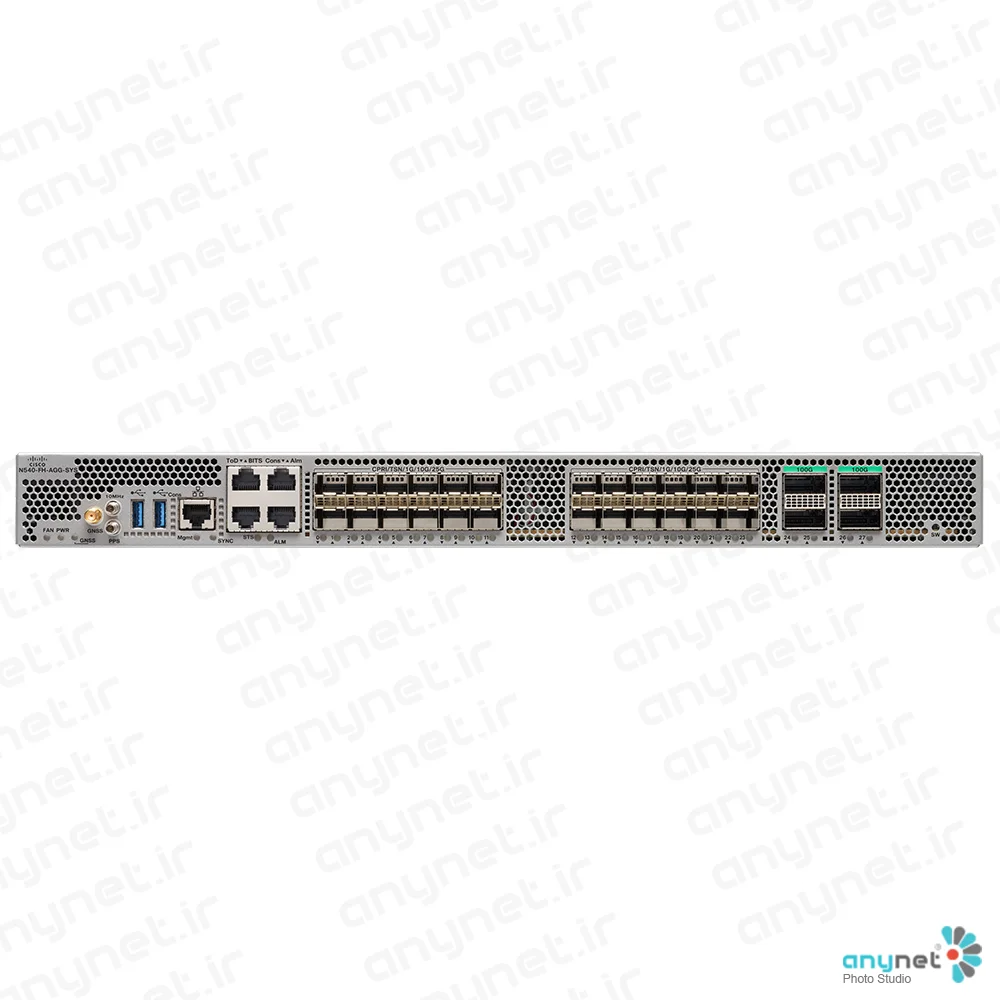

Cisco N540-FH-AGG-SYS Router
- Global Price List Information (GPL)
-
Model: N540-FH-AGG-SYS
-
Description:
-
Price: USDLast Update:
- End-of-Sale and End-of-Life Information (EOL/EOS)
- Release Date:
- End-of-Sale Date:
- End-of-Support Date:
The telecommunications industry is currently facing significant pressure to modernize Radio Access Network (RAN) infrastructures. As mobile operators strive to meet the surging bandwidth demands of 5G and legacy services, they must shift toward more efficient, cloud-scale, and virtualized architectures. This evolution is essential for reducing the high capital and operating expenditures associated with traditional network deployments.
Cisco’s Network Convergence System (NCS) 540 Fronthaul Routers are designed to address these challenges by providing a robust, software-defined foundation for modern mobile networks. By supporting Centralized RAN (CRAN) architectures, these routers help operators disaggregate base stations and centralize control functions, ultimately improving performance, scalability, and overall operational economics.
Product overview
The Cisco NCS 540 Fronthaul Router portfolio consists of two primary models: the N540-FH-CSR-SYS, designed for remote indoor cell site routing, and the N540-FH-AGG-SYS, which serves as an aggregation router. Both platforms are built on high-performance, low-latency ASICs and are enhanced with Field-Programmable Gate Arrays (FPGAs). This unique hardware combination allows for the flexibility needed to adapt to evolving radio interface specifications, including CPRI, eCPRI, and Radio over Ethernet (RoE).
These devices are temperature-hardened, compact, and power-efficient, making them suitable for a variety of deployment environments, including indoor and outdoor cabinets. They run on the carrier-class Cisco IOS XR Software, which provides advanced automation, network visibility, and programmability. By integrating these routers into the Cisco Converged SDN Transport architecture, service providers can simplify their end-to-end network operations while protecting their long-term investments in 5G technology.
Features and benefits
- High-Performance Transport: Delivers high-speed, ultra-low latency forwarding (typically <10 μs) to meet the strict requirements of 5G radio transport.
- Programmable Architecture: Utilizes an FPGA-enhanced design that allows for rapid adaptation to changing industry standards and radio interface processing.
- Precise Synchronization: Supports advanced timing and frequency synchronization, including integrated GNSS receivers and IEEE 1588-2008 PTP, essential for modern radio techniques.
- Operational Efficiency: Powered by Cisco IOS XR Software, offering automation, application awareness, and simplified management through open APIs (NETCONF/gRPC/YANG).
- Hardware Versatility: Features a small 1RU form factor with front-to-back airflow and temperature-hardened components for flexible installation.
- Interface Flexibility: Provides a wide range of connectivity options, including 10/25/100G Ethernet and various CPRI rates (3 through 8).
- Comprehensive QoS: Includes rich Quality of Service capabilities, such as hierarchical queuing and deep packet buffering, to ensure service level agreements (SLAs) are met.
- Investment Protection: Designed as a scalable, converged access platform that lowers the total cost of ownership (TCO) for mobile operators.
Overview
Radio Access Network (RAN) decisions are important and deserve a lot of attention. Given the large number of cell sites already in their networks, and those that will be added to meet the growing bandwidth demands from subscribers, RAN purchases can account for up to 80 percent of mobile operators’ Capital Expenditures (CapEx). Additionally, it is estimated that RAN Operating Expenses (OpEx) account for 60 percent of TCO. Consequently, there is tremendous pressure on mobile operators to operate more efficiently and improve operational economics while meeting the increasing demands of legacy wireline, wireless services, and new 5G offerings.
Up to now, the RAN has been based on legacy network technology. However, the increase in base stations to support 4G LTE expansions, and new 5G service introductions, is driving Mobile Network Operators (MNOs) to seek out new densification strategies. It is time for the RAN to evolve to become cloud scale, software defined, and virtualized. To this end, industry forums such as the Open RAN Alliance, IEEE Subcommittees, and the CPRI Cooperation, are working with Service Providers (SPs), to develop and test new densification strategies that can help them realize their business objectives and improve their TCO.
These densification strategies have been focused on demand for Cloud RAN or Centralized RAN (CRAN) architectures that are open, software defined, virtualized, and cloud scalable. CRAN disaggregates base stations by separating Radio Units (RUs) from Radio Equipment Controllers (RECs) and centrally locates these REC functions in regional/distributed data centers. This approach helps lower costs and improve performance and scalability.
The Cisco Network Convergence Systems 540 Fronthaul Routers (NCS540) are key elements of the Cisco Converged SDN Transport architecture. The solution and the routers are designed to meet and exceed stringent bandwidth, latency, and scalability performance demands of 5G now and in the foreseeable future. This solution simplifies the mobile network architecture end to end and significantly reduces operator TCO.
The Cisco Network Convergence Systems 540 Fronthaul Router portfolio is fully programmable, permitting customers to extend xHaul capabilities as specifications continue to evolve. They are based on high- performance, low-latency, next-generation Application Specific Integrated Circuits (ASICs) extended with a Field-Programmable Gate Array (FPGA) that permits the flexibility for quickly adapting to evolving radio interface processing specifications for CPRI, eCPRI, and Radio over Ethernet (ROE). Cisco has built these platforms with requisite hardware resources to permit operators to add RAN functions in a hosted model leveraging the built-in powerful FPGA. Leveraging a FPGA-enhanced architecture over a fixed ASIC pipeline, the Cisco Fronthaul Router product family offers the flexibility required to address both short-term and long-term mobile transport requirements. The new Cisco Fronthaul Router portfolio is truly designed to protect your investments in 5G and beyond.
These fronthaul routers are extensions of the comprehensive Cisco Network Convergence Systems Router portfolio designed for cost-effective delivery of next-generation services and applications. As such these routers are temperature-hardened, high-throughput, small form factor, low-power-consumption devices suitable for a number of deployments and configurations. They are powered by the industry-leading carrier-class version of Cisco IOS XR Software designed for operational efficiency and service agility.
Cisco IOS XR Software offers advanced features such as programmability, application awareness, network visibility, and automation. The Cisco NCS 540 series of routers is an intelligent converged access platform which enables service providers to deliver next-level business and entertainment experiences.
Key product benefits
● High-speed and ultra-low latency forwarding to meet stringent radio transport requirements
● Converged services with optimized transport performance for fronthaul
● Flexible and fully programmable architecture to support evolving standards
● Precise timing and synchronization capabilities to support new radio techniques
● Consistent end-to-end IP network to simplify architecture and operations
● Open and automated management
● Lowest TCO for fronthaul
Key technical product highlights
● 1 RU small form factor with depth <600mm
● Front-to-back airflow
● Temperature hardened, suitable for deployments in indoor or outdoor cabinets*
● Power consumption,
◦ Cell Site: N540-FH-CSR-SYS: minimum <250W, typical <285W, maximum 325W
◦ Aggregation: N540-FH-AGG-SYS: minimum <650W, typical <675W, maximum700W
● Versatile Ethernet interface options: 10/25/100G
● CPRI interface options: Rates 3/4/5/6/7/8
● Low latency forwarding, typically <10 µs
● Precise frequency and phase/time synchronization using the latest industry standards
● Integrated GNSS receiver
● Rich Quality of Service capabilities for different SLAs
● MEF 3.0 Compliant
● Excellent manageability
● Flexible consumption model
Images shown N540-FH-CSR-SYS and N540-FH-AGG-SYS
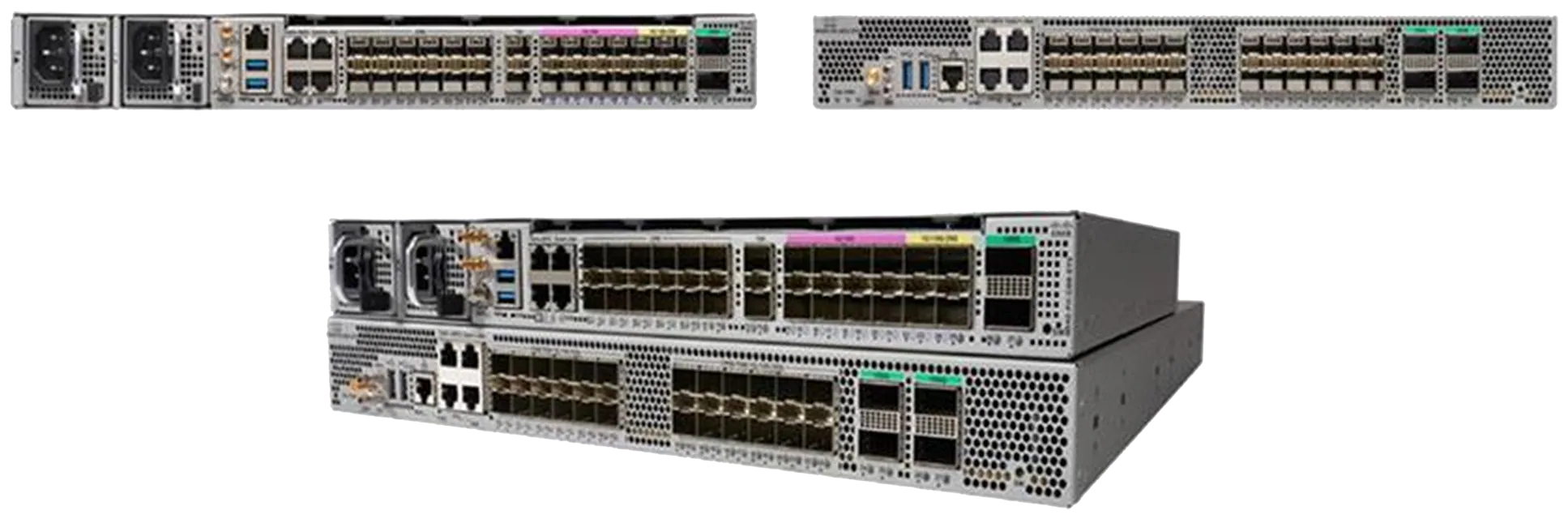
Cisco NCS 540 Fronthaul Router Family
Table 1. NCS 540 Fronthaul Router Model Comparison
| Chassis PID |
N540-FH-CSR-SYS (Remote Indoor CSR) |
N540-FH-AGG-SYS (Aggregation Router) |
| CPU Memory Storage |
8-core 1.7Ghz x86 CPU 8GB DRAM 32GB storage |
8-core 1.7Ghz x86 CPU 8GB DRAM 32GB storage |
| Interfaces |
8xCPRI Option 3-8 + *4x1/10G/CPRI 3-8 + 8x1/10G + 4x1/10/25G + 2x10/25G (802.1Qbu) + 2x100G *Universal Port = Port can be used for CPRI, eCPRI, Ethernet (1/10GE) |
*24x1G/10G/25G (802.1Qbu, CPRI option 3-8) + 4x100G *Universal Port = Port can be used for CPRI, eCPRI, Ethernet (1/10/25GE) |
| Throughput |
Up to 300 Gbps |
Up to 900 Gbps |
| Power Supplies Fans Airflow |
2 hot-swappable AC/DC power supplies provide 1+1 redundancy 6 fans provide 5+1 redundant system cooling Front-to-back airflow |
2 hot-swappable AC/DC power supplies provide 1+1 redundancy 6 modular fans provide 5+1 redundant system cooling Front-to-back airflow |
| Temperature Range |
I-Temp: -40°C to+65°C at 1,000ft +60°C at 6,000ft +50°C at 13,000ft |
C-Temp: 0°C to +55°C at 1,000ft +50°C at 6,000ft +45°C at 13,000ft |
| Surge Rating As per IEC 61000-4-5 |
AC: 1kV DM, 2kV CM DC: 1kV DM, 1kV CM |
AC: 1kV DM, 2kV CM DC: 1kV DM, 1kV CM |
| Timing |
SyncE, PTP Internal GNSS receiver SW* Interfaces: 1pps, 10MHz, ToD, antenna for GNSS Class C |
SyncE, PTP Internal GNSS receiver SW* Interfaces: 1pps, 10MHz, ToD, antenna for GNSS Class C |
| Physical Specification |
1RU Depth: 38.1cm 1.72 in. x 17.5 in. x 15 in (H x W x L) Weight: 7.55 kg |
1RU Depth: 58cm 1.72 in. x 17.5 in. x 22.82 in (H x W x L) Weight: 11.3 kg |
Table 2. Software feature support on NCS 540 Fronthaul Routers in Cisco IOS XR
| Description |
Specification |
| Layer 2 |
Layer 2 forwarding and bridging Bridge Domains (BD) Ethernet Flow Point (EFP) IEEE 802.1Q VLANs and Q-in-Q Ethernet Link Aggregation Group (LAG) Link Aggregation Control Protocol (LACP) 802.3ad G.8032 Jumbo frames on all ports |
| Layer 3 |
IPv4 and IPv6 unicast routing Layer 3 interfaces: physical interfaces and sub-interfaces Virtual Routing and Forwarding (VRF) Open Shortest Path First (OSPFv2, OSPFv3) Intermediate System to Intermediate System (ISIS, ISISv6) Multiprotocol Border Gateway Protocol (MP-BGP) Equal-Cost Multipath (ECMP) Bidirectional Forwarding Detection (BFD) Virtual Router Redundancy Protocol (VRRP) Integrated Routing Bridging (IRB) with Bridge Virtual Interface (BVI) Generic Routing Encapsulation (GRE) |
| MPLS |
Label switching (LER, LSR) Label Distribution Protocol (LDP) BGP Labeled Unicast (BGP-LU) MPLS Traffic Engineering with RSVP-TE Point-to-point L2VPN – Static, T-LDP, EVPN-VPWS Multipoint L2VPN – VPLS, EVPN L2/L3 EVPN with Anycast IRB 6PE, 6VPE IP Loop-Free Alternate (LFA) Fast Reroute (FRR) RSVP-TE Fast Reroute (FRR) |
| Segment Routing (SR) |
Segment Routing with MPLS data plane (SR-MPLS) Segment Routing with IPv6 data plane (SRv6) ** ISIS, OSPF, BGP extensions to segment routing BGP Egress Peering Engineering (BGP-EPE) Segment Routing Traffic Engineering (SRTE) Segment Routing Path Computation Element (SR-PCE) Topology Independent Loop-Free Alternate (TI-LFA) Segment Routing On-Demand Next-hop (SR-ODN) |
| Multicast |
IPv4 and IPv6 multicast routing PIM-SM, PIM-SSM IGMPv3, MLDv2 mLDP mVPN P2MP-TE |
| Quality of Service (QoS) |
Class-based 3-level Hierarchical QoS Virtual Output Queueing (VOQ) Policing, Shaping Multi-level priority queuing Classification based on L2/L3/L4 fields Remarking Weighted Random Early Detection (WRED) Deep packet buffer |
| Timing |
SyncE with ESMC Integrated GNSS receiver IEEE 1588-2008 PTP T-GM, T-BC, T-TSC G.8265.1, G.8275.1, G.8275.2 G.8273.2 Class B/C |
| Security |
Control-plane and management plane protection Local Packet Transport Services (LPTS) Authentication, Authorization, and Accounting (AAA) Terminal Access Controller Access-Control System Plus (TACACS+) Secure Shell (SSH) Layer 3 ingress and egress ACLs for IPv4 and IPv6 Layer 2 ingress ACLs Unicast Reverse Path Forwarding (Unicast RPF) |
| OAM |
CDP, LLDP, ICMP, DHCP Relay IP SLA MPLS OAM Ethernet OAM: CFM, Y.1731 DM/SLM TWAMP Model/Event Driven Telemetry Netflow SPAN/ERSPAN |
| Manageability |
CLI SNMP MIB NETCONF/gRPC (XML, JSON, GPB) YANG models (native, open: OpenConfig, IETF) RPM-based SW infrastructure Zero-Touch Provisioning (ZTP) with iPXE 3rd party application hosting on N540-24Z8Q2C-SYS |
Supported transceiver modules
Please refer to Transceiver Module Group (TMG) Compatibility Matrix for the NCS 540 Series supported transceivers.
Environment
Table 3. Environmental properties for NCS 540 fixed systems
| Normal operating temperature |
Industrial temperature: –40°C to +65°C (1,000 ft.), +60°C (6,000 ft.), +45°C (13,000 ft.) Commercial temperature: 0°C to +55°C (1,000 ft.),+50°C (6,000 ft.), +45°C (13,000 ft.) |
| Nonoperating (storage) temperature |
–40 to 70°C (–40 to 158°F) |
| Operating humidity |
NCS 540: 15% to 85% (noncondensing) except |
| Storage (relative) humidity |
5% to 95% at 40°C per NEBS GR-63-Core |
| Altitude |
0 to 13,000 ft. |
| Power |
Worldwide ranging AC (90–265V; 50–60 Hz) Worldwide ranging DC (–40V to –72V) |
Regulatory standards compliance
Table 4. Regulatory standards compliance: Safety and EMC at FCS
| Specification |
Description |
| Regulatory compliance |
Products comply with CE markings according to directives 2004/108/EC and 2006/95/EC |
| Network Equipment Building Standards (NEBS) |
Designed to meet GR-63-CORE, GR-1089-CORE and GR-3108 Class-2 |
| Safety |
UL 60950-1 Second Edition CAN/CSA-C22.2 No. 60950-1 Second Edition EN 60950-1 Second Edition IEC 60950-1 Second Edition AS/NZS 60950-1 GB4943 |
| EMC standards |
47CFR Part 15 (CFR 47) Class A AS/NZS CISPR22 Class A CISPR22 Class A EN55022 Class A ICES003 Class A VCCI Class A EN61000-3-2 EN61000-3-3 KN22 Class A CNS13438 Class A |
| EMC immunity |
EN55024 CISPR24 EN300386 KN 61000-4 series |
| ETSI |
ETS/EN 300 119 Part 4 ETS/EN 300 019 - Storage: Class 1.2, Transportation: Class 2.3, In- Use/Operational: Class 3.2 ETS/EN 300 753 |
| RoHS |
The product is RoHS-6 compliant with exceptions for leaded-ball grid-array (BGA) balls and lead press-fit connectors |
Ordering information
Table 5. Router Chassis ordering information for the NCS 540 fronthaul platform
| Router PID |
N540-FH-CSR-SYS (Remote Indoor CSR) |
N540-FH-AGG-SYS (Aggregation Router) |
| Description |
8xCPRI Option 3-8 + *4x1/10G/CPRI 3-8 + 8x1/10G + 4x1/10/25G + 2x10/25G (802.1Qbu) + 2x100G *Universal Port = Port can be used for CPRI, eCPRI, Ethernet (1/10GE) |
*24x1G/10G/25G (802.1Qbu, CPRI option 3-8) + 4x100G *Universal Port = Port can be used for CPRI, eCPRI, Ethernet (1/10/25GE) |
| Power Supplies Fans Accessories |
Power Supply: N540-PWR400-A N540-PWR400-D Rack Mounting Kits: N540-RKM-19-FHC N540-RKM-23-FHC N540-RKM-ETSI-FHC Cable Management Bracket: N540-CBL-BRKT-FHC |
Power Supply: N540-PWR750-A N540-PWR750-D Fan Assembly: N540-FAN-FHA Rack Mounting Kits: N540-RKM-19-FHA N540-RKM-23-FHA N540-RKM-ETSI-FHA N540-RKM-4PST-FHA Cable Management Bracket: N540-CBL-BRKT-FHA |
| Software |
XR-7.3-K9-AC-TRK / TRK-7.3-54-K9 |
XR-7.3-K9-AC-TRK / TRK-7.3-54-K9 |
Table 6. Ordering information for software licenses available on NCS 540 Fronthaul Routers
| Product ID (PID) |
Description |
| ESS-AC-10G-RTU-1 |
Access Essentials SW Right-to-Use v1.0 per 10G |
| ADV-AC-10G-RTU-1 |
Access Advantage w/o Essentials SW RTU v1.0 10G |
| ADN-AC-10G-RTU-1 |
Access Advantage w/ Essentials SW RTU v1.0 10G |
| ESS-ADN-AC-10G-RT |
Access Essentials to Advantage Upgrade RTU per 10G |
| ESS-AC-10G-SIA-3 |
Access Essentials SIA 10G 3-5 year term |
| ESS-AC-10G-SIA-5 |
Access Essentials SIA 10G 5-10 year term |
| ADV-AC-10G-SIA-3 |
Access Advantage w/o Essentials SIA 10G 3-5 year term |
| ADV-AC-10G-SIA-5 |
Access Advantage w/o Essentials SIA 10G 5-10 year term |
| ADN-AC-10G-SIA-3 |
Access Advantage w/ Essentials SIA 10G 3-5 year term |
| ADN-AC-10G-SIA-5 |
Access Advantage w/ Essentials SIA 10G 5-10 year term |
| ESS-ADN-AC-10G-S3 |
Access Essentials to Advantage Upgrade SIA 10G 3-5 yrs |
| ESS-ADN-AC-10G-S5 |
Access Essentials to Advantage Upgrade SIA 10G 5-10 yrs |
| N540-24Z8Q2C-FC-SW |
NCS 540 Series additional Software Licenses (RTU, SIA) |
Table 7. Ordering information for power cables supported on NCS 540 Fronthaul Routers
| Part number |
Description |
| CAB-AC-SA |
Power Cord - South Africa, 16/10A,250V,1830mm, -40C to +85C |
| CAB-AC-ARG |
Power Cord - Argentina, 10A,250V,2500mm, -40C to +85C |
| CAB-AC-ISR |
Power Cord - Israel, 16/10A,250V,2500mm, -40C to +85C |
| CAB-AC-TAI |
Power Cord - Taiwan, 15/10A,125V,2500mm, -40C to +85C |
| CAB-AC-CHI |
Power Cord - China, 10A,250V,2500mm, -40C to +85C |
| CAB-AC-KOR |
Power Cord - Korea, 16/10A,125V,2500mm, -40C to +85C |
| CAB-AC-EUR |
Power Cord - Europe, 16/10A,250V, 2500mm, -40C to +85C |
| CAB-AC-ITL |
Power Cord - Italy, 10A,250V, 2500mm, -40C to +85C |
| CAB-AC-UK |
Power Cord - UK, 13/10A, 250V, 2500mm, -40C to +85C |
| CAB-AC-AUS |
Power Cord - Australia, 10A,250V,2500mm, -40C to +85C |
| CAB-AC-US |
Power Cord - US, 15A,125V,2500mm, -40C to +85C |
| CAB-AC-BRA |
Power Cord - Brazil, 10A,250V,2500mm, -40C to +85C |
| CAB-AC-IND |
Power Cord - India, 16/10A,250V,2500mm, -40C to +85C |
| CAB-AC-SUI |
Power Cord - Swiss, 10A,250V,2500mm, -40C to +85C |
| CAB-AC-SA |
Power Cord - South Africa, 16/10A,250V,1830mm, -40C to +85C |
| CAB-AC-ARG |
Power Cord - Argentina, 10A,250V,2500mm, -40C to +85C |
| Model | N540-FH-AGG-SYS |