


Cisco Nexus N9K-C9364C-H1 Switch
- Global Price List Information (GPL)
-
Model: N9K-C9364C-H1
-
Description:
-
Price: USDLast Update:
- End-of-Sale and End-of-Life Information (EOL/EOS)
- Release Date:
- End-of-Sale Date:
- End-of-Support Date:
The Cisco N9364C-H1 switch is a high-performance, 64-port 100G fixed switch designed to meet the demanding requirements of modern data centers. As artificial intelligence and machine learning applications continue to grow, this switch provides the necessary latency, congestion management, and telemetry capabilities to support next-generation leaf and spine network architectures. It is built to offer a power-efficient and compact solution for large-scale cloud and data center environments that require high-density 100G fabrics.
By integrating with advanced management tools like Cisco Nexus Dashboard Insights and the Cisco Nexus Dashboard Fabric Controller, the N9364C-H1 enables teams to effectively manage, troubleshoot, and analyze their IT infrastructure. The platform is engineered to provide the visibility, automation, and security needed to build a robust and high-performance network fabric, ensuring that organizations can maintain reliable operations while scaling their infrastructure to meet evolving business needs.
Product overview
The Cisco N9364C-H1 is a 2-Rack-Unit (2RU) switch based on Cisco Cloud Scale technology, specifically designed to support modern cloud architectures. It features 64 ports of 100 Gigabit Ethernet, delivering a total bandwidth of 12.8 Tbps and 2.5 bpps across all ports. Beyond its primary 100G capability, the switch offers flexibility by supporting various lower port speeds, including 10, 25, and 40 Gbps, making it a versatile choice for diverse aggregation needs within the data center.
To ensure high performance and data integrity, the switch is equipped with 40MB of on-die packet buffer and includes MACsec capability on 16 of its ports. The hardware is designed for high availability, featuring hot-swappable power supply units and fans with N+1 redundancy. Additionally, the switch supports a wide range of subscription-based licensing models, including Cisco Data Center Network (DCN) Premier, Advantage, and Essentials, allowing users to enable advanced Layer-3 routing and management features as required by their specific network environment.
Features and benefits
- Architectural Flexibility: Supports Cisco ACI, VXLAN EVPN, and a comprehensive set of Layer-2 and Layer-3 protocols, including IPv4/IPv6 unicast and multicast routing.
- AI/ML Optimization: Features advanced congestion management algorithms such as Priority Flow Control (PFC), Explicit Congestion Notification (ECN), and Weighted Random Early Detection (WRED) to ensure lossless transport for RoCE.
- Intelligent Buffer Management: Utilizes Approximate Fair Dropping (AFD) and Dynamic Packet Prioritization (DPP) to distinguish between "mice" and "elephant" flows, optimizing performance during link congestion.
- Extensive Programmability: Offers Day-0 automation via POAP and supports modern DevOps tools like Ansible, along with REST APIs and model-driven telemetry for enhanced network observability.
- High Scalability and Security: Provides flexible forwarding tables supporting up to two million entries and includes IEEE 802.1ae MACsec on all ports for physical-layer traffic encryption.
- Operational Efficiency: Includes Cisco Nexus Dashboard services for simplified automation, analytics, and visibility, alongside In-Service Software Upgrades (ISSU) to minimize downtime.
- Hardware Reliability: Features 128-way Equal-Cost MultiPath (ECMP) routing to prevent bottlenecks and hot-swappable components to ensure continuous operation.
Product overview
Artificial-Intelligence and Machine-Learning (AI/ML) applications are being used increasingly in today’s data centers, and the Cisco N9000 Series Switches have the hardware and software capabilities to provide the right latency, congestion-management mechanisms, and telemetry to meet the requirements of those applications. The Cisco N9000 Series Switches address the need for high-performance, power-efficient, compact switching in the network infrastructures and are designed to support high-density 100G fabrics for next-generation leaf and spine designs.
Large-cloud and data-center networking teams require a flexible, reliable solution that efficiently manages, troubleshoots, and analyzes their IT infrastructure. In addition, they need security, automation, visibility, analytics, and assurance. Coupled with tools such as Cisco Nexus Dashboard Insights for visibility and Cisco Nexus Dashboard Fabric Controller for automation, Cisco N9000 Series Switches are ideal platforms to build a high-performance AI/ML network fabric.
The Cisco N9364C-H1 switch introduces high-density 100G aggregation for the data center fabric. It also offers various lower port speeds and densities, including 10, 25, and 40 Gbps. The Cisco N9364C-H1 switch is based on Cisco Cloud Scale technology equipped to support next-generation cloud architecture.
The Cisco N9364C-H1 is a 2-Rack-Unit (2RU) 64-port 100 Gigabit Ethernet switch that supports 12.8 Tbps of bandwidth and 2.5 bpps across all ports. The switch provides 40MB of on-die packet buffer with MACsec capability on 16 ports.
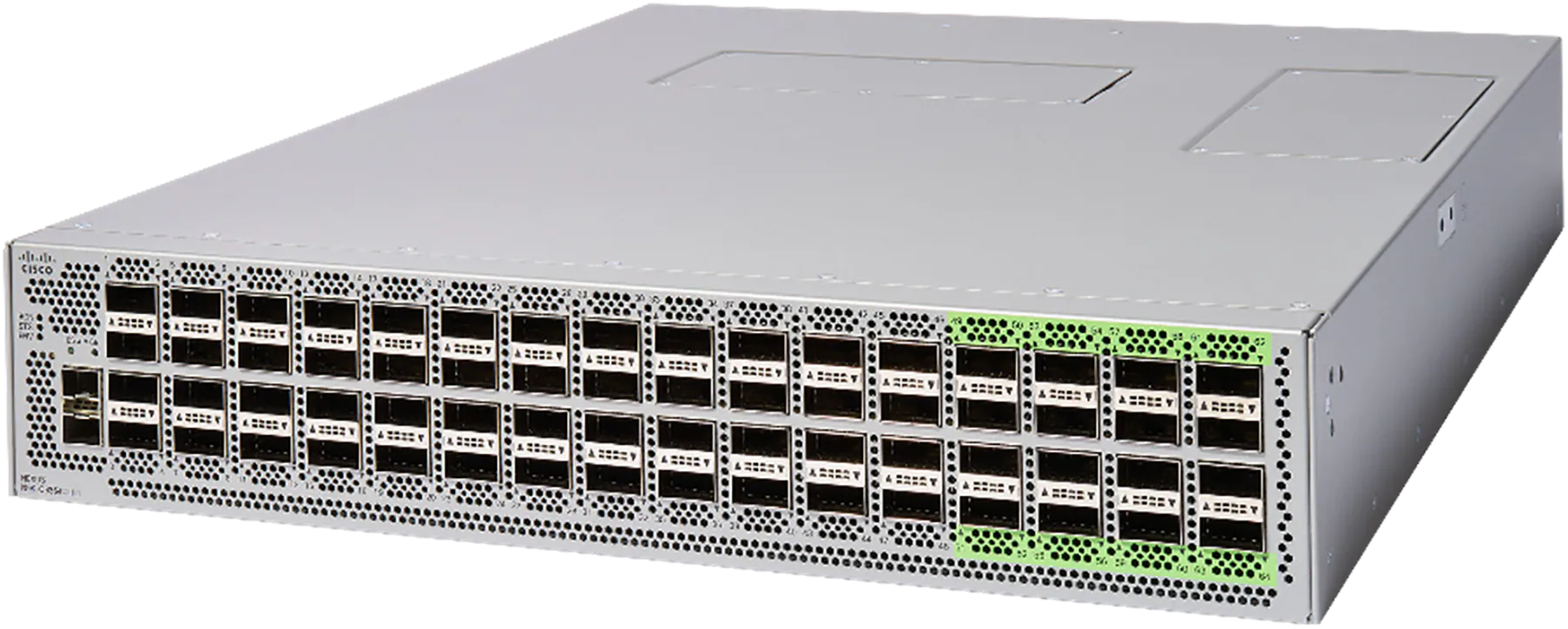
Cisco N9364C-H1 switch, front view
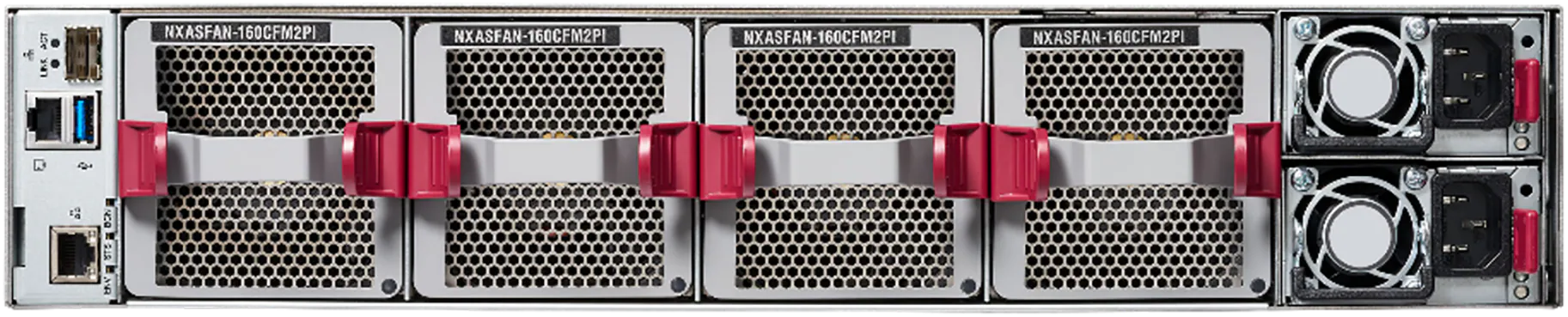
Cisco N9364C-H1 switch, rear view
Features and benefits
Table 1. Features and benefits
| Features |
Description and benefits |
| Architectural flexibility |
Cisco N9000 Series Switches support Cisco Application Centric Infrastructure (Cisco ACI), Cisco NX-OS VXLAN EVPN, Cisco IP Fabric for Media, Cisco Nexus Data Broker, and IP routed on Ethernet switched Layer-2 fabrics using a comprehensive set of unicast and multicast IPv6/IPv4 and Ethernet protocols.
● Purpose-built Cisco NX-OS Software operating system with comprehensive, proven innovations. The operating system is modular, with a dedicated process for each routing protocol: a design that isolates faults while increasing availability.
● Industry-leading Cisco Software-Defined Networking (SDN) solution with Cisco ACI support. Cisco ACI is a holistic, intent-driven architecture with centralized automation and policy-based application profiles.
● Support for standards-based VXLAN EVPN fabrics, inclusive of hierarchical multisite support (Refer to VXLAN network with MP-BGP EVPN control plane for more information.)
● Three-tier BGP architectures, enabling horizontal, nonblocking IPv6 network fabrics at web scale
● Comprehensive protocol support for Layer-3 (v4 and v6) unicast and multicast routing protocol suites, including BGP, Open Shortest Path First (OSPF), Interior System to Interior System (IS-IS), Enhanced Interior Gateway Routing Protocol (EIGRP), Routing Information Protocol Version 2 (RIPv2), Protocol Independent Multicast Sparse Mode (PIM-SM), Source-Specific Multicast (SSM), and Multicast Source Discovery Protocol (MSDP)
● Segment Routing (SR and SRv6) allows the network to forward Multiprotocol Label Switching (MPLS) packets and engineer traffic without Resource Reservation Protocol (RSVP) Traffic Engineering (TE). It provides a control-plane alternative for increased network scalability and virtualization. Cisco IP Fabric for Media helps you migrate from an SDI router to an IP-based infrastructure. In an IP-based infrastructure, a single cable has the capacity to carry multiple bidirectional traffic flows and can support different flow sizes without requiring changes to the physical infrastructure.
● Cisco Nexus Dashboard Data Broker provides customers complete observability into their network and solution(s) that can help them identify and mitigate security threats, realize and remediate performance bottlenecks, adhere to data compliance, and have insight into capacity-planning operations.
|
| Extensive programmability |
● Day-0 automation through Power On Auto Provisioning (POAP), drastically reducing provision time
● Industry-leading integrations for leading DevOps configuration management applications, such as Ansible. Extensive native YANG, and industry-standard OpenConfig model support through RESTCONF/NETCONF/gNMI
● REST API interacting with Data Management Engine (DME)
● Model-Driven telemetry, which enhances network observability
● Third-party application-hosting using Cisco Application Framework (CAF)
|
| High scalability, flexibility, and security |
● Flexible forwarding tables that support up to two million shared entries
● Flexible shared ingress and egress of a maximum of 28,000 ACL entries
● IEEE 802.1ae MAC Security (MACsec) capability on all ports, which allows traffic encryption at the physical layer and provides secure server, border leaf, and leaf-to-spine connectivity
|
| AI/ML networking |
Cisco N9000 Series Switches support innovative congestion management and flow-control algorithms along with the right latency and telemetry to meet the design requirements of AI/ML fabrics.
● Priority Flow Control (PFC) is a key capability supported on Cisco N9000 Series Switches that prevents Ethernet frame drops by signaling, controlling, and managing Ethernet flows along a path by sending pause frames to appropriate senders.
● The platform also supports Explicit Congestion Notification (ECN), which provides end-to-end notification per IP flow by marking packets that experienced congestion, without dropping traffic. The platform is capable of tracking ECN statistics, including the number of marked packets that have experienced congestion.
● The platform offers lossless transport for Remote Direct Memory Access (RDMA) over converged Ethernet (RoCE) with support of Data Center Bridging (DCB) protocols:
◦ Enhanced Transmission Selection (ETS) reserves bandwidth per priority class in network contention situations. ◦ Data Center Bridging Exchange Protocol (DCBX) can discover and exchange priority and bandwidth information with endpoints.
● Weighted Random Early Detection (WRED) is a congestion-avoidance technique that allows Cisco N9000 Series Switches to detect and react to congestion in the network by marking flows that could cause congestion.
● The platform offers Cisco’s innovative intelligent buffer management, which offers the capability to distinguish mice and elephant flows and apply different queue-management schemes to them based on their network forwarding requirements in the event of link congestion.
● Approximate Fair Dropping (AFD) with Elephant Trap (ETRAP). By using ETRAP, AFD distinguishes long-lived elephant flows from short-lived mice flows. ETRAP measures the byte counts of incoming flows and compares this against the user-defined ETRAP threshold. After a flow crosses the threshold, it becomes an elephant flow.
● Dynamic Packet Prioritization (DPP) provides the capability of separating mice flows and elephant flows into two different queues so that buffer space can be allocated to them independently.
|
| Hardware and software high availability |
● Virtual Port-Channel (vPC) technology provides Layer-2 multipathing through the elimination of Spanning Tree Protocol (STP).
● Capability to link fabrics in a VXLAN environment, eliminating the need for peer-to-peer VPC. The 128-way Equal-Cost MultiPath (ECMP) routing enables the use of Layer-3 fat-tree designs. This feature helps organizations prevent network bottlenecks, increase resiliency, and add capacity with little network disruption.
● Software-Maintenance Upgrades (SMUs) contain fixes for specific defects. They provide a quick resolution of critical issues.
● In-Service Software Upgrades (ISSUs) allow upgrades of device software while the switch continues to forward traffic. ISSUs reduce or eliminate the downtime typically caused by software upgrades.
● The switches use hot-swappable Power-Supply Units (PSUs) and fans with N+1 redundancy.
|
| Cisco Nexus Dashboard |
Cisco Nexus Dashboard is a platform that transforms data-center and cloud-network operations through simplicity, automation, and analytics. Cisco Nexus Dashboard Fabric Controller (NDFC), Cisco Nexus Dashboard Insights (NDI), Cisco Nexus Dashboard Orchestrator (NDO), and Cisco Nexus Dashboard Data Broker (NDDB) are integrated as services into Cisco Nexus Dashboard. Cisco Nexus Dashboard is included with all Cisco N9000 switch tiered licenses. Cisco Nexus Dashboard Fabric Controller requires a Cisco Data Center Networking (DCN) Essentials license, Cisco Nexus Dashboard Orchestrator requires a Cisco DCN Advantage license, and Cisco Nexus Dashboard Insights requires a Cisco DCN Premier or a Cisco DCN Day-2 Ops add-on license. |
Licensing
The default system software has a comprehensive Layer-2 security and management feature set. To enable additional functions, including Layer-3 IP unicast and IP multicast routing and Cisco Nexus Data Broker, you must install additional licenses. The Cisco N9364C-H1 switch uses the XF2 class Cisco Data Center Network (Cisco DCN) Premier, Advantage, and Essentials subscription licenses. The licensing guide illustrates the software packaging and licensing available to enable advanced features. For the latest software release information and recommendations, refer to the release notes.
Product specifications
Table 2. Cisco N9364C-H1 switch specifications
| Item |
Cisco N9364C-H1 switch |
| Technical |
● 64-port 100G QSFP28 ports
● Supports 4 x 10G and 4 x 25G breakout
● On-die buffer: 40MB
● System memory: 32GB, expandable to 64GB
● SSD: 128GB
● USB: 1 port
● RS-232 serial console ports: 1
● Management ports: 2
● CPU: 4 cores
|
| Power and cooling |
● Power: 1400W AC, 2000W DC, 2000W HV
● Hot-swappable, 4 fans, 3+1 redundancy
● Typical power: 605 W
● Maximum power: 1100 W
|
| Physical and environmental |
● Dimensions (H x W x D): 3.39 x 17.41 x 22.28 in. (8.6 x 44.2 x 56.6 cm)
● Acoustics:
◦ Port-side intake: ◦ at 50% fan speed: 77.5 dBA ◦ at 70% fan speed: 87.1 dBA ◦ at 90% fan speed: 92 dBA ◦ at 100% fan speed: 94.3 dBA ◦ Port-side exhaust: ◦ at 60% fan speed: 82.3 dBA ◦ at 80% fan speed: 90 dBA ◦ at 100% fan speed: 96.6 dBA
● Operating temperature: 32 to 104F (0 to 40C)
● Nonoperating (storage temperature): -40 to 131F (-40 to 55C)
● Humidity: 5 to 95% (non-condensing)
● Altitude: 0 to 13,123 ft (0 to 4000m)
● Mean Time Between Failure (MTBF): 192,380 hours
|
Table 3. Cisco N9364C-H1 switch power-supply specifications
| Model |
Cisco N9300 AC power supply |
Cisco N9300 DC power supply |
Cisco N9300 HV power supply |
| Output power |
1400 W |
2000 W |
2000 W |
| Input voltage |
10-127V AC 200-240V AC |
-40 to-72V DC |
100-127V AC 200-277V AC 240-380V DC |
| Input frequency |
47-63 Hz |
N/A |
50-60 Hz |
| Connector |
IEC 60320 C14 |
Amphenol C10-638976-000 |
Anderson Power product: Saf-D-Grid |
| Efficiency |
80PLUS Platinum efficiency rating |
N/A |
80PLUS Platinum efficiency rating |
Table 4. Performance and scalability specifications
| Item |
Cisco N9364C-H1 switch |
| Number of slices |
● 2 slices
|
| Maximum number of IPv4 Longest Prefix Match (LPM) routes* |
● ~2 million
|
| Maximum number of IPv4 host entries* |
● ~2 million
|
| Maximum number of IPv6 Longest Prefix Match (LPM) routes* Maximum number of IPv6 host entries* |
● ~1 million
● ~2 million
|
| Maximum number of MAC address entries* |
● ~1 million
|
| Maximum number of multicast routes |
● 256,000
|
| Number of Internet Group Management Protocol (IGMP) snooping groups |
● Maximum: 32,000
|
| Maximum number of access control list (ACL) entries |
● 14,000 shared ingress and egress/slice
Max: 28,000 shared ingress and egress |
| Maximum number of VLANs |
● 4096
**
|
| Number of Virtual Routing and Forwarding (VRF) instances |
● Maximum: 16,000
|
| Maximum number of ECMP paths |
● 128
|
| Maximum number of port channels* |
● 512
|
| Maximum number of links in a port channel* |
● 32
|
| Number of SPAN sessions |
● 32 (4 active)
|
| Maximum number of VLANs in Rapid Per-VLAN Spanning Tree (RPVST) instances |
● 4K
|
| Maximum number of Hot-Standby Router Protocol (HSRP) groups |
● 1000
|
| Maximum number of Multiple Spanning Tree (MST) instances |
● 64
|
| Flow-table size |
● 128K/slice
|
| Number of Network Address Translation (NAT) entries |
● 2000
|
| Number of output queues per physical port |
● 8
|
Table 5. Weight
| Part number |
Weight |
| N9K-C9364C-H1 without power supplies or fans |
30.8 lbs (14.0 kg) |
| N9K-C9364C-H1 with power supplies and fans |
44.0 lbs (20 kg) |
| NXA-PAC-1400W-PI / NXA-PAC-1400W-PE |
2.64 lbs (1.2 kg) |
| NXA-PDC-2KW-PI / NXA-PDC-2KW-PE |
2.42 lbs (1.1 kg) |
| NXASFAN-160CFM2PI |
1.3 lbs (0.6 kg) |
Supported optics modules
For details on the optical modules available and the minimum software release required for each supported optical module, visit here.
Ordering information
Table 6. Ordering information
| Part number |
Product description |
| N9K-C9364C-H1 |
Cisco N9300 64p 100G switch |
| N9K-C9364C-H1= |
Cisco N9300 64p 100G switch w/o power supply, fans |
| NXA-PAC-1400W-PI |
Cisco N9000 1400W AC power supply, port-side intake |
| NXA-PAC-1400W-PI= |
Cisco N9000 1400W AC power supply, port-side intake, spare |
| NXA-PAC-1400W-PE |
Cisco N9000 1400W AC power supply, port-side exhaust |
| NXA-PAC-1400W-PE= |
Cisco N9000 1400W AC power supply, port-side exhaust, spare |
| NXA-PDC-2KW-PI |
Cisco N9K 2KW DC PS, port-side intake |
| NXA-PDC-2KW-PI= |
Cisco N9K 2KW DC PS, port-side intake, spare |
| NXA-PDC-2KW-PE |
Cisco N9K 2KW DC PS, port-side exhaust |
| NXA-PDC-2KW-PE= |
Cisco N9K 2KW DC PS, port-side exhaust, spare |
| NXA-PHV-2KW-PI |
Cisco N2KW PHV power supply, port-side intake |
| NXA-PHV-2KW-PI= |
Cisco N2KW PHV power supply, port-side intake, spare |
| NXASFAN-160CFM2PI |
Cisco Nexus fan, 160CFM, port-side intake airflow /w EEPROM |
| NXASFAN-160CFM2PI= |
Cisco Nexus fan, 160CFM, port-side intake airflow /w EEPROM, spare |
| NXASFAN-160CFM2PE |
Cisco Nexus fan, 160CFM, port-side exhaust airflow /w EEPROM |
| NXASFAN-160CFM2PE= |
Cisco Nexus fan, 160CFM, port-side exhaust airflow /w EEPROM, spare |
| NXK-ACC-RMK2-2RU |
N3K/9K Fixed Rack Mount Kit, 2RU front and rear removal |
| NXK-ACC-RMK2-2RU= |
N3K/9K Fixed Rack Mount Kit, 2RU front and rear removal, spare |
Regulatory standards compliance
Table 7. Regulatory standards compliance: safety and EMC
| Specification |
Description |
| Regulatory compliance |
Product complies with CE Markings according to directives 2014/30/EU and 2014/35/EU |
| Safety |
● ANSI/UL 60950-1 2nd Edition and 62368-1 3rd Edition
● CAN/CSA-C22.2 No. 60950-1 2nd edition and 62368-1 3rd edition
● EN 62368-1 2nd Edition
● IEC 62368-1 3rd Edition
● AS/NZS 62368-1 3rd Edition
|
| EMC: emissions* |
● 47 CFR Part 15 Class A
● CISPR32 Class A
● CNS 15936
● EN 55032 Class A
● EN 61000-3-3
● EN IEC 61000-3-11
● EN IEC 61000-3-2
● EN61000-3-12
● ICES-003:Iss:7 Class A
● KS C 9832
● VCCI-CISPR 32 Class A
|
| EMC: immunity |
● CISPR24
● CISPR35
● EN55035
● EN/IEC61000-6-1
● EN 300 386
● EN61000-6-1
● EN61000-6-2
● IEC61000-6-1
● IEC61000-6-2
● KS C 9835
|
| RoHS |
● The product is RoHS-6 compliant with exceptions for leaded-Ball Grid-Array (BGA) balls and lead press-fit connectors.
|
| Model | N9K-C9364C-H1 |