


Cisco PVDM4-256 Module
- Global Price List Information (GPL)
-
Subcategory: Cisco 4400 Series Packet Voice/Fax DSP Modules
-
Model: PVDM4-256
-
Description: 256-channel DSP module
-
Price: 10,954.50 USDLast Update: 2021-08-09
- End-of-Sale and End-of-Life Information (EOL/EOS)
- Release Date:
- End-of-Sale Date:
- End-of-Support Date:
Cisco Packet Voice Digital Signal Processor Modules (PVDMs) are essential components designed to enhance the capabilities of the Cisco Catalyst 8000 Edge Platforms Family and the Cisco 4000 Series Integrated Services Routers (ISRs). These modules provide the necessary hardware to support high-density voice connectivity and advanced media services within Cisco Unified Communications solutions. By integrating these processors, organizations can achieve superior voice quality and media processing while maintaining a compact and efficient hardware footprint.
The PVDM architecture is built to handle the increasing demands of modern enterprise networks, offering scalable solutions that grow alongside business needs. Whether for small branch offices or larger deployments, these modules ensure that voice traffic is managed effectively, providing reliable performance for both traditional and IP-based communication environments.
Product overview
The Cisco PVDM lineup is categorized into three distinct form factors, each tailored to specific hardware slots and density requirements. The Motherboard PVDMs (PVDM4) are designed for direct installation onto the router motherboard or into T1/E1 Network Interface Modules (NIMs), supporting up to 256 channels. For higher density requirements, the PVDM Enhanced Services Modules (SM-X-PVDM) can be installed in SM-X slots, offering support for up to 3080 channels. Additionally, the NIM PVDM modules provide a flexible option for NIM slots, also supporting up to 256 channels.
These modules utilize advanced multicore DSP technology to manage complex voice tasks, including conferencing, transcoding, and media optimization. While the PVDM4 and NIM-PVDM modules are versatile enough to handle both TDM and IP-based voice services, the SM-X-PVDM modules are specifically optimized for IP-based voice applications. This modular approach allows businesses to customize their router configurations based on their specific voice traffic volume and infrastructure requirements.
Features and benefits
- T1/E1 Voice Support: Enables the packetization of digital voice into IP packets, facilitating seamless TDM digital voice applications.
- Conferencing Capabilities: Supports both ad hoc and meet-me conferencing across various codecs, integrated directly with Cisco Unified Communications Manager.
- Universal Transcoding: Allows for the conversion between different supported codecs, ensuring compatibility across diverse network environments.
- Transrating: Facilitates the connection of dissimilar networks by repacketizing codecs to match different packetization periods.
- Voice-Quality Management: Includes advanced features such as compression, voice-activity detection, jitter management, and ITU-T G.168 compliant echo cancellation with a 128-millisecond tail length.
- Energy Efficiency: Motherboard PVDM4 modules feature dedicated power-saving modes, allowing for a reduction of up to 5 watts per module when not in active use.
- Media Enhancement: Provides integrated tone detection, noise reduction, acoustic shock prevention, and gain control to ensure high-fidelity audio.
- Broad Codec Support: Compatible with a wide range of codecs, including G.711, G.722, G.729, iLBC, and iSAC, catering to various complexity and bandwidth needs.
Product overview
The Cisco Packet Voice Digital Signal Processor Modules (PVDMs) enable the Cisco Catalyst 8000 Edge Platforms Family and the Cisco 4000 Series Integrated Services Routers (ISRs) to provide rich-media capabilities such as high-density voice connectivity, conferencing, transcoding, media optimization, transrating, and secure voice for Cisco Unified Communications solutions. These new modules support unprecedented scale while allowing for a smaller solution footprint than ever before.
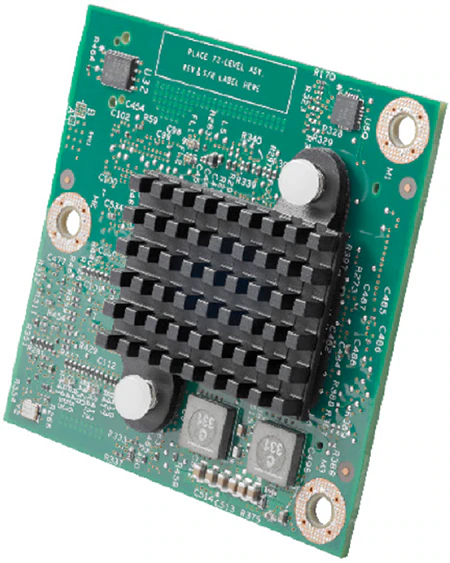
On-Board Motherboard PVDM (PVDM4-X)
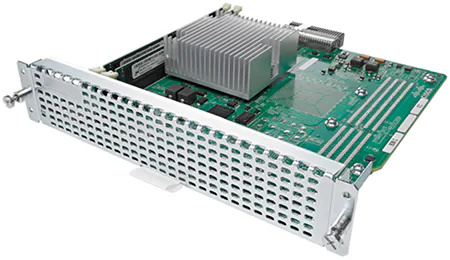
PVDM Enhanced Services Module (SM-X-PVDM)
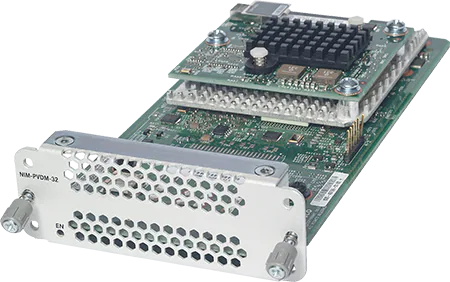
PVDM Network Interface Module (NIM-PVDM-X)
Features and benefits
The PVDMs support digital voice connections, conferencing, universal transcoding, and media optimization services:
●T1/E1 voice: One of the primary uses of PVDMs is to packetize digital voice into IP packets to enable Time-Division Multiplexing (TDM) digital voice applications.
●Conferencing: PVDM modules support ad hoc and meet-me conferencing with various codecs in conjunction with Cisco Unified Communications Manager and Cisco Unified Communications Manager Express.
●Universal transcoding: In conjunction with Cisco IOS Software, the PVDMs support universal transcoding, which allows conversion from any supported codec to any other supported codec.
●Transrating: The PVDMs support transrating, in which the same codec is repacketized in order to connect dissimilar networks that have different codec packetization periods.
●Voice-quality management: The PVDMs perform compression, voice-activity detection, jitter management, and echo cancellation. The echo cancellation offered in the PVDMs has a tail length of 128 milliseconds and complies with ITU-T G.168.
●Energy savings: The motherboard PVDMs (PVDM4s) offer multiple power-saving modes, including a power-saver mode when the module is not in use. In power-saver mode, each PVDM4 can save up to 5 watts of power.
The analog voice modules (FXS, FXO, and E/M) and Basic Rate Interface (BRI) digital voice modules for the Catalyst 8000 and the 4000 Series ISRs contain built-in, nonconfigurable Digital Signal Processors (DSPs) and do not require any additional PVDMs for voice packetization.
Refer to the PVDM Q&A for commonly asked questions.
Form factor and options
The Cisco PVDMs are available in three form factors with four supported densities in each form factor:
●Motherboard PVDMs (PVDM4) for densities up to 256 channels (Figure 1)
●PVDM enhanced Services Modules (SM-X-PVDM) for densities up to 3080 channels (Figure 2)
●NIM PVDM for densities up to 256 channels (Figure 3)
The motherboard PVDMs are supported on all Cisco 4000 Series ISRs except the ISR 4461. They can be plugged directly into the single slot on the router motherboard or into the Network Interface Module (NIM) that supports T1/E1 ports. A PVDM4 module plugged into the motherboard delivers IP-based voice services such as conferencing, media optimization, and transcoding only.
A PVDM4 module plugged into the T1/E1 NIM would be used for voice T1/E1 connectivity. Any excess channels can be reused toward other IP-based services supported on the motherboard slot. Enhanced DSP architecture accommodates a new packet-processing engine optimized for rich-media voice applications, while concurrently supporting the TDM-IP voice framework.
The PVDM enhanced services modules are supported on all Catalyst 8300s and ISRs that contain an SM-X slot - namely the Cisco 4331, 4351, 4451 and 4461 ISRs.
The PVDM network interface modules are supported on Catalyst 8300s and ISR 4461 all of which contain NIM slots.
The SM-X modules and the NIM PVDM modules support only IP-based voice services and cannot be used for TDM applications.
Table 1 lists the various PVDM options along with their slot requirements.
Table 1.Cisco PVDM Part Numbers and Slot Requirements
| Part Number |
Slot |
Description |
| PVDM4-32(=) |
On-board motherboard or T1/E1 module slot |
32-channel high-density voice DSP module, or spare |
| PVDM4-64(=) |
On-board motherboard or T1/E1 module slot |
64-channel high-density voice DSP module, or spare |
| PVDM4-128(=) |
On-board motherboard or T1/E1 module slot |
128-channel high-density voice DSP module, or spare |
| PVDM4-256(=) |
On-board motherboard or T1/E1 module slot |
256-channel high-density voice DSP module, or spare |
| SM-X-PVDM-500(=) |
Enhanced services module slot |
768-channel high-density voice DSP module, or spare |
| SM-X-PVDM-1000(=) |
Enhanced services module slot |
1024-channel high-density voice DSP module, or spare |
| SM-X-PVDM-2000(=) |
Enhanced services module slot |
2048-channel high-density voice DSP module, or spare |
| SM-X-PVDM-3000(=) |
Enhanced services module slot |
3080-channel high-density voice DSP module, or spare |
| NIM-PVDM-32(=) |
Network Interface module slot |
NIM PVDM with 32-channel DSP |
| NIM-PVDM-64(=) |
Network Interface module slot |
NIM PVDM with 64-channel DSP |
| NIM-PVDM-128(=) |
Network Interface module slot |
NIM PVDM with 128-channel DSP |
| NIM-PVDM-256(=) |
Network Interface module slot |
NIM PVDM with 256-channel DSP |
Codec support and capacity
The PVDM4 modules support a wide range of codecs of different complexities. They support all codecs supported by the Cisco 2800/3800 High-Density PVDMs (PVDM3s). Table 2 lists the codecs supported on the PVDM4 and SM-X-PVDM modules, and Table 3 gives the channel densities of the PVDM4, SM-X-PVDM and NIM-PVDM modules. Table 4 lists the media-enhancement features.
Table 2.Voice, Fax, and Modem Codec Support on PVDMs
| Low-Complexity Codecs |
Complexity |
Motherboard PVDMs (PVDM4s) |
PVDM Enhanced Services Modules (SM-X-PVDMs) |
NIM PVDM Modules |
| Clear channel |
Low |
Supported |
Not applicable |
Supported |
| G.711 |
Low |
Supported |
Supported |
Supported |
| Fax and modem pass-through |
Low |
Supported |
Not supported |
Supported |
| G.722 |
Medium |
Supported |
Supported |
Supported |
| G.726 |
Medium |
Supported |
Not supported |
Supported |
| G.728 |
High |
Supported |
Not supported |
Supported |
| G.729 |
High |
Supported |
Supported (mapped to G.729a) |
Supported |
| G.729a |
Medium |
Supported |
Supported |
Supported |
| G.729b |
High |
Supported |
Supported (mapped to G.729ab) |
Supported |
| G.729ab |
Medium |
Supported |
Supported |
Supported |
| Fax Relay |
Medium |
Supported |
Not supported |
Supported |
| iLBC (Internet low bit rate codec) |
High |
Supported |
Supported |
Supported |
| iSAC (Internet speech audio codec) |
High |
Transcoding only |
Transcoding only |
Transcoding only |
| AMR-WB |
High |
Not supported |
Not supported |
Not supported |
| Modem relay |
High |
Supported |
Not supported |
Supported |
Table 3.Channel Densities of PVDM4, NIM-PVDM-X and SM-X-PVDM Modules
| Name |
Number of Channels |
||
| Low Complexity |
Medium Complexity |
High Complexity |
|
| PVDM4-32 |
32 |
24 |
16 |
| PVDM4-64 |
64 |
48 |
32 |
| PVDM4-128 |
128 |
96 |
64 |
| PVDM4-256 |
256 |
192 |
128 |
| SM-X-PVDM-500 |
768 |
384 |
192 |
| SM-X-PVDM-1000 |
1024 |
512 |
256 |
| SM-X-PVDM-2000 |
2048 |
1024 |
512 |
| SM-X-PVDM-3000 |
3080 |
1400 |
770 |
| NIM-PVDM-32 |
32 |
24 |
16 |
| NIM-PVDM-64 |
64 |
48 |
32 |
| NIM-PVDM-128 |
128 |
96 |
64 |
| NIM-PVDM-256 |
256 |
192 |
128 |
Table 4.Media-Enhancement Features
| Feature |
Motherboard PVDMs (PVDM4s) |
PVDM Enhanced Services Modules (SM-X-PVDMs) |
NIM PVDM Modules |
| Echo cancellation |
Yes |
No |
Yes |
| Tone detection |
Yes |
Yes |
Yes |
| Noise reduction |
Yes |
Yes |
Yes |
| Acoustic shock prevention |
Yes |
Yes |
Yes |
| Gain control |
Yes |
Yes |
Yes |
Cisco platform availability and performance
The PVDM4 modules are supported on all Cisco 4000 Series ISRs except the ISR 4461. The platform motherboard has one slot for the PVDM4 module. You can plug any additional PVDM4 modules into the T1/E1 NIMs.
The SM-X-PVDM modules are supported on the Catalyst 8300 and the Cisco 4000 Series ISRs with a SM-X slot. Table 5 provides details on the platform support. Tables 6 and 7 give information on platform performance for transcoding and conferencing, respectively.
The NIM-PVDM-X modules are supported on the Catalyst 8300 and the ISR 4461.
Table 5.Platform Availability for SM-X-PVDM Modules
| 4000 Series Platform |
SM-X-PVDM-500 (maximum channels) |
SM-X-PVDM-1000 (maximum channels) |
SM-X-PVDM-2000 (maximum channels) |
SM-X-PVDM-3000 (maximum channels) |
| C8300-1N1S-6T |
1 (500) |
1 (1000) |
1 (2000) |
1 (3000) |
| C8300-1N1S-4T2X |
1 (500) |
1 (1000) |
1 (2000) |
1 (3000) |
| C8300-2N2S-6T |
2 (1000) |
2 (2000) |
1 (2000) |
1 (3000) |
| C8300-2N2S-4T2X |
2 (1000) |
2 (2000) |
2 (4000) |
2 (6000) |
| 4321 |
Not supported |
Not supported |
Not supported |
Not supported |
| 4331 |
1 (500) |
1 (1000) |
Not supported |
Not supported |
| 4351 |
2 (1000) |
1 (1000) |
Not supported |
Not supported |
| 4431 |
Not supported |
Not supported |
Not supported |
Not supported |
| 4451 |
2 (1000) |
2 (2000) |
1 (2000) |
1 (3000) |
| 4461 |
3(1500) |
3 (3000) |
2 (4000) |
2 (4000) |
All SM-X-PVDM modules require minimum of 8GB RAM
Table 6.Platform Performance for Transcoding
| Platform |
Low Complexity to Low Complexity |
| C8300-1N1S-6T |
3336 |
| C8300-1N1S-4T2X |
3336 |
| C8300-2N2S-6T |
3592 |
| C8300-2N2S-4T2X |
6672 |
| 4321 |
768 |
| 4331 |
1024 |
| 4351 |
1280 |
| 4431 |
1024 |
| 4451 |
3336 |
| 4461 |
6160 |
Table 7.Platform Performance for Conferencing
| Platform |
Low Complexity (8-party) |
| C8300-1N1S-6T |
498 |
| C8300-1N1S-4T2X |
520 |
| C8300-2N2S-6T |
591 |
| C8300-2N2S-4T2X |
937 |
| 4321 |
130 |
| 4331 |
220 |
| 4351 |
245 |
| 4431 |
241 |
| 4451 |
502 |
| 4461 |
850 |
Note that the 4000 Series ISRs do not support the PVDM3 modules, and the 2900 and 3900 Series ISRs do not support the PVDM4, SM-X-PVDM and NIM-PVDM-X modules.
Product specifications
Table 8 gives the specifications for the PVDM4 and SM-X-PVDM modules.
Table 8.Module Specifications
| Feature |
Motherboard PVDMs (PVDM4s) |
PVDM Enhanced Services Modules (SM-X-PVDMs) |
PVDM Network Interface Modules (NIM-PVDM-X) |
| Components |
|||
| DSP |
Multicore DSP technology |
Multicore DSP technology |
Multicore DSP technology |
| Interface |
Integrated Services Card (ISC) slot on motherboard or T1/E1 NIM |
Enhanced services module (SM-X) |
Network Interface module (NIM-PVDM-X) |
| Features |
|||
| Operating temperature |
32° to 122°F (0° to 50°C) |
32° to 104°F (0° to 40°C) |
32° to 122°F (0° to 50°C) |
| Voltage |
3.3V |
12V |
12V |
| Current |
1.47A |
4.17A |
1.25A |
| Power |
4.85W |
50W |
15W |
| Weight |
0.08 lb (36 g) |
1.78 Ib (808 g) |
0.45lb (204 g) |
| Dimensions (H x W x D) |
0.67 x 2.50 x 2.62 in. (1.7 x 5.1 x 6.7 cm) |
1.58 x 8.55 x 8.10 in. (4.0 x 21.7 x 20.6 cm) |
1.25 x 3.50 x 7.24 in. (3.18 x 8.89 x 18.39 cm) |
| Regulatory and Compliance |
|||
| Safety |
Complies with:
●IEC 60950 (worldwide)
●AS/NZS 60950-1 (Australia and New Zealand)
● CAN/CSA-C22.2 No. 60950-1, 1
st and 2
nd Ed. (Canada)
●GB4943-95 (People's Republic of China)
●EN60950-1, 1
st and 2
nd Ed. (CENELEC; includes EU and EFTA)
●NOM-019-SCFI-1998 (Mexico)
●UL 60950-1, 1
st and 2
nd Ed. (United States)
|
Complies with:
●IEC 60950 (worldwide) + A1 and A2
●AS/NZS 60950-1 (Australia and New Zealand)
●CAN/CSA-C22.2 No. 60950-1, 2
nd Ed. (Canada)
●GB4943-95 (People's Republic of China)
●EN60950-1, 2
nd Ed. (CENELEC; includes EU and EFTA) plus Am1 and Am2
●NOM-019-SCFI-1998 (Mexico)
●UL 60950-1, 2
nd Ed. (United States)
|
Complies with: IEC 60950-1, 2nd Ed with all group differences and national deviations (worldwide)
●CAN/CSA-C22.2 No. 60950-1-07. (Canada)
●EN 60950-1, 2
nd Ed. (CENELEC; includes EU and EFTA)
●UL 60950-1, 2
nd Ed. (United States)
●IEC 62368, 2
nd Ed with all group differences and national deviations (worldwide)
●CAN/CSA-C22.2 No. 62368-1-14. (Canada)
●EN 62368-1, 2
nd Ed. (CENELEC; includes EU and EFTA)
●UL 62368-1, 2
nd Ed. (United States)
|
| Homologation |
Platform dependent |
Platform dependent |
Platform dependent |
| Mean time between failures (MTBF) |
System dependent |
System dependent |
System dependent |
| EMC |
|||
| Emissions |
●CISPR22, Class B
●EN55022, Class B, CFR47, Part 15, Subpart B, Class B
|
●CISPR22, Class A
●EN55022, Class A, CFR47, Part 15, Subpart B, Class B
|
●CISPR32, Class A
●EN55032, Class A, CFR47, Part 15, Subpart B, Class A
|
| Harmonics |
EN61000-3-2 |
EN61000-3-2 |
EN61000-3-2 |
| Flicker |
EN61000-3-3 |
EN61000-3-3 |
EN61000-3-3 |
| Immunity |
●CISPR24
●EN 55024
●EN50082-1
|
●CISPR24
●EN 55024
●EN50082-1
|
●CISPR24
●EN 55024
●EN61000-6-1
|
| Electrostatic discharge (ESD) |
EN 61000-4-2 |
EN 61000-4-2 |
EN 61000-4-2 |
| RF fields |
EN 61000-4-3 |
EN 61000-4-3 |
EN 61000-4-3 |
| EFT |
EN 61000-4-4 |
EN 61000-4-4 |
EN 61000-4-4 |
| Surge |
EN 61000-4-5 |
EN 61000-4-5 |
EN 61000-4-5 |
| Conducted RF |
EN 61000-4-6 |
EN 61000-4-6 |
EN 61000-4-6 |
| Power-frequency magnetic fields |
EN 6100-4-8 |
EN 6100-4-8 |
EN 6100-4-8 |
| Voltage dips, sags, and interruptions |
EN 61000-4-11 |
EN 61000-4-11 |
EN 61000-4-11 |
| Model | PVDM4-256 |
| Category | Cisco 4400 Series Integrated Services Routers |
| Subcategory | Cisco 4400 Series Packet Voice/Fax DSP Modules |
| Description | 256-channel DSP module |
| Price | 10,954.50 USD |
| Last Update | 2021-08-09 |