


Cisco 1 Gigabit Transceiver WDM-SFP-2CH-CONV
- Global Price List Information (GPL)
-
Model: WDM-SFP-2CH-CONV
-
Description:
-
Price: USDLast Update:
- End-of-Sale and End-of-Life Information (EOL/EOS)
- Release Date:
- End-of-Sale Date:
- End-of-Support Date:
Managing network growth while keeping operational costs under control is a constant challenge for modern enterprise networks and service providers. Cisco addresses this by offering scalable optical solutions that allow organizations to expand their bandwidth capacity over existing fiber infrastructure without the heavy expense of laying new physical cables.
The Cisco Coarse Wavelength Division Multiplexing (CWDM) Small Form-Factor Pluggable (SFP) solution is designed specifically to help businesses scale Gigabit Ethernet and Fibre Channel services. By leveraging WDM technology, it enables multiple data streams to travel simultaneously across a single pair of single-mode fibers, delivering a flexible and cost-effective approach to network expansion.
Product overview
The Cisco CWDM product suite consists of a comprehensive set of hot-swappable components tailored for high-density, high-speed optical connections. At the core of this system are the Cisco CWDM SFP Transceiver Modules. These transceivers operate across eight distinct optical wavelengths—ranging from 1470 nm to 1610 nm with 20 nm channel spacing—and plug directly into standard SFP ports on Cisco switches and routers.
To effectively route and consolidate these optical signals, Cisco offers passive optical multiplexing hardware. This includes the Cisco CWDM Multiplexer/Demultiplexer (MUX/DEMUX) modules, which are available in both 4-channel and 8-channel configurations. These units aggregate multiple distinct wavelengths onto a single fiber pair at one end of the link and split them back into individual signals at the destination.
Completing the product lineup are the Cisco CWDM Optical Add/Drop Multiplexer (OADM) modules, which come in 1-channel and 2-channel variants. OADMs give network engineers the ability to selectively add or drop specific wavelengths at intermediate network nodes without disrupting the main traffic passing through the fiber, making them ideal for complex ring or point-to-point network designs.
Features and benefits
- Scalable Fiber Capacity: Multiplexes up to eight distinct channels onto a single pair of single-mode fibers, significantly reducing the need for additional fiber leases or installations.
- Hot-Swappable Architecture: Allows transceivers and passive modules to be installed, removed, or upgraded without taking down the host system or disrupting operational traffic.
- Protocol and Speed Flexibility: Supports multiple payload rates seamlessly, including Gigabit Ethernet and 1-Gbps / 2-Gbps Fibre Channel applications.
- Standardized Optical Wavelengths: Complies with the ITU-T G.694.2 CWDM grid standard across eight specific spectrum channels from 1470 nm to 1610 nm.
- Unpowered Passive Modules: MUX/DEMUX and OADM devices require zero electrical power or active cooling, which maximizes hardware reliability and simplifies site installation.
- Digital Optical Monitoring (DOM): Enables real-time diagnostic tracking of key parameters such as optical transmit/receive power, module temperature, laser bias current, and supply voltage.
- Versatile Topology Support: Facilitates diverse network layouts—including point-to-point, bus, and resilient optical ring architectures—via integrated OADM modules.
- Infrastructure Investment Protection: Leverages existing standard SFP slots across Cisco switches, routers, and optical platforms to provide a simple, cost-effective bandwidth upgrade path.
The Cisco 2-Channel SFP WDM Transponder expands the range of applications and platforms supported by coarse wavelength-division multiplexing (CWDM) and dense wavelength-division multiplexing (DWDM) pluggable optics solutions from Cisco. It supports any client, any protocol, and any speed between 155 Mbps (OC-3/STM-1) and 2.488 Gbps (OC-48/STM-16).
Product overview
The Cisco 2-Channel SFP WDM Transponder (Figure 1) is an unmanaged unit that can be used to convert any incoming optical signal into a CWDM or DWDM channel. Its flexibility in terms of data rates, protocols, and wavelength-division multiplexing (WDM) options is provided by Cisco pluggable optics, which reside on both the client side and the trunk side.
In addition, when Small Form-Factor Pluggable (SFP) devices with the same wavelength reside on client and trunk sides, the unit can be simply used as a 3R regenerator (re-amplification, reshaping and retiming) for the uplink data stream (client to network path) and a 2R regenerator (re-amplification and reshaping) for the downlink data stream (network to client path), turning it into a very dynamic and flexible module.
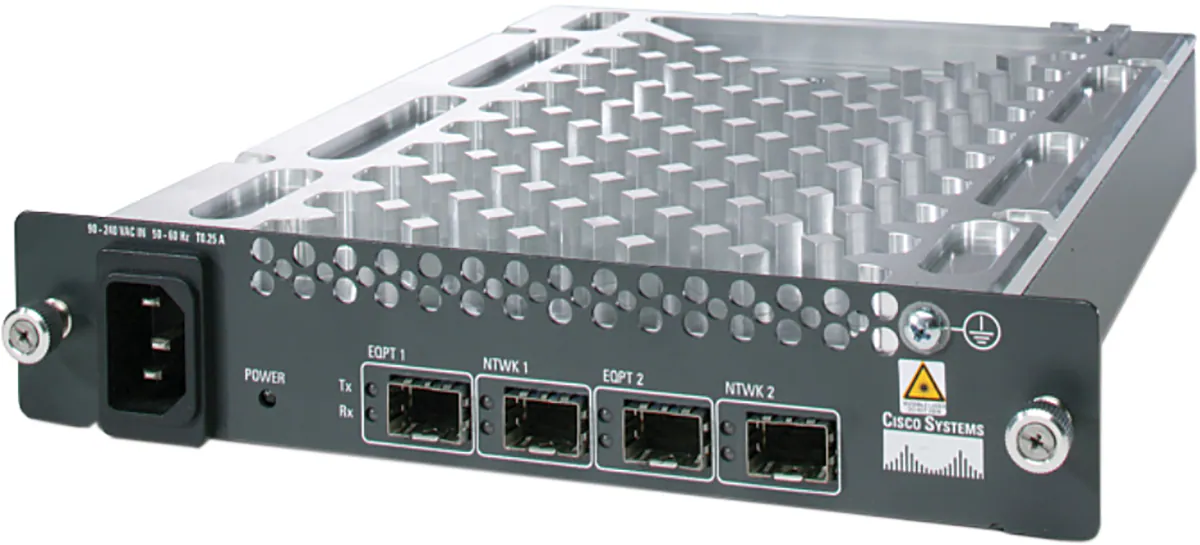
Cisco 2-Channel SFP WDM Transponder
The transponder effectively extends the range of client devices that can connect to the CWDM or DWDM network using pluggable optics: third-party SONET/SDH add/drop multiplexers (ADMs), storage and Ethernet devices, or Cisco platforms that do not support pluggable WDM optics can connect to the WDM network by using this transponder, which operates the wavelength conversion from older 850/1300/1550 nanometer (nm) signals to any CWDM or DWDM channels. This conversion is enabled by the WDM SFP ports sitting on the line side (Figure 2).

SFP Ports on the transponder
Each transponder supports up to two CWDM or DWDM line SFP optics (plugged into the ports labeled “NTWK1” and “NTWK2”) as well as two client SFP optics (plugged in the ports labeled “EQPT1” and “EQPT2”). The range of Cisco SFP optics on the transponder supports any protocol and speed between 155 Mbps and 2.488 Gbps.
The transponder is compatible with the passive Cisco CWDM chassis (Figure 3) (part number CWDM-CHASSIS-2=). Two transponder devices can coexist together in the two-slot chassis. There is no limit to the number of chassis that can be stacked in a rack. Alternatively, the transponder can coexist in the same chassis with any Cisco CWDM passive filters.
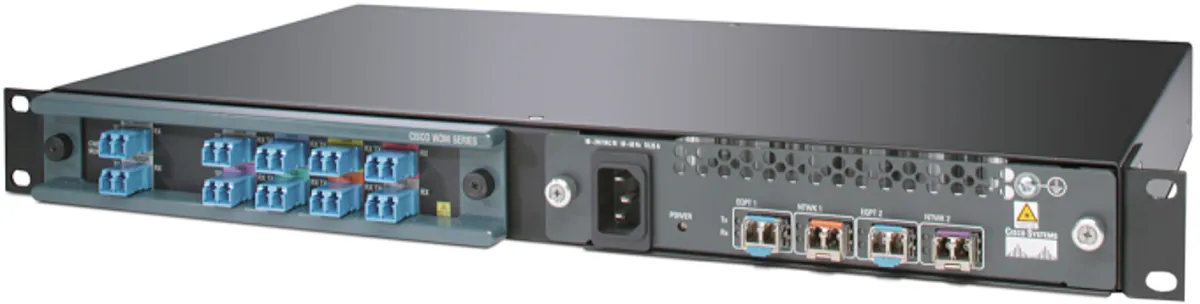
Cisco CWDM chassis
Table 1 lists the compatible SFP optics required by each application.
Table 1. Supported SFP optics and applications
|
Client Protocol |
Bit Rate (Mbps) |
Client SFP |
CWDM Line SFP |
DWDM Line SFP |
|
SONET/SDH |
2488 |
SFP-OC48-SR SFP-OC48-IR1 SFP-OC48-LR2 |
● CWDM-SFP-1470=
● CWDM-SFP-1490=
● CWDM-SFP-1510=
● CWDM-SFP-1530=
● CWDM-SFP-1550=
● CWDM-SFP-1570=
● CWDM-SFP-1490=
● CWDM-SFP-1610=
|
32 channels ● DWDM-SFP-3033=
● DWDM-SFP-3112=
– ● DWDM-SFP-XXXX=
– ● DWDM-SFP-5979=
● DWDM-SFP-6061=
|
|
622 |
SFP-OC12-SR SFP-OC12-IR1 SFP-OC12-LR1 SFP-OC12-LR2 SFP-OC12-MM |
|||
|
155 |
SFP-OC3-SR SFP-OC3-IR1 SFP-OC3-LR1 SFP-OC3-LR2 SFP-OC3-MM |
● ONS-SE-155-1470=
● ONS-SE-155-1490=
● ONS-SE-155-1510=
● ONS-SE-155-1530=
● ONS-SE-155-1550=
● ONS-SE-155-1570=
● ONS-SE-155-1590=
● ONS-SE-155-1610=
|
– |
|
|
Gigabit Ethernet |
1250 |
GLC-LH-SM= GLC-SX-MM= GLC-ZX-SM= GLC-BX-D= GLC-BX-U= SFP-GE-L= SFP-GE-S= SFP-GE-Z= |
● CWDM-SFP-1470=
● CWDM-SFP-1490=
● CWDM-SFP-1510=
● CWDM-SFP-1530=
● CWDM-SFP-1550=
● CWDM-SFP-1570=
● CWDM-SFP-1490=
● CWDM-SFP-1610=
|
32 channels ● DWDM-SFP-3033=
● DWDM-SFP-3112=
– ● DWDM-SFP-XXXX=
– ● DWDM-SFP-5979=
● DWDM-SFP-6061=
|
|
Fibre Channel |
1063 |
DS-SFP-FC-2G-LW= ONS-SE-G2F-LX= DS-SFP-FC-2G-SW= ONS-SE-G2F-SX= |
||
|
2125 |
DS-SFP-FC-2G-LW= ONS-SE-G2F-LX= DS-SFP-FC-2G-SW= ONS-SE-G2F-SX= |
Applications
The transponder is designed for situations where most of the equipment operates directly with pluggable optics, but a few platforms without WDM pluggable optics need to connect to the WDM network. Figure 4 shows an example of two sites connected through SONET links: The transponders at each location take the signals from the SONET equipment and convert them to CWDM channels, which communicate with passive Cisco CWDM devices.
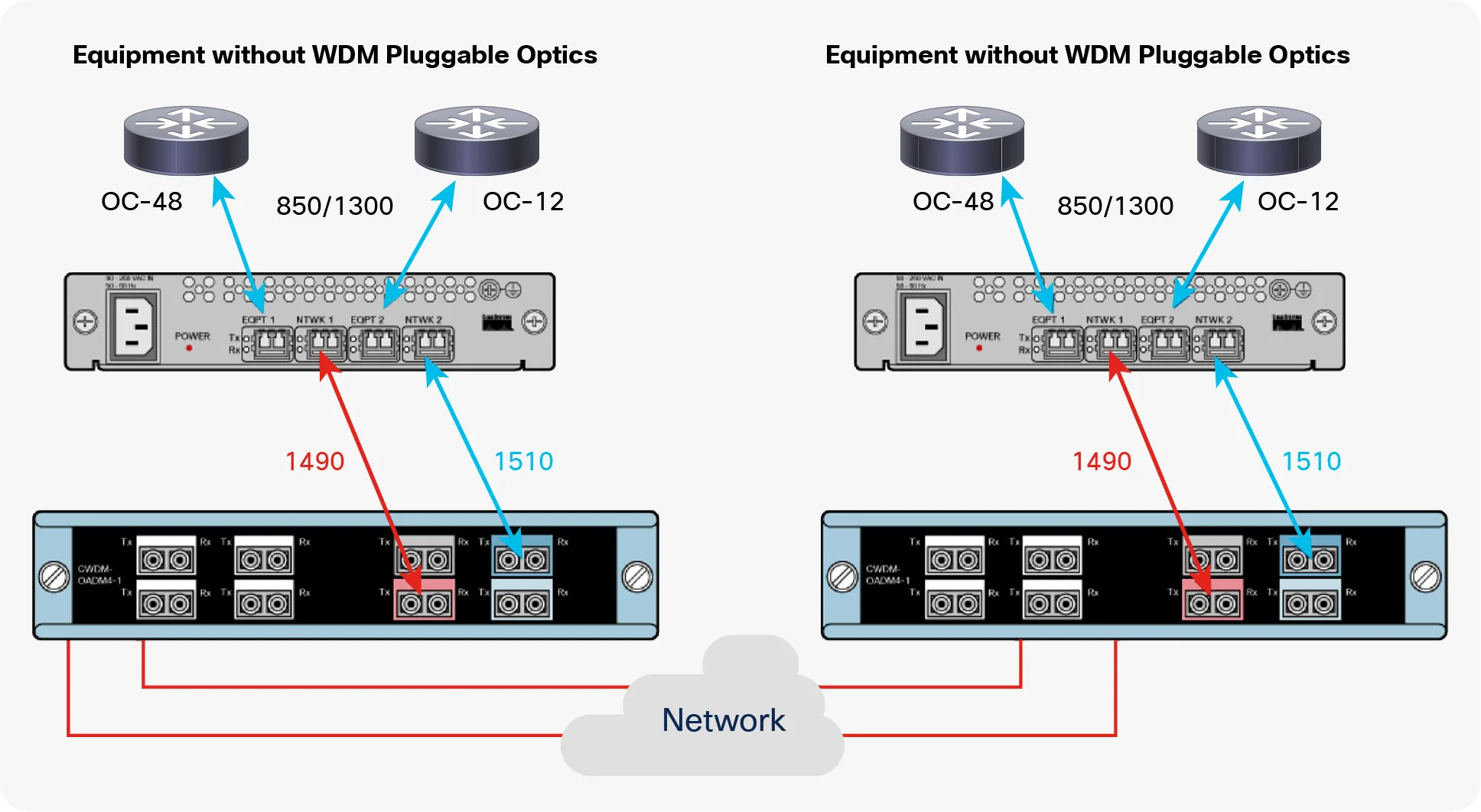
Example Deployment Scenario
Product specifications
The Cisco 2-Channel SFP WDM Transponder is an unmanaged unit that runs no software. The front-panel LEDs (Figure 5) report various alarm conditions as summarized in Table 2. Tables 3 to 6 list product and optical specifications.
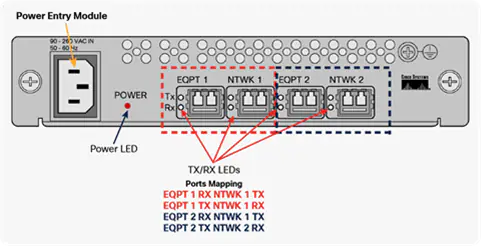
Front-Panel LEDs
Table 2. LED descriptions
|
Led Name |
Color |
Description |
|
POWER |
Green |
Power on |
|
Off |
Power off |
|
|
EQPT1/2 TX |
Green |
Equipment 1 laser on |
|
Red |
Equipment 1 laser off |
|
|
Off |
Equipment 1 SFP not present |
|
|
EQPT1/2 RX |
Green |
Equipment 1 signal detected |
|
Red |
Equipment 1 loss of signal |
|
|
Flashing green |
Equipment 1 loss of lock |
|
|
Off |
Equipment 1 SFP not present |
|
|
NTWK1/2 TX |
Green |
Network 1 laser on |
|
Red |
Network 1 laser off |
|
|
Off |
Network 1 SFP not present |
|
|
NTWK1/2 RX |
Green |
Network 1 signal detected |
|
Red |
Network 1 loss of signal |
|
|
Off |
Network 1 SFP not present |
Table 3. Product specifications
|
Configuration |
Parameter |
Specification |
|
Electrical |
Supply voltage |
90–240VAC |
|
Max power consumption |
9.7W |
|
|
Connector type |
IEC 60320 C14 inlet plug |
|
|
Reliability |
Mean time between failures (MTBF) |
24.68 years |
|
Mechanical |
Dimensions |
● 6.91 in. (faceplate 8.25 in.) W
● 1.6 in. H
● 10 in. D
|
|
Weight (estimated with 4 SFPs) |
4–5 lb |
|
|
Environmental |
Temperature |
0–40° C |
|
Performance |
Bit rate |
100–2500 Mbps |
|
Regeneration |
● 3R upstream (from client to trunk SFP)
● 2R downstream (from trunk to client)
|
Table 4. CWDM SFP optical specification (OC-3/STM-4, OC-48/STM-16, 1G Ethernet, 1G Fiber Channel and 2G Fiber Channel)
|
Parameter |
Symbol |
Minimum |
Maximum |
Units |
Notes and Conditions |
|
Transmitter Center Wavelength |
λ |
(λ – 4) |
(λ + 7) |
nm |
Available center wavelengths are 1470, 1490, 1510, 1530, 1550, 1570, 1590, and 1610 nm |
|
Side-Mode Suppression Ratio |
SMSR |
30 |
dB |
||
|
Transmitter Optical Output Power |
Pout |
0 |
5.0 |
dBm |
Average power coupled into single-mode fiber |
|
Receiver Optical Input Power (BER < 10–12 with PRBS 2–7—1) |
Pin |
–29.0 |
–7.0 |
dBm |
Data rate below 2000 Mbps |
|
Receiver Optical Input Power (BER < 10–12 with PRBS 2–7—1) |
Pin |
–28.0 |
–7.0 |
dBm |
Data rate above 2000 Mbps |
|
Receiver Optical Input Wavelength |
λ |
1450 |
1620 |
nm |
|
|
Transmitter Extinction Ratio |
OMI |
9 |
dB |
||
|
Dispersion Penalty at 100 km |
2 |
dB |
Data rate below 2000 Mbps |
||
|
Dispersion Penalty at 100 km |
3 |
dB |
Data rate above 2000 Mbps |
Table 5. CWDM SFP optical specification (OC-3/STM-1)
|
Parameter |
Symbol |
Minimum |
Maximum |
Units |
Notes and Conditions |
|
Transmitter Center Wavelength |
λ |
(λ–4) |
(λ + 7) |
nm |
Available center wavelengths are 1470, 1490, 1510, 1530, 1550, 1570, 1590, and 1610 nm |
|
Transmitter Optical Output Power |
Pout |
0 |
5.0 |
dBm |
Average power coupled into single-mode fiber |
|
Receiver Optical Input Power (BER <10–12 with PRBS 2–7—1) |
Pin |
–34.0 |
–7.0 |
dBm |
at 155 Mbps |
|
Receiver Optical Input Wavelength |
λ |
1450 |
1620 |
nm |
|
|
Dispersion Penalty at 100 km |
1 |
dB |
at 155 Mbps |
Table 6. DWDM SFP optical specification (OC-3/STM-4, OC-48/STM-16, 1G Ethernet, 1G Fiber Channel and 2G Fiber Channel)
|
Parameter |
Symbol |
Minimum |
Maximum |
Units |
Notes and Conditions |
|
Transmitter |
|||||
|
Spectral Width |
0.2 |
nm |
Full width, –20dB from maximum, with resolution bandwidth (RBW) = 0.01 nm |
||
|
Transmitter Center Wavelength |
λ |
λ – 100 |
λ + 100 |
pm |
Center wavelengths are in-line with Cisco DWDM channel plan and 100GHz ITU grid |
|
Side-Mode Suppression Ratio |
SMSR |
30 |
dB |
||
|
Transmitter Extinction Ratio |
OMI |
8.2 |
dB |
||
|
Transmitter Optical Output Power |
Pout |
0 |
4.0 |
dBm |
Average power coupled into single-mode fiber |
|
Receiver |
|||||
|
Receiver Optical Input Wavelength |
λ |
1530 |
1565 |
nm |
|
|
Receiver Damage Threshold |
|
|
–1 |
dBm |
|
|
Dispersion Tolerance |
|
–500 |
1600 |
ps/nm |
|
|
Power-Limited Performance at OSNR of 20 dB (< 2000 Mbps) or 21 dB (> 2000 Mbps) at 0.1-nm RBW |
|||||
|
Optical Input Power |
Pin |
–28.0 |
–9.0 |
dBm |
|
|
Dispersion Power Penalty < 2000 Mbps |
3 |
dB |
–800/+3600 ps/nm |
||
|
Dispersion Power Penalty > 2000 Mbps |
3 |
dB |
–800/+2400 ps/nm |
||
|
Noise-Limited Performance at OSNR of 18 dB (< 2000 Mbps) or 19 dB (> 2000 Mbps) at 0.1-nm RBW |
|||||
|
Optical Input Power |
Pin |
–22.0 |
–9.0 |
dB |
|
|
Dispersion OSNR Penalty < 2000 Mbps |
2 |
dB |
-800/+3600 ps/nm |
||
|
Dispersion OSNR Penalty > 2000 Mbps |
3 |
-800/+2400 ps/nm |
|||
Ordering information
To place an order, visit the Cisco ordering homepage. Table 7 lists ordering information for the Cisco 2-Channel SFP WDM Transponder.
Table 7. Ordering information
|
Product Name |
Part Number |
|
Cisco 2-Channel SFP WDM Transponder |
WDM-SFP-2CH-CONV= |
For more information
For more information about Cisco WDM products, visit https://www.cisco.com/en/US/products/ps6575/index.html.
| Model | WDM-SFP-2CH-CONV |