


Cisco WS-C4948-E Switch
- Global Price List Information (GPL)
-
Model: WS-C4948-E
-
Description:
-
Price: USDLast Update:
- End-of-Sale and End-of-Life Information (EOL/EOS)
- Release Date:
- End-of-Sale Date:
- End-of-Support Date:
The Cisco Catalyst 4948 Switch is a high-performance, rack-optimized solution designed for low-density, multilayer aggregation of servers and workstations. Built upon the robust architecture of the Cisco Catalyst 4500 Series, this switch provides wire-speed, low-latency switching across Layers 2 through 4. It is specifically engineered to meet the demands of data-intensive environments where reliability and scalability are critical.
By utilizing dedicated ternary content addressable memory (TCAM), the switch ensures that intelligent network services, such as security and quality of service (QoS), can be provisioned concurrently without compromising performance. This architecture allows the device to handle complex network requirements while maintaining the flexibility to grow alongside evolving business needs.
Product overview
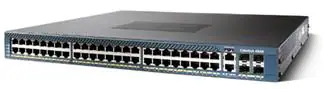
The Cisco Catalyst 4948 is a fixed-configuration, 1-rack-unit (1RU) switch that features 48 ports of 10/100/1000BASE-T connectivity. To provide additional flexibility, it includes four alternative wired ports capable of supporting 1000BASE-X Small Form-Factor Pluggable (SFP) optics. The device is designed for nonstop operation, offering optional internal AC or DC 1+1 hot-swappable power supplies and a hot-swappable fan tray with redundant fans.
The product line also includes the Cisco Catalyst 4948 10 Gigabit Ethernet Switch and the Cisco Catalyst 4900M Switch, which offer varying levels of capacity and modularity. These switches are managed through the Cisco IOS Software, with options ranging from LAN Base for basic Layer 2 requirements to IP Base and Enterprise Services images for advanced Layer 3 routing and enterprise-grade features.
Features and benefits
- High-Performance Switching: Delivers a 96-Gbps switching fabric with a forwarding rate of 72 million packets per second (mpps) for wire-speed performance.
- Hardware-Based Routing: Utilizes Cisco Express Forwarding to ensure consistent performance regardless of the number of active services or route entries.
- Redundancy and Reliability: Features 1+1 hot-swappable power supplies and a redundant, hot-swappable fan tray to minimize downtime for critical applications.
- Advanced QoS and Security: Includes 32,000 hardware entries for ACLs and QoS, allowing for granular traffic management and robust security enforcement.
- Comprehensive Management: Supports a wide array of management tools, including SNMP, Telnet, and web-based CiscoWorks solutions, alongside dedicated console and management ports.
- Flexible Software Options: Offers scalable software licensing (LAN Base, IP Base, and Enterprise Services) to match specific network needs, with the ability to upgrade as requirements grow.
- Extensive Protocol Support: Provides broad support for Layer 2 and Layer 3 protocols, including OSPF, EIGRP, BGP, and various Spanning Tree Protocol enhancements.
- Proactive Monitoring: Includes Cisco Smart Call Home, which automatically monitors system health and notifies administrators of potential issues.
High-Performance, Rack-Optimized Server Switching
Product Overview
The Cisco Catalyst 4948 Switch is a wire-speed, low-latency, Layer 2 to 4, 1-rack-unit (1RU), fixed-configuration switch for rack-optimized server switching. Based on the proven Cisco Catalyst 4500 Series hardware and software architecture, the Cisco Catalyst 4948 offers exceptional performance and reliability for low-density, multilayer aggregation of high-performance servers and workstations. High performance and scalability of intelligent network services is made possible with dedicated specialized resources known as ternary content addressable memory (TCAM). Ample TCAM resources (64,000 entries) enable high feature capacity, providing wire-speed routing and switching performance with concurrent provisioning of services such as quality of service (QoS) and security, and helping ensure scalability for today's network requirements with ample room for future growth.
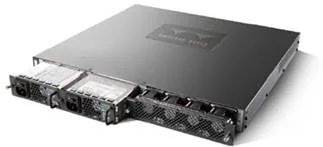
The Cisco Catalyst 4948 offers 48 ports of wire-speed 10/100/1000BASE-T with four alternative wired ports that can accommodate optional 1000BASE-X Small Form-Factor Pluggable (SFP) optics. [1] Exceptional reliability and serviceability are delivered with optional internal AC or DC 1+1 hot-swappable power supplies and a hot-swappable fan tray with redundant fans (Figures 1 and 2).
Features and Benefits
Wire-Speed Performance for 10/100/1000 Connectivity
The Cisco Catalyst 4948 delivers wire-speed throughput with low latency for data-intensive applications, using a 96-Gbps switching fabric with a forwarding rate of 72 million packets per second (mpps) in hardware for Layer 2 to 4 traffic. Switching performance remains high regardless of the number of route entries or Layer 3 and 4 services enabled. Hardware-based Cisco Express Forwarding routing architecture enables increased scalability and performance.
Power Supply Redundancy for Nonstop Operation
The Cisco Catalyst 4948 provides reliability for critical applications, with 1+1 redundant hot-swappable internal AC or DC power supplies. The 1+1 power supply design provides A-to-B failover when power supplies are connected to different circuits. AC and DC power supplies can be mixed in the same unit for outstanding deployment flexibility. The Cisco Catalyst 4948 also has a hot-swappable fan tray with four redundant fans for additional serviceability and availability.
Comprehensive Management
The Cisco Catalyst 4948 includes a single, dedicated 10/100 console port and a single, dedicated 10/100 management port for offline disaster recovery. Remote in-band management is available with the Simple Network Management Protocol (SNMP), Telnet client, Bootstrap Protocol (BOOTP), and Trivial File Transfer Protocol (TFTP). Support for local or remote out-of-band management is delivered through a terminal or modem attached to the console interface. The management port helps enable the Cisco Catalyst 4948 to reload a new image from a TFTP server within seconds.
The Cisco Catalyst 4948 delivers a comprehensive set of management tools to provide the visibility and control required for server switching. Managed with CiscoWorks solutions and embedded CiscoWorks CiscoView, the Cisco Catalyst 4948 can be configured and managed to deliver device, VLAN, traffic, and policy management. These web-based management tools offer numerous services, including software deployment and quick isolation of error conditions.
Software Configuration Options
Table 1 summarizes the software configuration options for the Cisco Catalyst 4948.
Table 1.Software Configuration Options for Cisco Catalyst 4948
| Software Image |
Description |
| LAN Base image |
Basic Layer 2 image |
| IP Base image |
Standard Layer 3 image, including Routing Information Protocol Version 1 (RIPv1), RIPv2, static routes, and Enhanced Interior Gateway Routing Protocol (EIGRP) stub |
| Enterprise Services image |
Enhanced Layer 3 image, including Open Shortest Path First (OSPF), Intermediate System–to–Intermediate System (IS-IS), EIGRP, Border Gateway Protocol (BGP), AppleTalk, and Internetwork Packet Exchange (IPX) software routing; also includes all IP Base image features |
Feature Comparison
Table 2 compares the features of the Cisco Catalyst 4948 Switch, Catalyst 4948 10 Gigabit Ethernet Switch, and Catalyst 4900M Switch.
Table 2.Cisco Catalyst 4900 Series Switches Model Comparison
| Feature and Description |
Cisco Catalyst 4948 |
Cisco Catalyst 4948 10 Gigabit Ethernet |
Cisco Catalyst 4900M |
| Switching capacity |
96 Gbps |
136 Gbps |
320 Gbps |
| Throughput |
72 mpps |
102 mpps |
●250 mpps for IPv4
●125 mpps for IPv6
|
| IPv6 support |
In software |
In software |
In hardware |
| Height |
1RU |
1RU |
2RU |
| Modular half-card slots |
0 |
0 |
2 |
| Maximum 10/100/1000 ports |
48 |
48 |
40 |
| Maximum 10 Gigabit Ethernet ports |
0 |
2 |
24 |
| Maximum Gigabit Ethernet (fiber) ports |
4 |
0 |
32 (Cisco TwinGig Converter Module) |
| Cisco TwinGig Converter Module support |
No |
No |
Yes (half-cards only) |
| Uplink optic type |
4 SFP optics |
2 X2 (10 Gigabit Ethernet) optics |
8 X2 (10 Gigabit Ethernet) optics |
| Multilayer switching |
IP Base and Enterprise Services options |
IP Base and Enterprise Services options |
IP Base and Enterprise Services options |
| Shared buffer |
16 MB |
16 MB |
16 MB |
| CPU |
266 MHz |
666 MHz |
1.3 GHz |
| Synchronous Dynamic RAM (SDRAM) |
256 MB |
256 MB |
512 MB |
| Active VLANs |
4096 |
4096 |
4096 |
| Multicast entries |
●28,000 (Layer 3)
●16,000 (Layer 2)
|
●28,000 (Layer 3)
●16,000 (Layer 2)
|
●56,000 for IPv4
●28,000 for IPv6
|
| Per-VLAN Spanning Tree (PVST) and VLAN IDs |
4096 |
4096 |
4096 |
| Spanning Tree Protocol instances |
1500 |
1500 |
3000 |
| Switched Virtual Interfaces (SVIs) |
2000 |
2000 |
4000 |
| Security and QoS hardware entries |
32,000 |
32,000 |
128,000 |
| MAC addresses |
32,000 |
55,000 |
55,000 |
| Switched Port Analyzer (SPAN) |
2 ingress and 4 egress |
2 ingress and 4 egress |
8 ingress and 8 egress |
| USB port |
No |
No |
Yes |
| Compact flash memory support |
No |
No |
Yes |
| System reset button |
No |
No |
Yes |
| Minimum software requirement |
Cisco IOS Software Release 12.2(20)EWA or later |
Cisco IOS Software Release 12.2(25)EWA or later |
Cisco IOS Software Release 12.2(40)XO or later |
Features and Specifications at a Glance
Performance and Switching
●96 Gbps nonblocking switch fabric
●72 mpps Layer 2 forwarding (hardware)
●72 mpps Layer 3 and 4 forwarding: IP routing and Cisco Express Forwarding (hardware)
●Layer 2 to 4 hardware-based switch engine (application-specific integrated circuit [ASIC]-based)
●Unicast and multicast routing entries: 32,000
●Support for 4096 active VLANs and 4096 VLAN IDs per switch
●Layer 2 multicast addresses: 16,384
●MAC addresses: 32,768
●Policers: 512 ingress and 512 egress
●Access control list (ACL) and QoS entries: 32,000
●Uplinks: 4 alternatively wired SFP ports with Cisco Gigabit EtherChannel support
●Latency: 6 microseconds for 64-byte packets
●SVIs: 2048
●Spanning Tree Protocol instances: 1500
●Internet Group Management Protocol (IGMP) snooping entries: 16,000
Layer 2 Features
●Layer 2 hardware forwarding at 72 mpps
●Layer 2 switch ports and VLAN trunks
●IEEE 802.1Q VLAN encapsulation
●Inter-Switch Link (ISL) VLAN encapsulation
●Dynamic Trunking Protocol (DTP)
●VLAN Trunking Protocol (VTP) and VTP domains
●PVST+ and Per-VLAN Rapid Spanning Tree Protocol (PVRST)
●Flexlink
●Spanning Tree PortFast and PortFast Guard
●Spanning Tree UplinkFast and BackboneFast
●IEEE 802.1s
●IEEE 802.1w
●IEEE 802.3ad
●Spanning Tree Root Guard
●Cisco Discovery Protocol Version 1 and 2
●IGMPv1, v2, and v3
●Cisco EtherChannel technology, Cisco Fast EtherChannel technology, and Cisco Gigabit EtherChannel technology support
●Port Aggregation Protocol (PAgP)
●Link Aggregation Control Protocol (LACP)
●Unidirectional Link Detection Protocol (UDLD) and aggressive UDLD on the SFP ports
●IEEE 802.1 Q-in-Q in hardware
●Layer 2 protocol tunneling
●Jumbo frames on all ports (up to 9216 bytes)
●Baby giants (up to 1600 bytes)
●Unidirectional Ethernet
●Hardware-based storm control (formerly known as broadcast and multicast suppression)
●Community private VLANs (PVLANs)
●Forced 10/100 autonegotiation
●Web Cache Communication Protocol (WCCP) Version 2 Layer 2 redirect
●Private VLAN promiscuous trunk
●Layer 2 promiscuous trunk over trunk port (L2PT)
●Class-of-service (CoS) mutation
●E-OAM 802.3ah and CFM: 802.1ag
Layer 3 Features
●Jumbo frames on all ports (up to 9216 bytes)
●Hardware-based IP Cisco Express Forwarding routing at 72 mpps
●Static IP routing
●IP routing protocols: EIGRP, OSPF, RIP, and RIPv2
●BGPv4 and Multicast Border Gateway Protocol (MBGP)
●Nonstop Forwarding (NSF) awareness
●Hot Standby Router Protocol (HSRP) v1 and v2
●Software routing of IPX and AppleTalk
●IS-IS routing protocol
●IGMPv1, v2, and v3
●IGMP filtering on access and trunk ports
●IP multicast routing protocols: Protocol Independent Multicast (PIM), Source-Specific Multicast (SSM), and Distance Vector Multicast Routing Protocol (DVMRP)
●Auto rendezvous point (Auto-RP)
●Distance Vector Multicast Routing Protocol (DVMRP)
●Pragmatic General Multicast (PGM)
●Cisco Group Management Protocol (GMP) server
●Full Internet Control Message Protocol (ICMP) support
●ICMP Router Discovery Protocol
●Policy-based routing (PBR)
●Virtual Route Forwarding lite (VRF-lite)
●VRF-aware IP services
●IPv6 software switching support
●OSPF fast convergence
●OSPF and EIGRP fast-convergence protection
●EIGRP stub
●Virtual Router Redundancy Protocol (VRRP)
●IP unnumbered for SVI
●Nonstop Forwarding (NSF) awareness
●WCCPv2
●Gateway Load Balancing Protocol (GLBP)
High-Availability Features
●1+1 hot-swappable AC or DC power supplies
●Hot-swappable field-replaceable fan tray with redundant fans
●HSRP v1 and v2
●VRRP
●Cisco IOS Embedded Event Manager (EEM)
●Cisco Generic Online Diagnostics (GOLD)
●Smart Call Home
Sophisticated QoS and Traffic Management
●Per-port QoS configuration
●Per-port and per-VLAN QoS
●Support for four queues per port in hardware
●Strict priority queuing
●IP differentiated services code point (DSCP) and IP precedence
●Classification and marking based on IP type of service (ToS) or DSCP
●Classification and marking based on full Layer 3 and 4 headers (IP only)
●Input and output policing based on Layer 3 and 4 headers (IP only)
●Support for 512 policers on ingress and 512 policers on egress configured as aggregate or individual
●Shaping and sharing output queue management
●Dynamic Buffer Limiting (DBL) advanced congestion-avoidance feature
●No performance penalty for granular QoS functions
●Matched CoS for non-IPv4 traffic
Predictable Performance
●96-Gbps switching fabric
●Layer 2 hardware forwarding at 72 mpps
●Layer 3 hardware-based IP Cisco Express Forwarding routing at 72 mpps
●Layer 4 TCP and User Datagram Protocol (UDP) hardware-based filtering at 72 mpps
●No performance penalty with advanced Layer 3 and 4 services enabled
●Software-based learning at a sustained rate of 500 hosts per second
●Support for 32,768 MAC addresses
●Support for 32,000 entries in routing table (shared between unicast and multicast)
●Support for 512 ingress policers and 512 egress policers
●Support for 32,000 ACL and QoS entries
●Scalability to 2048 virtual ports (VLAN port instances)
●Scalability to 8000 IGMP snooping entries
●Scalability to 1500 Spanning Tree Protocol instances
●Bandwidth aggregation up to 16 Gbps through Cisco Gigabit EtherChannel technology
●Hardware-based wire-speed multicast management
●Hardware-based wire-speed ACLs
Comprehensive Management
●Manageable through CiscoWorks Windows network-management software on a per-port and per-switch basis, providing a common management interface for Cisco routers, switches, and hubs
●Manageable through Cisco Network Assistant
●SNMPv1, v2, and v3 instrumentation, delivering comprehensive in-band management
●Command-line interface (CLI)-based management console to provide detailed out-of-band management
●Remote Monitoring (RMON) software agent to support four RMON groups (history, statistics, alarms, and events) for enhanced traffic management, monitoring, and analysis
●Support for all nine RMON groups through the use of a Cisco SwitchProbe analyzer (SPAN) port, which permits traffic monitoring of a single port, a group of ports, or the entire switch from a single network analyzer or RMON probe
●Analysis support, including ingress port, egress port, and VLAN SPAN
●Layer 2 traceroute
●Remote SPAN (RSPAN)
●Cisco Smartports macros
●SPAN ACL filtering
●Dynamic Host Configuration Protocol (DHCP) client autoconfiguration
●IfIndex persistence
●HTTPS
●Time Domain Reflectometry (TDR)
●MAC address notification
●Onboard failure logging (OBFL)
●Network Mobility Service Protocol (NMSP)
Advanced Security
●TACACS+ and RADIUS, which enable centralized control of the switch and restrict unauthorized users from altering the configuration
●Standard and extended ACLs on all ports
●IEEE 802.1X user authentication (with VLAN assignment, port security, voice VLAN, and guest VLAN extensions)
●IEEE 802.1X accounting
●IEEE 802.1X authentication failure
●IEEE 802.1X private VLAN assignment
●IEEE 802.1X private guest VLAN
●IEEE 802.1X RADIUS-supplied timeout
●IEEE 802.1X MAC-Auth-Bypass
●IEEE 802.1X inaccessible authentication bypass
●Cisco Network Admission Control (NAC) Layer 2 IEEE 802.1X
●Cisco NAC Layer 2 IP
●Cisco NAC Layer 2 IP inaccessible authentication bypass
●Trusted boundary
●Router ACLs (RACLs) on all ports (no performance penalty)
●VLAN ACLs (VACLs)
●Port ACLs (PACLs)
●PVLANs on access and trunk ports
●VTPv3
●DHCP snooping
●DHCP Option 82
●DHCP Option 82 insertion
●DHCP Option 82 pass-through
●Port security
●Port security for PVLAN ports
●Trunk port security
●Sticky port security
●Secure Shell (SSH) Protocol Versions 1 and 2
●VLAN Management Policy Server (VMPS) client
●Unicast MAC filtering
●Unicast port flood blocking
●Dynamic Address Resolution Protocol (ARP) inspection switch and restriction of unauthorized users from altering the configuration
●IP Source Guard
●Community PVLAN
●Control plane policing
●IEEE 802.1X unidirectional controlled port
●Voice VLAN sticky port security
●Secure Copy Protocol (SCP)
●IEEE 802.1X inaccessible authentication bypass
●MAC authentication bypass
●Cisco EtherChannel trunk port security
Traffic and Congestion Management
●Four queues per port
●Dynamic buffers
Switch Architecture
●Dynamic packet buffering, 16 MB shared memory
●266-MHz CPU speed
●6-MB flash memory
●256-MB SDRAM
Management
●Enhanced Object Tracking (EOT)
●IP service-level agreement (SLA)
●CiscoWorks LAN Management Solution (LMS), including CiscoWorks Resource Manager Essentials
●CiscoWorks CiscoView
●Cisco Network Assistant
●BGP4-MIB.my
●BRIDGE-MIB.my (RFC 1493)
●Static multicast MAC address in BRIDGE-MIB
●CISCO-BULK-FILE-MIB.my
●CISCO-CDP-MIB.my
●CISCO-CLASS-BASED-QOS-MIB.my
●CISCO-CONFIG-COPY-MIB.my
●CISCO-CONFIG-MAN-MIB.my
●CISCO-ENTITY-ASSET-MIB.my
●CISCO-ENTITY-EXT-MIB.my
●CISCO-ENTITY-FRU-CONTROL-MIB.my
●CISCO-ENTITY-SENSOR-MIB.my
●CISCO-ENTITY-VENDORTYPE-OID-MIB.my
●CISCO-ENVMON-MIB.my
●CISCO-FLASH-MIB.my
●CISCO-FTP-CLIENT-MIB.my
●CISCO-HSRP-MIB.my
●CISCO-IETF-IP-MIB.my
●CISCO-IETF-IP-FORWARD-MIB.my
●CISCO-IETF-ISIS-MIB.my
●CISCO-IF-EXTENSION-MIB.my
●CISCO-IGMP-FILTER-MIB.my
●CISCO-IMAGE-MIB.my
●CISCO-IPMROUTE-MIB.my
●CISCO-L2-TUNNEL-CONFIG-MIB.my
●CISCO-L2L3-INTERFACE-CONFIG-MIB.my
●CISCO-LAG-MIB.my
●CISCO-MEMORY-POOL-MIB.my
●CISCO-NDE-MIB.my
●CISCO-PAGP-MIB.my
●CISCO-PAE-MIB.my
●CISCO-PING-MIB.my
●CISCO-PORT-SECURITY-MIB.my
●CISCO-PORT-STORM-CONTROL-MIB.my
●CISCO-PRIVATE-VLAN-MIB.my
●CISCO-PROCESS-MIB.my
●CISCO-PRODUCTS-MIB.my
●CISCO-RF-MIB.my
●CISCO-RMON-CONFIG-MIB.my
●CISCO-RTTMON-MIB.my
●CISCO-STP-EXTENSIONS-MIB.my
●CISCO-SYSLOG-MIB.my
●CISCO-VLAN-IFTABLE-RELATIONSHIP-MIB.my
●CISCO-VLAN-MEMBERSHIP-MIB.my
●CISCO-VTP-MIB.my
●DOT3-MAU-MIB.my (RFC 3636)
●ENTITY-MIB.my
●ETHERLIKE-MIB.my
●EXPRESSION-MIB.my
●HC-RMON-MIB.my
●IEEE8021-PAE-MIB.my
●IEEE8023-LAG-MIB.my (802.3ad)
●IF-MIB.my
●IGMP-MIB.my
●IPMROUTE-MIB.my
●NOVELL-IPX-MIB.my
●NOVELL-RIP SAP-MIB.my
●OLD-CISCO-TS-MIB.my
●PIM-MIB.my
●RFC1213-MIB.my (MIB-II)
●RFC1243-MIB.my (APPLETALK MIB)
●RFC1253-MIB.my (OSPF-MIB)
●RMON-MIB.my (RFC 1757)
●RMON2-MIB.my (RFC 2021)
●SMON-MIB.my (Internet-Draft)
●SNMP-FRAMEWORK-MIB.my (RFC 2571)
●SNMP-MPD-MIB.my (RFC 2572)
●SNMP-NOTIFICATION-MIB.my (RFC 2573)
●SNMP-TARGET-MIB.my (RFC 2573)
●SNMP-USM-MIB.my (RFC 2574)
●SNMP-VACM-MIB.my (RFC 2575)
●SNMPv2-MIB.my
●TCP-MIB.my
●UDP-MIB.my
●RIP SNMP MIB
●LLDP MIB
Industry Standards
●Ethernet: IEEE 802.3 and 10BASE-T
●Fast Ethernet: IEEE 802.3u and 100BASE-TX
●Gigabit Ethernet: IEEE 802.3z and 802.3ab
●IEEE 802.1D Spanning Tree Protocol
●IEEE 802.1w rapid reconfiguration of spanning tree
●IEEE 802.1s multiple VLAN instances of spanning tree
●IEEE 802.3ad Link Aggregation Control Protocol (LACP)
●IEEE 802.1p CoS prioritization
●IEEE 802.1Q VLAN
●IEEE 802.1X user authentication
●1000BASE-X (SFP)
●1000BASE-SX
●1000BASE-LX/LH
●1000BASE-ZX
●RMON I and II standards
Indicators and Ports
●Fan, power supply 1, and power supply 2
●Power supply status: Green (operational) or red (faulty)
●System status: Green (operational) or red (faulty)
●Console: RJ-45 socket
●SFP ports: Link
●Image management port: 10/100BASE-TX (RJ-45 socket) data terminal equipment (DTE); green (good), orange (disabled), or off (not connected)
Supported SFPs
Table 3 lists the SFPs supported by the Cisco Catalyst 4948.
Table 3.SFPs Supported by Cisco Catalyst 4948
| SFP |
| Gigabit Ethernet SFP, LC connector, and LH transceiver |
| Gigabit Ethernet SFP, LC connector, and SX transceiver |
| Gigabit Ethernet SFP, LC connector, and ZX transceiver |
| Gigabit Ethernet SFP, RJ-45 connector, and 10/100/1000BASE-T transceiver |
| Cisco Coarse Wavelength-Division Multiplexing (CWDM) SFP 1470 nanometer (nm); Gigabit Ethernet and 1- and 2-Gbps Fibre Channel (gray) |
| Cisco CWDM SFP 1490 nm; Gigabit Ethernet and Fibre Channel (violet) |
| Cisco CWDM SFP 1510 nm; Gigabit Ethernet and Fibre Channel (blue) |
| Cisco CWDM SFP 1530 nm; Gigabit Ethernet and 1- and 2-Gbps Fibre Channel (green) |
| Cisco CWDM SFP 1550 nm; Gigabit Ethernet and Fibre Channel (yellow) |
| Cisco CWDM SFP 1570 nm; Gigabit Ethernet and Fibre Channel (orange) |
| Cisco CWDM SFP 1590 nm; Gigabit Ethernet and Fibre Channel (red) |
| Cisco CWDM SFP 1610 nm; Gigabit Ethernet and Fibre Channel (brown) |
Power Supply
The Cisco Catalyst 4948 offers a choice of 300W AC or DC power supplies. The switch can operate with one power supply present. When two power supplies are installed, the switch shares the power load between the two supplies (Table 4).
Table 4.AC and DC Power Supply Specifications
| Specification |
300W AC |
300W DC |
| Input current |
●4A @ 100V
●2A @ 240V
|
8A @ –40.5 to –75VDC |
| Output current |
25A @ 12 VDC |
25A @ 12 VDC |
| Weight |
Weight: 2.0 kg |
Weight: 2.0 kg |
| Heat dissipation |
1023 BTU/hr |
1023 BTU/hr |
| Average power use |
176W |
176W |
Switch Dimensions
●Width: 17.290 in. (43.9166 cm)
●Depth: 16.14 in. (40.9956 cm)
●Height: 1.712 in. (4.445 cm)
●Weight: 16.5 lb (7.48 kg) with one power supply
Software Requirements
The Cisco Catalyst 4948 high-performance edge switch is supported only in Cisco IOS Software and is not supported in the Cisco Catalyst OS Software. The minimum software version is Cisco IOS Software Release 12.2(20)EWA or later.
For the latest software release information and recommendations, please refer to the product bulletin at http://www.cisco.com/en/US/products/ps6021/prod_bulletins_list.html.
Environmental Conditions
●Operating temperature: 32º to 104ºF (0º to 40ºC)
●Storage temperature: –40º to 167ºF (–40º to 75ºC)
●Relative humidity: 10% to 90%, noncondensing
●Operating altitude: –60 to 2000m
Regulatory Standards Compliance
Table 5 summarizes the regulatory standards compliance of the Cisco Catalyst 4948. Table 6 lists the Cisco Catalyst 4948’s compliance with industry environmental standards.
Table 5.Regulatory Standards Compliance of Cisco Catalyst 4948
| Specification |
Description |
| Regulatory compliance |
Products bear CE marking, indicating compliance with the 89/336/EEC and 73/23/EEC directives, which include the safety and EMC standards listed here. |
| Safety |
●UL 60950-1
●CAN/CSA-C22.2 No. 60950-1
●EN 60950-1
●IEC 60950-1
●AS/NZS 60950
●IEC 60825-1
●IEC 60825-2
●EN 60825-1
●EN 60825-2
●21 CFR 1040
|
| EMC |
●FCC Part 15 (CFR 47) Class A
●ICES-003 Class A
●EN55022 Class A
●CISPR22 Class A
●AS/NZS 3548 Class A
●VCCI Class A
●EN55024
●ETS300 386
●EN50082-1
●EN61000-3-2
●EN61000-3-3
|
Table 6.Environmental Standards for the Cisco Catalyst 4948
| Specification |
Description |
| Network Equipment Building Standards (NEBS) |
●GR-63-Core NEBS Level 3
●GR-1089-Core NEBS Level 3
|
| European Telecommunications Standards Institute (ETSI) |
●ETS 300 019 Storage Class 1.1
●ETS 300 019 Transportation Class 2.3
●ETS 300 019 Stationary Use Class 3.1
|
New Cisco IOS Software Packaging for the Cisco Catalyst 4900 Series
Cisco provides a new Cisco IOS Software package for the Cisco Catalyst 4900 Series, creating a new foundation for features and functions and offering consistency across all Cisco Catalyst switches. The new Cisco IOS Software release is designated Release 12.2SG.
The Cisco IOS Software images for the Cisco Catalyst 4900 Series, formerly known as Basic Layer 3 (Standard Multilayer Image [SMI]) and Enhanced Layer 3 (Enhanced Multilayer Image [EMI]) images, are now called the IP Base and Enterprise Services images, respectively. Unless otherwise specified, all currently shipping Cisco Catalyst 4900 Series software features based on Cisco IOS Software are supported in the IP Base image; however, note the following points regarding the IP Base image:
●The IP Base image does not support the following routing-related features: BGP, EIGRP, OSPF, IS-IS, IPX, AppleTalk, VRF-lite, and PBR).
●The IP Base image supports the EIGRP stub for Layer 3 routing on all Cisco Catalyst 4900 Series supervisor engines. For more information about the EIGRP stub, go to http://www.cisco.com/en/US/tech/tk365/technologies_white_paper0900aecd8023df6f.shtml.
The Enterprise Services image supports all Cisco Catalyst 4900 Series software features based on Cisco IOS Software, including enhanced routing. Table 1 earlier in this document provides a more detailed description of the feature differences between the IP Base and Enterprise Services images.
LAN Base Image
Starting with Cisco IOS Software Release 12.2(52)SG, the LAN Base Software image will be the default Cisco IOS Software option for the Catalyst 4948. The IP Base and Enterprise Services images are available as optional upgrades. The LAN Base image is supported on the Catalyst 4948 and 4948-10GE. It is focused primarily on customers’ Layer 2 requirements, and therefore many of the IP Base features have been removed. If the customer requires some of the features at a later date, the LAN Base image is fully upgradable to the IP Base or Enterprise Services image. Table 7 compares the LAN Base image to the IP Base image.
Table 7.Cisco IOS Software Feature Comparison: LAN Base vs. IP Base Image
| LAN Base |
IP Base |
|
| Data center–grade HW |
Yes |
Yes |
| Basic Layer 2 |
Yes |
Yes |
| SPAN |
2 sessions |
8 sessions |
| Location services |
No |
Yes |
| Smart Call Home |
No |
Yes |
| HSRP and VRRP |
No |
Yes |
| GLBP |
No |
Yes |
| L2PT and Q-in-Q |
No |
Yes |
| Auto QoS |
Yes* |
Yes |
| EIGRP Stub |
No |
Yes |
| PIM SM/DM |
No |
Yes |
| Multicast Listener Discovery (MLD) snooping |
Yes* |
Yes |
| Flexlink |
Yes* |
Yes |
| PVST+ and PVRST+ |
Yes* |
Yes |
| EEM |
No |
Yes |
| Smartports |
Yes* |
Yes |
* Support added in 12.2(53)SG
Ordering Information
Table 8 provides ordering information for the Cisco Catalyst 4948.
Table 8.Ordering Information for Cisco Catalyst 4948
| Part Number |
Description |
| WS-C4948-S |
Cisco Catalyst 4948, IP Base software image (RIP, static routes), 1 AC power supply, fan tray |
| WS-C4948-E |
Cisco Catalyst 4948, Enterprise Services software image (IPX, AppleTalk, OSPF, EIGRP, IS-IS, BGP), 1 AC power supply, fan tray |
| WS-C4948 |
Cisco Catalyst 4948, optional software image, optional power supplies, fan tray |
| WS-C4948-BDL |
Cisco Catalyst 4948 10-switch multipack bundle shipped in 1 box, volume service option |
| S49LB-12252SG(=) |
Cisco IOS Software for Cisco Catalyst 4900 Series Switches (LAN Base image) |
| S49LBK9-12252SG(=) |
Cisco IOS Software for Cisco Catalyst 4900 Series Switches (LAN Base image with Triple Data Encryption Standard [3DES]) |
| S49IPB-12252SG(=) |
Cisco IOS Software for Cisco Catalyst 4900 Series Switches (IP Base image) |
| S49IPBK9-12252SG(=) |
Cisco IOS Software for Cisco Catalyst 4900 Series Switches (IP Base image with 3DES) |
| S49ES-12252SG(=) |
Cisco IOS Software for Cisco Catalyst 4900 Series Switches (Enterprise Services image with BGP support) |
| S49ESK9-12252SG(=) |
Cisco IOS Software for Cisco Catalyst 4900 Series Switches (Enterprise Services image with 3DES and BGP support) |
| WS-C4900-SW-LIC |
Cisco Catalyst 4948 IP Base upgrade license for LAN Base image |
| PWR-C49-300AC(=) |
Cisco Catalyst 4900 300W AC power supply |
| PWR-C49-300AC/2 |
Cisco Catalyst 4900 300W AC power supply, redundant |
| PWR-C49-300DC(=) |
Cisco Catalyst 4900 300W DC power supply |
| PWR-C49-300DC/2 |
Cisco Catalyst 4900 300W DC power supply, redundant |
| WS-X4991= |
Cisco Catalyst 4900 fan tray (spare) |
| C4948-ACC-KIT= |
Spare rack-mount and cable guide |
| C4948-BKT-KIT= |
Cisco Catalyst 4900 front and rear mount brackets |
| C4948-REAR-BKT(=) |
Cisco Catalyst 4900 high-performance rear mount brackets |
| Power Cable Options |
|
| CAB-US515-C15-US |
AC power cord, 110V North America |
| CAB-N5K6A-NA |
AC power cord, 220V North America |
| CAB-AS3112-C15-AU |
AC power cord (Australia) |
| CAB-CEE77-C15-EU |
AC power cord (Europe) |
| CAB-C2316-C15-IT |
AC power cord CD12 (Italy) |
| CAB-IR2073-C15-AR |
AC power cord (Argentina) |
| CAB-BS546-C15-SA |
AC power cord (South Africa) |
| CAB-BS1363-C15-UK |
AC power cord (United Kingdom) |
| CAB-7KACSXX |
AC power cord (Switzerland) |
| SFP Options |
|
| GLC-LH-SM= |
Gigabit Ethernet SFP, LC connector LH transceiver |
| GLC-SX-MM= |
Gigabit Ethernet SFP, LC connector SX transceiver |
| GLC-ZX-SM= |
Gigabit Ethernet SFP, LC connector ZX transceiver |
| GLC-BX-D= |
1000BASE-BX10-D downstream bidirectional single fiber; with digital optical monitoring (DOM) |
| GLC-BX-U= |
1000BASE-BX10-U upstream bidirectional single fiber; with DOM |
| CWDM-SFP-1470= |
Cisco CWDM SFP 1470 nm; Gigabit Ethernet and 1G/2G Fibre Channel (FC) (gray) |
| CWDM-SFP-1490= |
Cisco CWDM SFP 1490 nm; Gigabit Ethernet and FC (violet) |
| CWDM-SFP-1510= |
Cisco CWDM SFP 1510 nm; Gigabit Ethernet and 1G/2G FC (blue) |
| CWDM-SFP-1530= |
Cisco CWDM SFP 1530 nm; Gigabit Ethernet and 1G/2G FC (green) |
| CWDM-SFP-1550= |
Cisco CWDM SFP 1550 nm; Gigabit Ethernet and 1G/2G FC (yellow) |
| CWDM-SFP-1570= |
Cisco CWDM SFP 1570 nm; Gigabit Ethernet and 1G/2G FC (orange) |
| CWDM-SFP-1590= |
Cisco CWDM SFP 1590 nm; Gigabit Ethernet and 1G/2G FC (red) |
| CWDM-SFP-1610= |
Cisco CWDM SFP 1610 nm; Gigabit Ethernet and 1G/2G FC (brown) |
| CSS5-CABLX-LCSC= |
Cisco CSS 11500 10m fiber single-mode LX LC-to-SC connectors |
| CSS5-CABSX-LC= |
Cisco CSS 11500 10m fiber multimode SX LC connectors |
| CSS5-CABSX-LCSC= |
Cisco CSS 11500 10m fiber multimode SX LC-to-SC connectors |
| CAB-SM-LCSC-1M |
1m fiber single-mode LC-to-SC connectors |
| CAB-SM-LCSC-5M |
5m fiber single-mode LC-to-SC connectors |
For More Information
To learn more about how you can take advantage of Cisco Technical Support Services, talk to your Cisco representative or visit Cisco Technical Services at http://www.cisco.com/en/US/products/svcs/ps3034/ps2827/serv_category_home.html.
| Model | WS-C4948-E |